Abstract
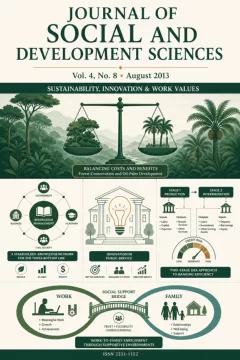
This study aims to find a linkage between Knowledge Management and Sustainable Development through implementation of Triple Bottom Line concept. It is a conceptual paper that applies literature review for proposing a conceptual model as the finding of this study. The model describes how a company should manage the knowledge to maintain good relationships with all of its stakeholders in order to achieve sustainable development in creating mutual benefit value for the good of all parties. This study identifies who the company’s stakeholders are, what their interests, and what knowledge the company should have and manage to fulfill the stakeholders’ interests towards sustainability. The conceptual model needs to be examined empirically. A case study implementing this model into a certain company can be considered as the further research.
Keywords
- Knowledge Management Search this journal for Knowledge Management (opens in a new tab)
- Stakeholders Search this journal for Stakeholders (opens in a new tab)
- Sustainable Development Search this journal for Sustainable Development (opens in a new tab)
- Sustainability Search this journal for Sustainability (opens in a new tab)
- Triple Bottom Line Search this journal for Triple Bottom Line (opens in a new tab)
References
- Al-Hakim, L. A. Y. & Hassan, S. (2011). The Role of Middle Managers in Knowledge Managament Implementation to Improve Organizational Performance in the Iraqi Mobile Telecommunication Sector. Interdisciplinary Journal of Contemporary Research in Business , 3(5), 948-965.
- Bennet, A. & Bennet, D. (2008). The Fallacy of Knowledge Reuse: Building Sustainable Knowledge. Journal of Knowledge Management , 12(5), 21-33.
- Blewitt, J. (2008). Understanding Sustainable Development. London: Earthscan.
- Cheung, C. F., Li, M. L., Shek, W. Y., Lee, W. B. & Tsang, T. S. (2007). A Systematic Approch for Knowledge Auditing: A Case Study in Transportation Sector. Journal of Knowledge Management , 11 (4), 140158.
- Elkington, J. (1998). Cannibals with Forks. Gabriola Island: New Society.
- Frederick, W. C., Davis, K. & Post, J. E. (1988). Business and Society: Corporate Strategy, Public Policy, Ethics. New York: McGraw-Hill Publishing Company.
- Gechev, R. (2005). Sustainable Development Economic Aspects. Indianapolis: University of Indianapolis Press.
- Grayson, D. (2011). Embedding Corporate Responsibility and Sustainability: Marks & Spencer. Journal of Management Development , 30(10), 1017-1026.
- Ergazakis, K., Karnezis, K., Metaxiotis, K. & Psarras, I. (2005). Knowledge Management in Enterprises: A Research Agenda. Intelligent Systems in Accounting, Finance and Management , 13, 17-26.
- Krisnawati, A. (2013). Performance Measurement Systems of Corporate Social Responsibility. Postgraduate Business Colloquium. Naresuan University, Thailand.
- Leydesdorff, L. (2006). The Knowledge Based Economy: Modeled, Measured, Simulated. Florida: Universal Publishers.
- Maples, A. D. (2005). Sustainable Development New Research. New York: Nova Science Publishers.
- March, J. & Simon, H. (1958). Organizations. USA: John Wiley & Sons, Inc.
- Nguyen, H. N. and Mohamed, S. (2011). Leadership Behaviors, Organizational Culture and Knowledge Management Practices: An Empirical Investigation. Journal of Management Development , 30(2), 206-221.
- Pirnea, I. C., Olaru, M. & Moisa, C. (2011). Relationship between Corporate Social Responsibility and Social Sustainability. Economy Transdisciplinarity Cognition , 14(1), 36-43.
- Robinson, H. S., Carillo, P. M., Anumba, C. J. & Al-Ghassani, A. M. (2006). STEPS: a Knowledge Management Maturity Roadmap for Corporate Sustainability. Business Process Management Journal , 12 (6), 793-808.
- Rooney, D. J., Hearn, G. N., Mandeville, T. & Joseph, R. (2003). Public Policy in Knowledge-based Economies: Foundations and Frameworks. Cheltenham: Edward Elgar Publishing Limited.
- Solomon, J. (2007). Corporate Governance and Accountability. West Sussex: John Wiley & Sons Ltd.
- Snyman, R. & Kruger, C. H. (2004). The Interdependency between Strategic Management and Strategic Knowledge Management. Journal of Knowledge Management , 8 (1), 5.
- Stewart, T. A. (1997). Intellectual Capital: The New Wealth of Organizations. London: Nicholas Brealey Publishing.
- WCED. (1987). Our Common Future. New York: University Press.
- WCED. (2000). Korea and the Knowledge e-based Economy: Making the Transition: Information Society. Cedex: World Bank Institut, OECD.
Downloads
No downloads have been recorded for this article yet. Figures appear here once readers begin downloading the full text.
How to Cite
Share this article
License
Copyright (c) 2013 Astrie Krisnawati (Author)

This work is licensed under a Creative Commons Attribution 4.0 International License.
Author (s) should affirm that the material has not been published previously. It has not been submitted and it is not under consideration by any other journal. At the same time author (s) need to execute a publication permission agreement to assume the responsibility of the submitted content and any omissions and errors therein. After submission of revised paper in the light of suggestions of the reviewers, the editorial team edits and formats manuscripts to bring uniformity and standardization in published material.
This work will be licensed under Creative Commons Attribution 4.0 International (CC BY 4.0) and under condition of the license, users are free to read, copy, remix, transform, redistribute, download, print, search or link to the full texts of articles and even build upon their work as long as they credit the author for the original work. Moreover, as per journal policy author (s) hold and retain copyrights without any restrictions.
Keywords
- Knowledge Management Search this journal for Knowledge Management (opens in a new tab)
- Stakeholders Search this journal for Stakeholders (opens in a new tab)
- Sustainable Development Search this journal for Sustainable Development (opens in a new tab)
- Sustainability Search this journal for Sustainability (opens in a new tab)
- Triple Bottom Line Search this journal for Triple Bottom Line (opens in a new tab)
Section
Published
Submissions
Have research to publish? Journal of Social and Development Sciences welcomes submissions.
Make a Submission