Abstract
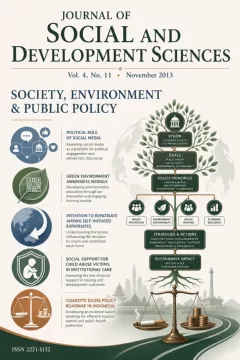
All forms of life in this world needs a healthy environment in which all living things interact continuously. Extensive use of the natural resources by humans resulted in the depletion of the environment. Thus, it is essentials that humans are made aware and take responsibility of protecting the environment for the present and future generations. To achieve this, environmental education are essential to encourage and educate citizen so that they are aware and play an active part in protecting the environment by making informed decisions on any actions taken. Education is the means to impart and develop the appropriate knowledge, skills and values in order to understand what human’s activities and action have done to the environment. Thus, sensitivity towards issues of the environment will emerge or arise within individual and in turn will nurture responsible attitude on protecting the environment. The aim of this study is to develop a conceptual framework of Green Environment Awareness Module. Special features in this module are providing informative, educative and reliable information about the environment which incorporate the use of QR-Code for easy retrieval. Development of the module using the Modified Delphi Technique was carried out.
Keywords
References
- Aini, R. (2011). Kesedaran kitar semula masih rendah. Kosmo Harian, January 22.
- Evans, S. M., Gill, M. E. & Marchant, J. (1996). Schoolchildren as educators: the indirect influence of environmental education in schools on parents' attitudes towards the environment. Journal of Biological Education , 30(4), 243-248.
- Gardner, G. T. & Stern, P. C. (1996). Environmental problems and human behavior (2nd Ed.). Boston, MA: Pearson Custom P ublishing.
- Jamilah, A. (2011). Pengetahuan Sikap dan Amalan Masyarakat Malaysia terhadap Alam Sekitar. MALIMSEA Journal of General Studies, 13, 139-154
- Zohir, M. A. & Nordin, A. R. (2007). Pendidikan alam sekitar di sekolah: komitmen guru. Diges Pendidik , 7(2), 74-81.
- Psaromiligkos, Y. & Retalis, S. (2003). Re-evaluating the electiveness of a web-based learning system: A comparative case study. Journal of Educational Multimedia and Hypermedia , 12(1), 5–20.
- Pudin, S., Tagi, K. & Periasamy, A. (2005). Environmental education in Malaysia and Japan: A comparative assessment. Paper presented at the Education for a sustainable future international conference, Ahmedabad, India. Retrieved 31 October 2013. http://www.ceeindia.org/esf/download/paper20.pdf
- West, D. M. (2013). Mobile Learning: Transforming Education, Engaging Students, and Improving Outcomes. Retrieved 31 October 2013 from www.brookings.edu/research/papers/2013/09/17mobile-learning-education-engaging-students-west.
- Zimmerman, B. J. & Schunk, D. H. (1989). Self-regulated learning and academic achievement: Theory, research, and practice. New York: Springer-Verlag.
Downloads
No downloads have been recorded for this article yet. Figures appear here once readers begin downloading the full text.
How to Cite
Share this article
License
Copyright (c) 2013 Rose Amnah Abd Rauf, Mohamad Sattar Rasul (Author)

This work is licensed under a Creative Commons Attribution 4.0 International License.
Author (s) should affirm that the material has not been published previously. It has not been submitted and it is not under consideration by any other journal. At the same time author (s) need to execute a publication permission agreement to assume the responsibility of the submitted content and any omissions and errors therein. After submission of revised paper in the light of suggestions of the reviewers, the editorial team edits and formats manuscripts to bring uniformity and standardization in published material.
This work will be licensed under Creative Commons Attribution 4.0 International (CC BY 4.0) and under condition of the license, users are free to read, copy, remix, transform, redistribute, download, print, search or link to the full texts of articles and even build upon their work as long as they credit the author for the original work. Moreover, as per journal policy author (s) hold and retain copyrights without any restrictions.
Keywords
Section
Published
Submissions
Have research to publish? Journal of Social and Development Sciences welcomes submissions.
Make a Submission