Abstract
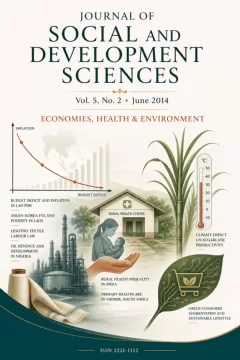
This study provides an understanding for the relationship between climatic factors and sugarcane productivity in India. The main objective of this paper is to estimates the impact of climatic and non-climatic factors on sugarcane productivity. To check the consistency of empirical results, simple linear regression model, Ricardian productivity regression (non-linear) model and Cobb-Douglas production function models are employed. The data set incorporates 390 observations corresponding to thirteen states with panel data for 30 years during 1980 to 2009. These all models include sugarcane productivity as dependent variable. Irrigated area, agriculture labour, consumption of fertilizers, literacy rate, tractors and farm harvest price (at constant level) are considered as explanatory variables. Average rainfall, average maximum and average minimum temperature include as climatic factors to capture the effect of climatic conditions on cane productivity. These climatic factors are incorporate for three weather seasons such as rainy, winter and summer. Empirical results based on Prais Winsten models with panels corrected standard errors (PCSEs) estimation shows that climatic factors i.e. actual rainfall, average maximum and average minimum temperature have a statistically significant impact on sugarcane productivity. The climatic effect for various factors on cane productivity are varies within different seasons. Average maximum temperature in summer and average minimum temperature in rainy season have a negative and statistically significant effect on sugarcane productivity. While, sugarcane productivity positively get affect with increasing average maximum temperature in rainy season and winter seasons. The study concluded that there is non-linear relationship between climatic factors and sugarcane productivity in India.
Keywords
References
- Bosello, F. & Zhang, J. (2005). Assessing Climate Change Impacts: Agriculture. CIP–Climate Impacts and Policy Division Working Paper 02. Available at: http://www.eclac.cl/ilpes/noticias/paginas/1/35691/Bosello_assesingclimatechangeimpacts.pdf.
- Cobb, C. W. & Douglas, P. H. (1928). A Theory of Production. American Economic Review , 18(1), 139-156.
- Deressa, T., Hassan, R. & Poonyth, D. (2005). Measuring the Impact of Climate Change on South African Agriculture: The Case of Sugarcane Growing Regions. Agrekon , 44(4), 524-542.
- Gbetibouo, G. A. & Hassan, R. M. (2005). Measuring the Economic Impact of Climate Change on Major South African Field Crops: A Ricardian Approach. Global and Planetary Change , 47, 143–152.
- Gupta, S., Sen, P. & Srinivasan, S. (2012). Impact of Climate Change on Indian Economy: Evidence from Food Grain Yields. Centre for Development Economics Working Paper 218, Delhi.
- Geethalakshmi, V., Lakshmanan, A., Rajalakshmi, D., Jagannathan, R., Sridhar, G., Ramara, Bhuvaneswari, A. P., Gurusamy, K. L. & Anbhazhagan, R. (2011). Climate Change Impact Assessment and Adaptation Strategies to Sustain Rice Production in Cauvery Basin of Tamil Nadu. Current Science , 101(03). 342-347.
- Haris, A. A., Biswas, S. & Chhabra, V. (2010). Climate Change Impacts on Productivity of Rice (Oryza Sativa) in Bihar. Indian Journal of Agronomy , 55(4), 295-298.
- Haim, D., Shechter, M. & Berliner, P. (2008). Assessing the Impact of Climate Change on Representative Field Crops in Israeli Agriculture: A Cause Study of Wheat and Cotton. Climatic Change , 86,425440.
- Hari, B. D., Gernot, B., Charity, G. O. & Hemanta, K. T. (2010). Capitalizing on Assets: Vulnerability and Adaption to Climate Change in Nepal. Social Development Papers Social Dimensions of Climate Change Paper, 121.
- Hundal, S. S. & Prabhjyot, K. (2007). Climate Variability and its Impact on Cereal Productivity in Punjab India. Current Science , 92(04), 506-512.
- Kumar, A., Sharma, P. & Ambrammal, S. K. (2014). Climatic Effects on Food Grain Productivity in India: A Crop Wise Analysis. Journal of Studies in Dynamics and Change , 1(1), 38-48.
- Kumar, K. S. K. & Parikh, J. (2001). Socio-economic Impacts of Climate Change on Indian Agriculture. International Review for Environmental Strategies , 2(2), 277-293.
- Kumar, K. S. K. (2009). Climate Sensitivity of Indian Agriculture does Spatial Effects Matter. SANDEE Working Paper 45-09, Kathmandu.
- Kumar, V., Sharma, Y. & Chauhan, S. (2011a). Impact of Climate Change on the Growth and Production of Saccharum Offcinarum and Magnifera Indica. International Journal of Science Technology and Management , 2(1), 42-47.
- Kumar, S. N., Aggarwal, P. K., Rani, S., Jain, S., Saxena, R. & Chauhan, N. (2011b). Impact of Climate Change on Crop Productivity in Western Ghats, Coastal and Northeastern Regions of India (Special Section: Climate Change: Projections and Impact for India). Current Science , 101, 332-341.
- Kar, J. & Kar, M. (2008). Environment and Changing Agricultural Practices: Evidence from Orissa, India. Indus Journal of Management and Social Sciences , 2(2), 119-128.
- Kurukulasuriya, P. & Mendelsohn, R. (2008). A Ricardian Analysis of the Impact of Climate Change on African Cropland. AFJARE , 2(1), 1-23.
- Kalra, N., Chakraborty, D., Sharma, A., Rai, J., Monica, H. K., Subhash, C., Kumar, P., Ramesh, B. S., Barman, D., Mittal, R. B., Lal, M. & Sehgal, M. (2008). Effect of Increasing Temperature on Yield of Some Winter Crops in Northwest India. Current Science , 94(1), 82-88.
- Kapur, D., Khosla, R. & Mehta, P. B. (2009). Climate Change: India’s Options. Economic and Political Weekly , 36(31), 34-42.
- Mendelsohn, R., Nordhaus, W. D. & Shaw, D. (1994). The Impact of Global Warming: A Ricardian Analysis. American Economic Review , 84(4), 753-771.
- Mano, R. & Nhemachena, C. (2007). Assessment of the Economic Impacts of Climate Change on Agriculture in Zimbabwe: A Ricardian Approach. Policy Research Working Paper, World Bank. Available at: http://elibrary.worldbank.org/doi/book/10.1596/1813-9450-4292.
- Mongi, H., Majule, A. E. & Lyimo, J. G. (2010). Vulnerability and Adaption of Rain Fed Agriculture to Climate Change and Variability in Semi-arid Tanzania. African Journal of Environmental Science and Technology , 4(6), 371-381.
- Masters, G., Baker, P. & Flood, J. (2010). Climate Change and Agricultural Commodities. CABI Working Paper, 02.
- Nastis, S. A., Michailidis, A. & Chatzitheodoridis, F. (2012). Climate Change and Agricultural Productivity. African Journal of Agricultural Research , 7(35), 4885-4893.
- Nandhini, U. S., Alagumani, T. & Shibi, S. (2006). Economic Analysis of Agriculture in Southern Parts of Coastal India. Agricultura Tropica et Subtropica , 39(4), 279-284.
- Oduol, J. B., Binam, A., Olarinde, J. N. B., Diagne, L. & Adekunle, A. (2011). Impact of Adoption of Soil and Water Conservation Technologies on Technical Efficiency: Insight from Smallholder Farmers in Sub-Saharan Africa. Journal of Development and Agricultural Economics , 3(14), 655-669.
- Onyeji, S. C. & Fischer, G. (1993). An Economic Analysis of Potential Impacts of Climate Change in Egypt. IIASA Working Paper, 93(12), Laxenburg.
- Pandey, A. P. (2007). Indian Sugar Industry -A Strong Industrial Base for Rural India. MPRA Paper, 6065.
- Ranuzzi, A. & Srivastava, R. (2012). Impact of Climate Change on Agriculture and Food Security. ICRIER Policy Series 16.
- Ramulu, M. (1996). Supply Response of Sugarcane in Andhra Pradesh. Finance India , 10(1), 116-122.
- Saseendran, S. A., Singh, K. K., Rathore, L. S., Singh, S. V. & Sinha, S. K. (2000). Effects of Climate Change on Rice Production in the Tropical Humid Climate of Kerala, India. Climate Change, 44, 495-514.
- Seo, S. N., Mendelshon, R. & Munasinghe, M. (2005). Climate Change and Agriculture in Sri Lanka: A Ricardian Valuation. Environment and Development Economics, Cambridge University Press , 10(5), 581-596.
- Srivastava, A. K. & Rai, M. K. (2012). Sugarcane Production: Impacts of Climate Change and its Mitigation. Biodiversitas , 13(4), 214-227.
- Shrivastava, A. K., Shrivastava, A. K. & Solomon, S. (2011). Sustaining Sugarcane Productivity under Depleting Water Resources. Current Sciences , 10(06), 748-754.
- United Nations Report. (2011). An Assessment of the Economic Impact of Climate Change on the Agriculture Sector in Jamaica. Economic Commission for Latin America and the Caribbean, Subregional Headquarters for the Caribbean.
- Zhai, F. & Zhuang, J. (2009). Agriculture Impact of Climate Change: A General Equilibrium Analysis with Special Reference to Southeast Asia. ADBI Working Paper Series, 131.
Downloads
No downloads have been recorded for this article yet. Figures appear here once readers begin downloading the full text.
How to Cite
Share this article
License
Copyright (c) 2014 Ajay Kumar, Pritee Sharma (Author)

This work is licensed under a Creative Commons Attribution 4.0 International License.
Author (s) should affirm that the material has not been published previously. It has not been submitted and it is not under consideration by any other journal. At the same time author (s) need to execute a publication permission agreement to assume the responsibility of the submitted content and any omissions and errors therein. After submission of revised paper in the light of suggestions of the reviewers, the editorial team edits and formats manuscripts to bring uniformity and standardization in published material.
This work will be licensed under Creative Commons Attribution 4.0 International (CC BY 4.0) and under condition of the license, users are free to read, copy, remix, transform, redistribute, download, print, search or link to the full texts of articles and even build upon their work as long as they credit the author for the original work. Moreover, as per journal policy author (s) hold and retain copyrights without any restrictions.
Keywords
Section
Published
Submissions
Have research to publish? Journal of Social and Development Sciences welcomes submissions.
Make a Submission