Abstract
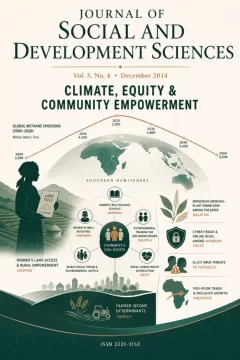
Developing countries are suffering most under climate change and global warming. The tragedy is that countries in the global South have contributed limitedly to climate change with the problem caused mainly by the fiscal activity of the northern developed countries. How effective have policy interventions been in tackling the climate crisis and how has civil society responded to tackling risks. By examining the case of the Global Methane Initiative (a multilateral partnership launched in 2010 by the United States Environmental Protection Agency along with thirty-six other countries to generate a voluntary, non-binding agenda for global collaboration to decrease anthropogenic methane releases), along with empirical analysis from projects in developing countries and through correspondence with the Global Methane Initiative Administrative Support Group in 2011, this paper seeks to explore whether the Global Methane Initiative presents a threat or opportunity, including what key strategies may be effective to either block or assist in advancing the process more decisively. How effective has the Global Methane Initiative been in addressing climate change? In addition to providing analyses of the key findings, this paper provides recommendations that may be explored by civil society groups for a common campaign to combat any deficiencies of the Global Methane Initiative.
Keywords
- Global Methane Initiative Search this journal for Global Methane Initiative (opens in a new tab)
- Global Methane Fund Search this journal for Global Methane Fund (opens in a new tab)
- Climate Change Search this journal for Climate Change (opens in a new tab)
- Global Warming Search this journal for Global Warming (opens in a new tab)
- Civil Society Search this journal for Civil Society (opens in a new tab)
References
- Academy of Science of South Africa. (2011). Towards a low carbon city: Focus on Durban, ASSAf, South Africa.
- Australian Broadcasting Corporation. (2008). Climate change sceptics speak out before green paper release. Online: http://www.abc.net.au/lateline/content/2008/s2303589.htm (Accessed July 2011).
- Boyle, R. (2010). Chinese Cow Manure Generates Electricity In Largest-Ever Methane Capture System. Online: http://www.popsci.com/technology/article/2010-11/chinese-cow-manure-generates-electricitylargest-ever-methane-capture-system (Accessed September 2011).
- Brackmort, K. (2010). Methane capture: Options for greenhouse gas emission reduction, Congressional Research Services, Prepared for members and committees of congress. Online: http://www.earthforum.net/NLE/CRSreports/10Jun/R40813.pdf (Accessed June 2011).
- British Broadcasting Corporation. (2006). Climate change hitting Africa, 28 October. Online: http://news.bbc.co.uk/2/hi/africa/6092564.stm (Accessed September 2011).
- Colonos Website. (2007). Leave the Oil in the Soil: Yasuni, ITT, the Huaorani people and the Amazon. Online: http://colonos.wordpress.com/2007/11/22/leave-the-oil-in-the-soil-yasuni-itt-the-huaoranipeople-and-the-amazon/ (Accessed October 2013).
- Fox New s. (2011). EPA spends $100 M on foreign grants in last decade, Study finds, 27 June. http://www.foxnews.com/politics/2011/06/27/epa-spent-100m-on-foreign-grants-in-last decade-study-finds/#ixzz1QVqKyH7T (Accessed March 2013). Online: -
- Global Methane Initiative – Agricultural Methane. (2011). Online:
- Global http://www.globalmethane.org/documents/ag_fs_eng.pdf (Accessed November 2012) Methane Initiative – Coal Mine Methane. (2011). Online: http://www.globalmethane.org/documents/coal_fs_eng.pdf (Accessed November 2012)
- Global Methane Initiative – Oil and gas systems methane. (2011). Online: http://www.globalmethane.org/documents/oil-gas_fs_eng.pdf (Accessed October 2012)
- Global Methane Initiative Factsheet. (2011). http://www.globalmethane.org/documents/gmi_factsheet.pdf (Accessed September 2012). Online:
- Guimei, Y. (2003). Multinationals' investment In Africa: An Analysis on the Current Situation, Bureau of International Cooperation. Online: http://bic.cass.cn.
- IEWY News. (2010). Global Initiative Seeks to Curb Methane Pollution. Online: http://www.iewy.com/10369global-initiative-seeks-to-curb-methane-pollution.html (Accessed December 2011)
- Iyayi, F. (2010). Environmental cost of gas flaring in Nigeria: In: Ojo, G. (2010) Envisioning a post petroleum Nigeria: Leave the oil in the soil, Kraft Books limited, Nigeria.
- Methane Blue Ribbon Panel. (2009). A fast action plan for methane abatement. Online: http://globalmethanefund.org/GMI_Concept_011209.pdf (Accessed February 2013)
- Point Carbon (2010). Price Forecast and Risk Assessment of Methane Projects and Methodologies: A delivery to the Global Methane Fund, Final Report.
- Provencher, J. (2007). What the deep-sea and cows have in common, Ocean News. Online: http://oceanlink.island.net/ONews/ONews7/methane.html.
- Unites States Environmental Protection Agency. (2011). Online at http://epa.gov/climatechange (Accessed March 2011).
- Unites States Environmental Protection Agency. (2013). Coalbed Methane Outreach Program. Online: http://www.epa.gov/cmop/faq.html#three (Accessed May 2013).
- Unites States Environmental Protection Agency. (2010). Coalbed Methane Extra. Online: http://www.epa.gov/cmop/docs/fall_2010.pdf (Accessed November 2012).
- United States Environmental Protection Agency. (2002). Evaluation of Impacts to Underground Sources of Drinking Water by Hydraulic Fracturing of Coalbed Methane Reservoirs. EPA 816-D-02-006. Chapter 6. Water Quality Incidents. Online: http://www.epa.gov/safewater/uic/cbmstudy/docs.html (Accessed January 2012).
Downloads
No downloads have been recorded for this article yet. Figures appear here once readers begin downloading the full text.
How to Cite
Share this article
License
Copyright (c) 2014 Llewellyn Leonard (Author)

This work is licensed under a Creative Commons Attribution 4.0 International License.
Author (s) should affirm that the material has not been published previously. It has not been submitted and it is not under consideration by any other journal. At the same time author (s) need to execute a publication permission agreement to assume the responsibility of the submitted content and any omissions and errors therein. After submission of revised paper in the light of suggestions of the reviewers, the editorial team edits and formats manuscripts to bring uniformity and standardization in published material.
This work will be licensed under Creative Commons Attribution 4.0 International (CC BY 4.0) and under condition of the license, users are free to read, copy, remix, transform, redistribute, download, print, search or link to the full texts of articles and even build upon their work as long as they credit the author for the original work. Moreover, as per journal policy author (s) hold and retain copyrights without any restrictions.
Keywords
- Global Methane Initiative Search this journal for Global Methane Initiative (opens in a new tab)
- Global Methane Fund Search this journal for Global Methane Fund (opens in a new tab)
- Climate Change Search this journal for Climate Change (opens in a new tab)
- Global Warming Search this journal for Global Warming (opens in a new tab)
- Civil Society Search this journal for Civil Society (opens in a new tab)
Section
Published
Submissions
Have research to publish? Journal of Social and Development Sciences welcomes submissions.
Make a Submission