Abstract
The objectives of entrepreneurship in Islam are guided by the Maqasid Al-Shariah . However, there is a mismatch between Islamic entrepreneurship objectives and Maqasid Al-Shariah based on available literatures, which have not been critically investigated. This paper presents a critical review of the literature within the Islamic entrepreneurship objectives and Maqasid Al-Shariah framework. The exploratory study adopting content analysis to achieve its aim found that the existing literature covered both the Din and Mu’amalah based objectives of Islamic entrepreneurship. However, there is dearth of literature that integrates the connection between objectives of Islamic entrepreneurship and Maqasid Al-Shari’ah . It is therefore suggested that researchers should conduct more researches to examine the integration of Maqasid Al-Shariah in Islamic entrepreneurship, particularly in respect to decision making in handling entrepreneurship issues.
Keywords
References
- Abu-Saifan, S. (2012). Social entrepreneurship: definition and boundaries. Technology Innovation Management Review , 2(2), 22-27.
- Abdullah, S. & Mikail, S. A. (2013). Entrepreneurship and Islam: An expository study on characteristics of Muslim entrepreneur. Proceeding of the 5th Islamic Economics System Conference: Sustainable Development Through The Islamic Economics System, Faculty Economics And Muamalat, Universiti Sains Islam Malaysia, Kuala Lumpur.
- Al-Mubarak, T. & Osmani, N. M. (2010). Applications of Maqasid al-Shari’ah and Maslahah in Islamic banking practices: An analysis. Paper presented at the International Seminar on Islamic Finance. (pp.1-17). Kochi, India. Retrieved September 20th, 2015, from http://irep.iium.edu.my/4251/1/Applications_of_Maqasid_Shari%60ah.pdf
- Al-Quran, Arabic Text with corresponding English Meanings. (1997). Translated by Saheeh International. Riyadh: Abdulqasim Publishing House.
- Alserhan, B. A. (2011). The principles of Islamic marketing. Gower Publishing, Ltd.
- Aziz, A. & Faizal, A. (2011). Islamic finance within trading framework: The way to legitimate profit. Munich Personal RePEc Archive, 47769, 1-29.
- Azmi, I. A. G., Basir, A., Muwazir, M. R., Hashim, R. C. & Mohamed, H. A. (2014). Motivation of Muslim women entrepreneurs in Malaysian SMEs. Paper presented at the 4th International Conference on Management, (pp. 1-11). Bali, Indonesia.
- Baqutayan, S. (2012). The innovation of human nature in Islam. International Journal of Social Sciences and Education, 2(1), 162-173.
- Bedoui, H. E. & Mansour, W. (2015). Performance and maqasid al-shari’ah’s pentagon-shaped ethical measurement. Science and Engineering Ethics , 21(3), 555-576.
- Belt, D. (2002). The world of Islam. National Geographic. Retrieved 25th September 2015 from http://ngm.nationalgeographic.com/ngm/data/2002/01/01/html/ft_20020101.5.html.
- Binks, M. & Vale, P. (1990). Entrepreneurship and Economic Change. New York: McGraw-Hill.
- Bula, O. H. (2012). Evolution and theories of entrepreneurship: A critical review on the Kenyan perspective. International Journal of Business and Commerce, 1(11), 81-96.
- Chapra, M. U. (2000). The Future of Economics: An Islamic Perspective. Leicester: The Islamic Foundation.
- Dusuki, A. W. & Abdullah, N. I. (2007). Maqasid al-shari'ah, Maslahah and corporate social responsibility. The American Journal of Islamic Social Sciences , 24(1), 25-45.
- Dusuki, A. W. & Bouheraoua, S. (2011). The framework of Maqasid al-Shari'ah and its implication for Islamic finance. Islam and Civilisational Renewal , 2(2), 316-336.
- Eroglu, O. & Picak, M. (2011). Entrepreneurship, national culture and Turkey. International Journal of Business and Social Science, 2(16), 146-151.
- Gümüsay, A. A. (2015). Entrepreneurship from an Islamic perspective. Journal of Business Ethics , 130(1), 199208. Hadith . Retrieved from: http://www.searchtruth.com
- Hallaq, W. B. (2004). A History of Islamic Legal Theories: An Introduction to Sunni Usul al-Fiqh. United Kingdom: Cambridge University Press.
- Hamid, E. S. (2012). Initiating Islamic Entrepreneurship among Muslim Communities. Proceedings of the International Conference on Islamic Leadership-2, (pp. 23-36). Indonesia, University of Indonesia.
- Hanafi, N. (2012). Business performance of women-owned SMEs in Malaysia: Learning and entrepreneurial orientations and the mediating roles of competitive advantage. Unpublished Doctoral Dissertation, Universiti Utara Malaysia.
- Hassan, M. K. & Hippler III, W. J. (2014). Entrepreneurship and Islam: An Overview. Econ Journal Watch , 11(2), 170-178.
- Juma’h, A. H., Campus, M. & Abu-Mounes, R. N. (2011). An introduction to the Islamic perspectives of conducting business. Revista Empresarial Inter Metro / Inter Metro Business Journal, 7(1), 58-68.
- Kayed R. N. & Hassan, M. K. (2010). Islamic entrepreneurship: A case study of Saudi Arabia . Journal of Developmental Entrepreneurship , 15(4), 379–413.
- Kayed, R. N. & Hassan, M. K. (2013). Islamic entrepreneurship. London: Routledge.
- Mohammad, M. O. & Shahwan, S. (2013). The objective of Islamic economic and Islamic banking in light of Maqasid Al-Shariah: A critical review. Middle-East Journal of Scientific Research , 13, 75-84.
- Rice, G. (1999). Islamic ethics and the implications for business. Journal of Business Ethics , 18(4), 345-358.
- Saripuddin, S. O. Z. M. (2015). Concept of business ethics in Islam - approach to the entrepreneur. Journal of Asian Business Strategy , 5(1), 13-18.
- Shane, S. (2003). A General Theory of Entrepreneurship: The Individual-Opportunity Nexus. UK: Edward Elgar.
- Shane, S. & Venkataraman, S. (2000). The promise of entrepreneurship as a field of research. Academy of management review , 25(1), 217-226.
- Zarabozo, J. (2007). What is Islam? Riyadh: Ministry of Islamic Affairs Endowments, Da'wah, and Guidance, Saudi Arabia.
Downloads
No downloads have been recorded for this article yet. Figures appear here once readers begin downloading the full text.
How to Cite
Share this article
License
Copyright (c) 2015 Farida Mohammed Shehu, Nor Hayati Binti Ahmad, Al-Hasan Al-Aidaros (Author)

This work is licensed under a Creative Commons Attribution 4.0 International License.
Author (s) should affirm that the material has not been published previously. It has not been submitted and it is not under consideration by any other journal. At the same time author (s) need to execute a publication permission agreement to assume the responsibility of the submitted content and any omissions and errors therein. After submission of revised paper in the light of suggestions of the reviewers, the editorial team edits and formats manuscripts to bring uniformity and standardization in published material.
This work will be licensed under Creative Commons Attribution 4.0 International (CC BY 4.0) and under condition of the license, users are free to read, copy, remix, transform, redistribute, download, print, search or link to the full texts of articles and even build upon their work as long as they credit the author for the original work. Moreover, as per journal policy author (s) hold and retain copyrights without any restrictions.
Keywords
Section
Published in
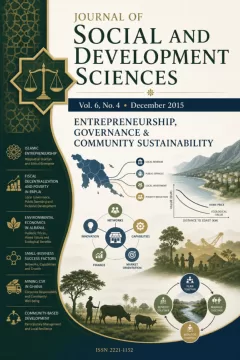 Vol. 6 No. 4 (2015)
Entrepreneurship, Governance & Community Sustainability
View issue contents
Published
Submissions
Have research to publish? Journal of Social and Development Sciences welcomes submissions.
Make a Submission