Abstract
In Papua province, fiscal decentralization policy had a positive impact on the potential development and regional government creativity. The effectiveness in managing regional wealth will affect to the regional revenue which can further determine the effect of fiscal decentralization and economic growth to improve on poverty. The method used is multiple linear regression analysis technique. The results showed simultaneous fiscal decentralization and economic growth has a significant effect on poverty. In partial result, the negative fiscal decentralization variable and significant fiscal decentralization on poverty means there is decreased percentage in the number of the poor people.
Keywords
References
- Adi, P. H. (2005). Impact of Fiscal Desentralization on Ecomonics Growth (Study in Regencies and Cities in Java-Bali). Journal of Interdiscipline Development Study, Post Graduate Program UKSW. Salatiga , 17(23), 23
- Akai, N. & Sakata, M. (2002). Fiscal Decentralization Contributes to Economic Growth: Evidence from StateLevel Cross-Section Data for the United States. Journal of Urban Economics, 3, 93- 108.
- Adisubrata, W. S. (1999). Regional Autonomy in Reformatioan Era. Unit Publishing and Printing (UPP) AMP YKPN. Yogyakarta.
- Akita,T., Kurniawan, P. A. & Miyata, S . ( 2003). Structural Changes and Regional Income Inequality in Indonesia: A Bidimensional Decomposition Analysis. Asian Economic Journal, 25(1), 55–77.
- Bahl, R. W. & Linn, J. F. (1992). Urban Public Finance in Developing Countries, Oxford University Press, Oxford.
- Beier & Ferrazzi. (1998). Fiscal Decentralization in Indonesia: A Comment on Smokeand Lewis. Word Development , 26(12), 2201–2211.
- Bird, R. M. & Vaillancourt, F. (1998). Fiscal Decentralization in Developing Countries DesentralisasiTranslated by AlmizanUlfa. PT. GramediaPustakaUtama. Jakarta.
- Brodjonegoro, B. & Vaques, J. M. (2002). An Analysis of Indonesian’s Transfer System: Recent Performance and Future Prospect. Working Paper. George State University. Andrew Young School of Policy Studies.
- Buentjen, C. (1998). Fiscal Decentralization in Indonesia: The Challenge of Designing Institutions. GTZ-SfDM Project. Jakarta.
- Central Bureau of Statistics (BPS). (1999). Domestic Product Regional Bruto in Indonesia According to Business Fields.
- Dartanto, T. & Brodjonegoro, B. P. S. (2003). Impact of Fiscal Decentralization on Economics Growth and Regional Disparity in Indonesia: AnalysisofMacro Economics simultaneous Model. Journal of Economics and Development Indonesia , 4(1).
- Davoodi, H. R. & Zou, H. (1998). Fiscal Decentralization and Economic Growth: a Cross-CountryStudy. Journal of Urban Economics, 13, 244-257.
- Davoodi, H. R. (2001). Fiscal Decentralization, IMF Research Bulletin, 2 June.
- Devas, N. (1997). Indonesia: What Do We Mean by Decentralization? Public Administration and Development , 17, 351-367.
- Esmara, H. (1986). Planning and Development in Indonesia. Jakarta: Gramedia Pustaka Utama.
- Fisher, R. (1996). State and Local Public Finance. Irwin Publications. Chicago.
- Helms, J. L. (1985).The Effect of State and Local Taxes on Economic Growth: A Time Series – Cross Section Approach in Wallace E Oates (Ed) The Economics of Fiscal Federalism and Local Finance. Edward Elgar. Centelham.United Kingdom.
- Hirchman, A. (1968).The Strategy of Economic Development.Yale University Press. Connecticut.
- Islam, I. (1999). Making Decentralization Work: Reaping the Rewards and Managing the Risks. UNSFIR Working Paper. Jakarta.
- Jütting, J., Kauffmann, C., Mc Donnell, I., Osterrieder, H., Pinaud, N. & Wegner, L. (2004). Decentralizationand Poverty in Developing Countries: Exploring the Impact.” OECD Development Centre Working Paper No. 236
- Kaloh, J. (2002). Looking for Regional Autonomy Forms. Jakarta. PT Rineka Cipta.
- Litvack, J., Jundid, A. & Bird, R. (1998). Decentralization in Developing Country.The World Bank, Washington, DC.
- Mahi, R. & Muchtar, K. (2000). Decentralization Policy in Transition Era.LPEM FE-UI, Jakarta.
- Manor, J. (1999).The Political Economy of Democratic Decentralization. Washington: World Bank, IBRD, 6. Mardiasmo. & Halim, A. (1999). Autonomy and Regional Financial Management. Andi.Yogyakarta.
- Martinez-Vazquez, J. & McNab, R. M. (2001). Fiscal Decentralization and Economic Growth, Working Paper 01–1, International Studies Program, Andrew Young School of Policy Studies, Georgia State University, Atlanta.
- Myrdal, G. (1957). Economic Theory and under developed Regions London: Duckworth. Nuralam. (2010). Influences of Fiscal Dezentralization on Expenditure Structure and Economic Growth in
- Regencies/Cities in Papua Province. Dissertation. Post Graduate. University of Brawijaya. Malang.
- Oates, W. E. (1972). Fiscal Federalism, Harcourt Brace Jovanovich, New York.
- Oates, W. E. (1993). Fiscal Decentralization and Economic Development. National Tax Journal , 16(2), 237-243.
- Pidie, A. M. (1997). Regional Autonomy and District Leader in 21 st Century. Gaya Media Pratama. Jakarta.
- Rosenstein-Rodan, P. (1943-1957). Problems of Industrialization of Eastern and South Eastern Europe. Economic Journal , 53, 210-211. June-September, 202-21.
- Saragih, J. P. (2003). Fiscal Decentralization and Regional Financial in Autonomy. Ghalia Indonesia. Jakarta.
- Sidik, M. (2000). Policy of National Fiscal to Support Regional Autonomy. Paper in Program Study of Magister Management in Economics Development.Yogyakarta
- Stewart, J. (1988). Understanding the Management of Local Government: Its Special Purpose, Conditions and Task. Longman Group UK Ltd.
- Strauss, J. (2000). Users Guide for the Indonesia Family Life Survey. Wave , 3(2). RAND.
- Suwandi, &Warokka, A. (2013). Fiscal Decentralization and Special Local Autonomy: Evidence from in Emerging Market. Journal of Southeast Asian Research , 20(13).
- Syafrizal. (2008). Regional Economics Theory and Application. 1 st edition. Baduose Publishing, Padang
- Wahyuni, S. (2008). Analysis of Financial Regional Capability in Supporting Local Activities. Thesis. Yogyakarta
- Wong, J. D. (2004). The Fiscal Impact of Economic Growth and Development on Local Government Capacity. Journal of Public Budgeting, Accounting and Financial Management , 16(3), 413-423.
- World Bank. (2002). Decentralizing Indonesia: A Regional Public Expenditure Review, Report No 26191-IND, World Bank, Washington DC.
- Xie, D., Zou, H. & Davoodi, H. (1999). Fiscal Decentralization and Economic Growth in the United States . Journal of Urban Economics , 10(5), 228-39.
- Zhang, T. & Zou, H. (1998). Fiscal Decentralization, Public Spending, and Economic Growth in China. Journal of Public Economics, 17, 221-40.
Downloads
No downloads have been recorded for this article yet. Figures appear here once readers begin downloading the full text.
How to Cite
Share this article
License
Copyright (c) 2015 Suwandi, Nuralam (Author)

This work is licensed under a Creative Commons Attribution 4.0 International License.
Author (s) should affirm that the material has not been published previously. It has not been submitted and it is not under consideration by any other journal. At the same time author (s) need to execute a publication permission agreement to assume the responsibility of the submitted content and any omissions and errors therein. After submission of revised paper in the light of suggestions of the reviewers, the editorial team edits and formats manuscripts to bring uniformity and standardization in published material.
This work will be licensed under Creative Commons Attribution 4.0 International (CC BY 4.0) and under condition of the license, users are free to read, copy, remix, transform, redistribute, download, print, search or link to the full texts of articles and even build upon their work as long as they credit the author for the original work. Moreover, as per journal policy author (s) hold and retain copyrights without any restrictions.
Keywords
Section
Published in
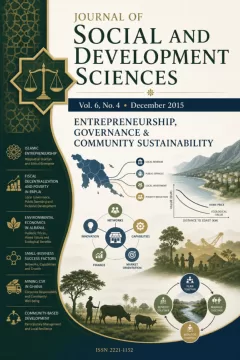 Vol. 6 No. 4 (2015)
Entrepreneurship, Governance & Community Sustainability
View issue contents
Published
Submissions
Have research to publish? Journal of Social and Development Sciences welcomes submissions.
Make a Submission