Abstract
This paper examines the impact of education on the age/earnings profiles of self-employed Bangladeshi men, using data from a survey carried out by the first author in 2010. Its results strongly support the perception that educational attainment and on-the-job experience are strongly complementary rather than mutually substitutable in increasing the likelihood of achieving a high income level. Yet the high degree of earnings heterogeneity among well-educated respondents in the sample also indicates that academic excellence is a catalyst but not a guarantor for entrepreneurial success, and that levels of education that are formally equivalent may nevertheless have very different implications for the likelihood of prosperity in business.
Keywords
References
- Aitchison, J. & Silvey, S. (1957). The Generalization of Probit Analysis to the Case of Multiple Responses. Biometrika , 44, 131-140. DOI: https://doi.org/10.1093/biomet/44.1-2.131
- Bangladesh Board of Investments. (2015). Export Processing Zones. Available online at http://www.boi.gov.bd/index.php/investment-climate-info/export-processing-zones (retrieved January 17th, 2015).
- Bank of Bangladesh. (2010). SME Credit Policy and Programmes. Available online at http://www.bb.org.bd/sme/smepolicye.pdf (retrieved January 17th, 2015).
- Barnett, W., Geweke, J. & Wolfe, M. (1991). Semi nonparametric Bayese an Estimation of the Asymptotically Ideal Production Model. Journal of Econometrics , 47, 5-50. DOI: https://doi.org/10.1016/0304-4076(91)90009-3
- Becker, G. (1964). Human Capital. National Bureau of Economic Research, New York.
- Card, D. (1999). The Causal Effect of Education on Earnings. In: O. C. Ashenfelter and D. Card (ed.), Handbook of Labor Economics , 3(1), 1801-1863, Amsterdam (Elsevier). DOI: https://doi.org/10.1016/S1573-4463(99)03011-4
- Casanova, M. (2013). Revisiting the Hump-Shaped Wage Profile. Working paper, University of California, Los Angeles.
- Feger, F. (2000). A Behavioral Model of the German Compound Feed Industry: Functional Form, Flexibility, and Regularity. Doctoral dissertation, University of Göttingen.
- Harmon, C., Oosterbeek, H. & Walker, I. (2003). The Returns to Education: Microeconomics. Journal of Economic Surveys , 17(2), 115 - 156. DOI: https://doi.org/10.1111/1467-6419.00191
- Hauser, R. & Diamond, T. (1977). Schooling, Ability, and Earnings: Cross-Sectional Findings 8 to 14 Years after High School Graduation. Sociology of Education , 50(3), 182-206. DOI: https://doi.org/10.2307/2112649
- Heckman, J. J. (1979). Sample selection bias as a specification error. Econometrica , 47, 153–161 DOI: https://doi.org/10.2307/1912352
- Heckman, J. J., Lochner, L. J. & Todd, P. E. (2006). Earnings Functions, Rates of Return and Treatment Effects: The Mincer Equation and Beyond. In: E. Hanushek and F. Welch (ed.), Handbook of the Economics of Education , 1, 307 - 458, Amsterdam (Elsevier). DOI: https://doi.org/10.1016/S1574-0692(06)01007-5
- Kabir, M. & Chowdhury, K. (1981). The pattern of age reporting errors in the districts of Bangladesh. Rural Demography Journal , 8(2), 33-54.
- Mazzonna, F. & Peracchi, F. (2011). Aging, Cognitive Abilities, and Retirement. Working paper, Tor Vergata University, Rome. DOI: https://doi.org/10.2139/ssrn.2004289
- Mincer, J. (1974): Schooling, Experience and Earnings. New York (National Bureau of Economic Research).
- Neal, D. & Rosen, S. (2000). Theories of the Distribution of Earnings. Chapter 7 in: Atkinson, A.B., and F. Bourguignon, Handbook of Income Distribution, 379–427, Amsterdam (North-Holland). DOI: https://doi.org/10.1016/S1574-0056(00)80010-X
- Neyman, J. & Pearson, E. (1933). On the Problem of the Most Efficient Tests of Statistical Hypotheses. Philosophical Transactions of the Royal Society A: Mathematical, Physical and Engineering Sciences , 231(694–706), 289–337. DOI: https://doi.org/10.1098/rsta.1933.0009
- Van der Sluis, J., Van Praag, C. M. & Vijverberg, W. (2008). Education and Entrepreneurship Selection and Performance: A Review of the Empirical Literature. Journal of Economic Surveys , 22(5), 795-841. DOI: https://doi.org/10.1111/j.1467-6419.2008.00550.x
- VanPraag, C. M. & Peter, H. V. (2007). What is the Value of Entrepreneurship? A Review of Recent Research. Small Business Economics , 29, 351-382. DOI: https://doi.org/10.1007/s11187-007-9074-x
- Wilks, S. S. (1938). The Large-Sample Distribution of the Likelihood Ratio for Testing Composite Hypotheses. The Annals of Mathematical Statistics , 9, 60–62. DOI: https://doi.org/10.1214/aoms/1177732360
- Wright, R. E. (1991). Cohort Size and Earnings in Britain. Journal of Population Economics , 4, 295-305. DOI: https://doi.org/10.1007/BF02426373
Downloads
Full-text downloads recorded for this article, by month.
No downloads have been recorded for this article yet. Figures appear here once readers begin downloading the full text.
How to Cite
Share this article
License
Copyright (c) 2015 Mahfuza Khatun, Sikandar Siddiqui (Author)

This work is licensed under a Creative Commons Attribution 4.0 International License.
Author (s) should affirm that the material has not been published previously. It has not been submitted and it is not under consideration by any other journal. At the same time author (s) need to execute a publication permission agreement to assume the responsibility of the submitted content and any omissions and errors therein. After submission of revised paper in the light of suggestions of the reviewers, the editorial team edits and formats manuscripts to bring uniformity and standardization in published material.
This work will be licensed under Creative Commons Attribution 4.0 International (CC BY 4.0) and under condition of the license, users are free to read, copy, remix, transform, redistribute, download, print, search or link to the full texts of articles and even build upon their work as long as they credit the author for the original work. Moreover, as per journal policy author (s) hold and retain copyrights without any restrictions.
Keywords
Section
Published in
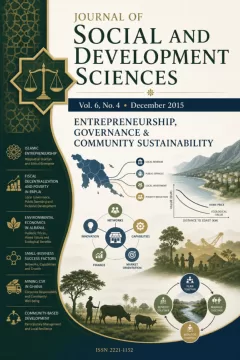 Vol. 6 No. 4 (2015)
Entrepreneurship, Governance & Community Sustainability
View issue contents
Published
Submissions
Have research to publish? Journal of Social and Development Sciences welcomes submissions.
Make a Submission