Abstract
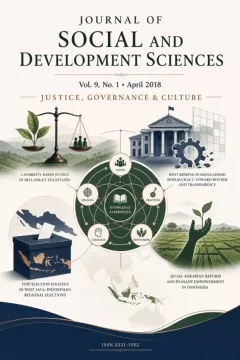
This article introduces the concept of quasi agrarian reform and critique of the de Soto theory of formal property. According to writer, agrarian reform, both redistribution and legalization of assets, must be run in Indonesia. The Indonesian government follows the de Soto theory by implementing the Farmers Empowerment Program. The objective of the quasi agrarian reform program is to encourage farmers to take credit in banks provided by the Government under the scheme Credit for the People (KUR).The importance of agrarian reform in Indonesia to empower farmers to solve various structural problems, such as poverty, unemployment and inequality. Implementation of an asset legalization program in this paper is called quasi agrarian reform, not in line with the original aspirations. Farmers prefer security in possession of land while the government wants it further that is the willingness of farmers to pledge their land in banks.
Keywords
- Quasi-agrarian Reform Search this journal for Quasi-agrarian Reform (opens in a new tab)
- Agrarian Reform Search this journal for Agrarian Reform (opens in a new tab)
- Peasant Empowerment Search this journal for Peasant Empowerment (opens in a new tab)
- Agrarian Conflict Search this journal for Agrarian Conflict (opens in a new tab)
- Impoverishment of Peasant Search this journal for Impoverishment of Peasant (opens in a new tab)
References
- ATR/BPN, K. (2016). Laporan Akuntabilitas Kinerja Instansi Pemerintah Kementrian ATR/BPN Tahun 2015 (Performance Report of Government Institution Ministry of ATR / BPN Year 2015). Kementrian ATR/BPN. Jakarta
- Binswanger-Mkhize, H. P. (2014). From Failure to Success in South African Land Reform. African Journal of Agricultural and Resource Economics, 9(4), 253-269.
- BPS. (2016). Indikator Kesejahteraan Rakyat 2015 (Indicator of People's Welfare 2015). BPS. Jakarta
- FAO. (1981). The Peasants' Charter. FAO. Rome
- Feder, K. D. (2009). Land Registration, Governance, and Development: Evidence and Implication for Policy. World Bank Research Observer, 1(1), 233-266.
- Friedman, J. (1992). Empowerment: The Politics of Alternatif Development. Blackwell. Cambridge
- Groenewald, J. A. (2004). Conditions for Successful Land Reform in Africa. South African Journal of Economic and Management Sciences, 7(4), 673-704.
- Ife, J. & Tesoriero, F. (2006). Community Development: Community-Based Alternatives in an age of Globalisation. Pearson Education. Ottawa
- Jacobs, S. (2010). Agrarian Reform. Current Sociology, 61(5-6), 862-885.
- Jhingan, M. (2012). Ekonomi Pembangunan dan Perencanaan (Economic Development and Planning). PT RajaGrafindo Persada. Jakarta
- Jones, D. S. (2010). Landregistration and Administrative Reform in Southeast Asian States: Progress and Constrains. International Public Management Review, 11(1), 67-89
- Kementan (2014). Statistik Lahan Pertanian Tahun 2009-2013 (Agricultural Land Statistics Year 2009-2013). Pusat Data & Sistem Informasi Kementan. Jakarta
- Neuman, W. L. (2014). Metode Penelitian Sosial: Pendekatan Kualitatif dan Kuantitatif (Social Research Methods: Qualitative and Quantitative Approaches). PT. Indeks. Jakarta
- NK Agustin, J. F. (2012). Sertipikasi Lahan Pertanian Mendorong Peningkatan Produksi Pangan (Agricultural Land Certification Encourages Increased Food Productions). Litbang Pertanian. Jakarta
- Tontteh, E. O. & Omirin, M. M. (2015). Land Registration Within the Framework of Land Aministration Reform in Lagos State. Pasific Rim Property of Recearch Journal, 21(2), 161-177.
- Puswanhari, D. S. (2012). Faktor-Faktor Dominan Pemanfaatan Sertifikat Tanah Sebagai Jaminan Kredit Perbankan oleh UMK (Dominant Factors of Utilization of Land Certificate as Credit Guarantee Banking by MSEs). Universitas Indonesia. Jakarta.
- Rahman, N. F. (2012). Land Reform dari Masa ke Masa (Land Reform from Time to Time). Tanah Air Beta. Yogyakarta.
- Soto, H. D. (2006). The Mystery of Capital: Rahasia Kejayaan Kapitalisme Barat. Qalam. Jakarta
- Winoto, J. (2013). Reforma Agraria di Indonesia, Bunga Rampai (Agrarian Reform in Indonesia). Worldpress. Yogyakarta.
- Wiradi, G. (2000). Reforma Agraria Perjalanan yang Belum Berakhir (Agrarian Reform Unfinished Journey). Insist. Yogyakarta.
- Tuma, E. T. (1966). Twenty-Six Centuries of Agrarian Reform: A Comparative Analysis. University of California Press. California.
Downloads
No downloads have been recorded for this article yet. Figures appear here once readers begin downloading the full text.
How to Cite
Share this article
License
Copyright (c) 2018 Af Sigit Rochadi (Author)

This work is licensed under a Creative Commons Attribution 4.0 International License.
Author (s) should affirm that the material has not been published previously. It has not been submitted and it is not under consideration by any other journal. At the same time author (s) need to execute a publication permission agreement to assume the responsibility of the submitted content and any omissions and errors therein. After submission of revised paper in the light of suggestions of the reviewers, the editorial team edits and formats manuscripts to bring uniformity and standardization in published material.
This work will be licensed under Creative Commons Attribution 4.0 International (CC BY 4.0) and under condition of the license, users are free to read, copy, remix, transform, redistribute, download, print, search or link to the full texts of articles and even build upon their work as long as they credit the author for the original work. Moreover, as per journal policy author (s) hold and retain copyrights without any restrictions.
Keywords
- Quasi-agrarian Reform Search this journal for Quasi-agrarian Reform (opens in a new tab)
- Agrarian Reform Search this journal for Agrarian Reform (opens in a new tab)
- Peasant Empowerment Search this journal for Peasant Empowerment (opens in a new tab)
- Agrarian Conflict Search this journal for Agrarian Conflict (opens in a new tab)
- Impoverishment of Peasant Search this journal for Impoverishment of Peasant (opens in a new tab)
Section
Published
Submissions
Have research to publish? Journal of Social and Development Sciences welcomes submissions.
Make a Submission