Abstract
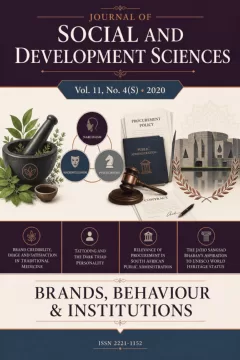
There are several displays commonly labeled as body modifications, including body piercings, scarification, tattoos, cutting, etc. In this study, we were focused on one distinct form of body modification, namely tattoos. The current exploratory study investigated the connection between body modifications (BM) and Dark Triad personality for a sample of 77 university students with BM, compared to a control group of 77 non-BM individuals. Three self-administrated questionnaires were used to collect the data: Self-Report Psychopathy Scale-Short Form, Mach-IV scale, and Narcissistic Personality Inventory. The findings suggest that subclinical psychopathy is most strongly connected to body modifications. An increased number of tattoos was also significantly correlated with a higher level of anti-sociality. Participants with visible body modifications had significantly higher affective callousness and overall self-reported subclinical psychopathy levels, compared with individuals with non-visible alterations.
Keywords
- Body Modifications Search this journal for Body Modifications (opens in a new tab)
- Narcissism Search this journal for Narcissism (opens in a new tab)
- Dark Triad Search this journal for Dark Triad (opens in a new tab)
- Subclinical Psychopathy Search this journal for Subclinical Psychopathy (opens in a new tab)
- Machiavellianism Search this journal for Machiavellianism (opens in a new tab)
- Tattoo Search this journal for Tattoo (opens in a new tab)
References
- Baumeister, R. F. (1997). Identity, self-concept and self-esteem. In R. Hogan, J. Johnson, & S. Briggs, Handbook of personality psychology (pp. 681-710). San Diego.
- Braithwaite, R., Robillard, A., Woodring, T., Stephens, T. & Arriola, K. J. (2001). Tattooing and body piercing among adolescent detainees: Relationship to alcohol and other drug use. Journal of Substance Abuse, 13(1-2), 5-16.
- Brooks, T. L., Woods, E. R., Knight, J. R. & Shrier, L. A. (2003). Body modification and substance use in adolescents: is there a link? Journal of Adolescent Health, 32(1), 44-49.
- Bui, E., Rodgers, R., Cailhol, L., Birmes, P., Chabrol, H. & Schmitt, L. (2010). Body piercing and psychopathology: a review of the literature. Psychotherapy and psychosomatics, 79(2), 125-129.
- Caliendo, C., Armstrong, M. L. & Roberts, A. E. (2005). Self-reported characteristics of women and men with intimate body piercings. Journal of Advanced Nursing, 49(5), 474-484.
- Caroll, S. T., Riffenburg, R. H. & Myhre, E. B. (2002). Tattoos and body piercing as indicators of adolescent risk-taking behaviors. Pediatrics, 109(6), 1021-1027.
- Christie, R. & Geis, F. L. (1970). Studies in Machiavellianism. New York: Academic Press.
- Cipolletta, S., Faccio, E. & Berardi, S. (2010). Body piercing: does it modify self-construction? A research with repertory grids. Personal Construct Theory and Practice, 7, 85-95.
- Degelmen, D. & Price, N. D. (2002). Tattoos and ratings of personal characteristics. Psychological Reports, 90, 507-514.
- DeMello, M. (2003). Bodies of Inscription: A cultural history of the modern tattoo community. Duke: Duke University Press.
- Deschesnes, M., Fines, P. & Demers, S. (2006). Are Tattooing and Body Piercing Indicators of Risk-Taking Behaviours Among High School Students? Journal of Adolescence, 29(3), 379-393.
- Doss, K. & Ebesu Hubbard, A. S. (2009). The communicative value of tattoos: The role of public selfconsciousness on tattoo visibility. Communication research reports, 26(1), 62-74.
- Emmons, R. A. (1984). Factor analysis and construct validity of the Narcissistic Personality Inventory. Journal of Personality Assessment, 48(3), 291-300.
- Favazza, A. R. (1996). Bodies under siege: Self-mutilation and body modification in culture and psychiatry. Baltimore, MD: The John Hopkins University Press.
- Forbes, G. B. (2001). College students with tattoos and piercing: Motives, family experiences, personality factors, and perceptions by others. Psychological Reports, 89, 774-786.
- Furnham, A., Richards, S. C. & Paulhus, D. L. (2013). The Dark Triad of Personality: A 10-year review. Social and Personality Psychology Compass, 7(3), 199-216.
- Gordts, S., Uzieblo, K., Neumann, C., Van den Bussche, E. & Rossi, G. (2017). The validity of the Self-Report Psychopathy Scale (SRP-III Full and Short Versions) in a Community Sample. Assessment, 24(3), 308-325.
- Jackson, L. A., Ervin, K. S. & Hodge, C. N. (1992). Narcissism and body image. Journal of Research in Personality, 26(4), 357-370.
- Jones, D. N. & Paulhus, D. L. (2009). Machiavellianism. In M. R. Leary, & R. H. Hoyle, Handbook of Individual Differences in Social Behavior (pp. 93-108). New York: Guilford.
- Kaufman, S. B., Yaden, D. B., Hyde, E. & Tsukayama, E. (2019). The Light vs. Dark Triad of Personality: Contrasting two very different profiles of human nature. Frontiers in psychology, 10, 467.
- Lipowska, M. & Lipowski, M. (2015). Narcissism as a moderator of satisfaction with body image in young women with extreme underweight and obesity. PLoS ONE, 10(5).
- Meyer, H. D. (1992). Norms and self-interest in ultimatum bargaining: The prince's prudence. Journal of Economic Psychology, 13(2), 215-232.
- Myers, J. (1992). Nonmainstream body modification: Genital piercing, branding & cutting. Journal of Contemporary Ethnography, 21(3), 267-306.
- Nathanson, C., Paulhus, D. L. & Williams, K. M. (2006). Personality and misconduct correlates of body modification and other cultural deviance markers. Journal of Research in Personality, 40(5), 779-802.
- Paulhus, D. L. & Williams, K. M. (2002). The Dark Triad of personality: Narcissism, Machiavellianism, and psychopathy. Journal of Research in Personality, 36(6), 556-563.
- Paulhus, D. L., Neumann, C. S. & Hare, R. (in press). Manual for the Hare Self-Report Psychopathy Scale. Toronto: Multi-Health Systems.
- Post, R. S. (1968). The Relationship of Tattoos to Personality Disorders. The Journal of Criminal Law, Criminology, and Police Science, 59(4), 516-524.
- Raskin, R. N. & Hall, C. S. (1979). A Narcissistic Personality Inventory. Psychological Reports, 590.
- Raskin, R. N. & Hall, C. S. (1981). The Narcissistic Personality Inventory: alternative form reliability and further evidence of construct validity. Journal of personality assessment, 45(2), 159-162.
- Raspa, R. F. & Cusack, J. (1990). Psychiatric implications of tattoos. American Family Physician, 41(5), 1481-1486.
- Riopka, S. J., Coupland, R. & Olver, M. E. (2015). Self-reported psychopathy and its association with criminal cognition and antisocial behavior in a sample of university undergraduates. Canadian Journal of Behavioral Science/ Revue Canadienne des sciences du comportement, 47(3), 216-225.
- Roberts, T. A., Auinger, P. & Ryan, S. A. (2004). Body piercing and high-risk behavior in adolescents. Journal of Adolescent Health, 34(3), 224-229.
- Romanienko, L. A. (2011). Nonverbal Communication. Body Piercing and Identity Construction: A Comparative Perspective. New York: Wroclaw.
- Rooks, J. K., Roberts, D. J. & Scheltma, K. (2000). Tattoos: the relationship to trauma, psychopathology and other myths. Minnesota Medicine, 83(7), 24-27.
- Stirn, A., Hinz, A. & Brahler, E. (2006). Prevalence of tattooing and body piercing in Germany and perception of health, mental disorders, and sensation seeking among tattooed and body-pierced individuals. Journal of Psychosomatic Research, 60(5), 531-534.
- Swami, V. & Furnham, A. (2007). Unattractive, promiscuous, and heavy drinkers: Perceptions of women with tattoos. Body Image, 4, 343-352.
- Swami, V., Gaughan, H., Tran, U. S., Kuhlmann, T., Stieger, S. & Voracek, M. (2015). Are tattooed adults really more aggressive and rebellious than those without tattoos? Body image, 15, 149-152.
- Tate, J. C. & Shelton, B. L. (2008). Personality correlates of tattooing and body piercing in a college sample: The kids are alright. Personality and Individual Differences, 45(4), 281-285.
- Von Wiederhold, M. W. (1995). Piercing the body: A symbolic voice, a psychoanalytic view of contemporary body modification. Doctoral dissertation. Berkeley, California: Wright Institute Graduate School of Psychology.
- Wohlrab, S., Stahl, J., Rammsayer, T. & Kappeler, P. M. (2007). Differences in personality characteristics between body-modified and non-modified individuals: associations with individual personality traits and their possible evolutionary implications. European Journal of Personality, 21(7), 931-951.
Downloads
No downloads have been recorded for this article yet. Figures appear here once readers begin downloading the full text.
How to Cite
Share this article
License
Copyright (c) 2021 Dan Florin Stanescu, Marius C. Romascanu (Author)

This work is licensed under a Creative Commons Attribution 4.0 International License.
Author (s) should affirm that the material has not been published previously. It has not been submitted and it is not under consideration by any other journal. At the same time author (s) need to execute a publication permission agreement to assume the responsibility of the submitted content and any omissions and errors therein. After submission of revised paper in the light of suggestions of the reviewers, the editorial team edits and formats manuscripts to bring uniformity and standardization in published material.
This work will be licensed under Creative Commons Attribution 4.0 International (CC BY 4.0) and under condition of the license, users are free to read, copy, remix, transform, redistribute, download, print, search or link to the full texts of articles and even build upon their work as long as they credit the author for the original work. Moreover, as per journal policy author (s) hold and retain copyrights without any restrictions.
Keywords
- Body Modifications Search this journal for Body Modifications (opens in a new tab)
- Narcissism Search this journal for Narcissism (opens in a new tab)
- Dark Triad Search this journal for Dark Triad (opens in a new tab)
- Subclinical Psychopathy Search this journal for Subclinical Psychopathy (opens in a new tab)
- Machiavellianism Search this journal for Machiavellianism (opens in a new tab)
- Tattoo Search this journal for Tattoo (opens in a new tab)
Section
Published
Submissions
Have research to publish? Journal of Social and Development Sciences welcomes submissions.
Make a Submission