Abstract
Youth participation in public policies such as the employment policy process has gained prominence in academic and policy literature. Despite this, research on youth participation in the employment policy process has received little attention in Ghana. This paper draws on documentary analysis to unlock the challenging pathways of youth participation in Ghana’s youth employment and entrepreneurial development agency. The paper finds that a web of challenges such as insufficient access to information, overpoliticization of GYEEDA, poor level of coordination of stakeholders, and prevalence of diversity and social exclusion are embedded in obstructing the youth participation in GYEEDA. The study recommends that policymakers such as the government and other stakeholders should provide adequate measures to ensure that beneficiaries such as the youths are engaged in the design, formulation, and execution of the youth employment policy process in Ghana.
Keywords
- Youth Search this journal for Youth (opens in a new tab)
- Participation Search this journal for Participation (opens in a new tab)
- Employment Search this journal for Employment (opens in a new tab)
- Policy Formulation Search this journal for Policy Formulation (opens in a new tab)
- Policy Implementation Search this journal for Policy Implementation (opens in a new tab)
References
- African Union. (2011). African youth decade 2009-2018 Plan of Action: Accelerating youth empowerment for sustainable development. Addis Ababa, Ethiopia.
- Bessant, J. (2018). Young precariat and new work order? A case for historical sociology. Journal of Youth Studies, 1-19.
- Brown, V. & Paulus, P. (2002). Current perspectives and directions in making group brainstorming more effective recommendations from associative memory. Psychological Science , 11(6), 208-212.
- Busse, B., Hashem-Wangler, A. & Tholen, J. (2015). Two worlds of participation: Young people and politics in Germany. The Sociological Review , 63(2), 118–140.
- Chamisa, S. F. & Shava, E. (2016). Youth Involvement in Policy Making: A Case Study of South Africa. Journal of Social Sciences , 49(2), 165–174.
- Checkoway, B. (1998). Involving young people in neighborhood development. Children and Youth Services Review , 20, 765-795.
- Côté, J. E. (2014). Towards a new political economy of youth. Journal of Youth Studies, 17(4), 527–543.
- Dalton, R. J. (2017). The participation gap: Social Status and political inequality. Oxford University Press.
- Deutsch, M. (1962). Cooperation and trust: Some theoretical notes. In J. R. Jones, Nebraska symposium on motivation. Lincoln, NE: University of Nebraska Press.
- Dowding, K. (1996). Power. Buckingham: Open University Press.
- Economic Commission for Africa. (2011). African youth report: Addressing youth education and employment nexus in the new global economy. Addis Ababa: Ethiopia. United Nations Economic Commission for Africa.
- Falls, I., Bahhouth, V., Chuang, C. M. & Bahhouth, J. (2014). Factors influencing students’ perceptions of online teamwork. SAGE Open.
- Gaiser, W., ve, J. D. & Spannring, R. (2010). Youth and political participation, empirical results for Germany within a European context. Nordic Journal of Youth Research, 18(4), 427-450.
- Ghana Statistical Service. (2014). Ghana living standard survey round 6 (GLSS6). Accra, Ghana: Labour Force Report.
- Ghana Statistical Service. (2012). 2010 Population & housing census national analytical report. Accra, Ghana.
- Gough, K. V., Langevang, T. & Owusu, G. (2013). Youth employment in a globalizing world.). International Development Planning Review , 35(2), 91–102.
- Grauenkaer, L. & Tufte, T. (2018). Development in practice youth-led communication for social change: Empowerment, citizen media, and cultures of governance in Northern Ghana Development in Practice , 28(3), 400–413.
- Greetje, T. (2009). Youth policy and participation. Children and Youth Services Review, 31(5), 572-596.
- Gutmann, A. & Thompson, D. (2004). Why Deliberative Democracy. New Jersey: Princeton University Press.
- Gyampo, R. E. (2015). Youth in parliament and youth representation in Ghana. Journal of Asian and African Studies , 50(1), 69 –82.
- Gyampo, R. E. & Debrah, E. (2012). The youth and party manifesto. The case of the 2012 General Elections, Journal of African Elections, 12(2), 96–114.
- Gyampo, R. & Debrah, E. (2012). The youth and party manifesto. The case of the 2012 General Elections. Journal of African Elections , 12(2), 96-114.
- Gyampo, R. & Obeng-Odoom, F. (2013). Youth participation in local and national development in Ghana. Journal of Pan African Studies , 5(9), 129-150.
- Hart, J. & Henn, M. (2017). Neoliberalism and the unfolding patterns of young people’s political engagement and political participation in contemporary Britain. Societies , 7(4), 33.
- Johnson, D. W. & Johnson, R. T. (2010). New developments in social interdependence theory new developments in social interdependence theory. Genetic, Social, and General Psychology Monographs, 131(4), 285–358.
- Langevang, T. (2008). Claiming place: The production of young men's street meeting places in Accra, Ghana. Geografiska Annaler: Series B, Human Geography, 90(3), 227–242.
- Malley, K. (2005). Children and young people participating in PRSP processes – Lessons from Save the Children’s Experience. London: Save the Children.
- Ministry of Youth and Sports. (2013). National youth policy of Ghana: Towards an empowered youth, impacting positively on national development. Accra-Ghana: Accra Printing.
- Molloy, D., White, C. & Hosfield, N. (2002). Understanding youth participation in local government a qualitative study final report. National Centre for Social Research , 78(21), 71-98.
- Mycock, A. & Tonge, J. (2012). The party politics of youth citizenship and democratic engagement. Parliamentary Affairs, 65(1), 138–161.
- NDPC. (2010). Report on the status of the youth benefits from the youth employment programs in Ghana. Accra-Ghana.
- O’Toole, T. (2015). Beyond crisis narratives: Changing modes and repertoires of political participation among young people. In K. Kallio, S. Mills, & T. Skelton, Politics, citizenship and rights. Singapore: Springer.
- Patton, M. Q. (2002). Qualitative research and evaluation methods (3rd ed.) CA: Thousand Oaks Sage.
- Percy-Smith, B. & Thomas, N. (2009). A handbook of children and young people’s participation. Oxford: Routledge.
- Sloam, J. (2016). Diversity and voice: The political participation of young people in the European Union. The British Journal of Politics and International Relations , 18(3), 521–537.
- Tarricone, P. & Luca, J. (2010). Employees, teamwork, and social interdependence- a formula for a successful business? Team Performance Management. An International Journal , 8(3/4), 54–59.
- Tsekoura, M. (2016). Debates on Youth Participation: From Citizens Preparation to Active Social Agents. Rev. Katalysis , 19(1), Florianopolis.
- UNESCO. (2004). Empowering Youth through National Policies. Paris.
- United Nations. (2007). World youth report: Young people’s transition to adulthood: Progress and challenges. Department of Economic and Social Affairs [DESA] New York, USA.
- United Nations. (2003). World youth report: the global situation of young people. Department of Economic and Social Affairs [DESA]: New York, USA.
Downloads
No downloads have been recorded for this article yet. Figures appear here once readers begin downloading the full text.
How to Cite
Share this article
License
Copyright (c) 2021 Edward Brenya, Dominic Degraft Arthur, Janet Nyarko (Author)

This work is licensed under a Creative Commons Attribution 4.0 International License.
Author (s) should affirm that the material has not been published previously. It has not been submitted and it is not under consideration by any other journal. At the same time author (s) need to execute a publication permission agreement to assume the responsibility of the submitted content and any omissions and errors therein. After submission of revised paper in the light of suggestions of the reviewers, the editorial team edits and formats manuscripts to bring uniformity and standardization in published material.
This work will be licensed under Creative Commons Attribution 4.0 International (CC BY 4.0) and under condition of the license, users are free to read, copy, remix, transform, redistribute, download, print, search or link to the full texts of articles and even build upon their work as long as they credit the author for the original work. Moreover, as per journal policy author (s) hold and retain copyrights without any restrictions.
Keywords
- Youth Search this journal for Youth (opens in a new tab)
- Participation Search this journal for Participation (opens in a new tab)
- Employment Search this journal for Employment (opens in a new tab)
- Policy Formulation Search this journal for Policy Formulation (opens in a new tab)
- Policy Implementation Search this journal for Policy Implementation (opens in a new tab)
Section
Published in
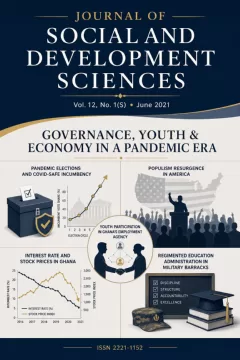 Vol. 12 No. 1(S) (2021)
Governance, Youth & Economy in a Pandemic Era
View issue contents
Published
Submissions
Have research to publish? Journal of Social and Development Sciences welcomes submissions.
Make a Submission