Abstract
Over the last five years, there has been a downward trend in the BECE performance by pupils in the Basic schools of military barracks in Ghana. The military high command has been concerned about the current performance of pupils in the BECE, and the responsibility lies with the Directorate of Education of the Ghana Armed forces to undertake all efforts at reversing the tide. The study is predicated upon the need to explore all possible causes of a consistent downward trend of BECE performance over the past five years. It is speculated that in the case of the Armed Forces schools, the quality of education could either be significantly enhanced or diminished by the peculiarity of the administration. Thus, the study quantitatively examined the place of military culture as a part of the administration and how the phenomenon impacts academic performance. The findings revealed that not only does military culture impact teacher work output, but the coercive nature of the relationship between the Educational Officers and civilian teaching staff is detrimental to the academic environment. Therefore, this paper recommends that the coercive administrative approach be modified to allow for a much more cooperative and social approach, which would create a conducive and free environment for academic work and consequently improve academic performances.
Keywords
- Academic Performances Search this journal for Academic Performances (opens in a new tab)
- Regimented Administrative Structures Search this journal for Regimented Administrative Structures (opens in a new tab)
- Administrative Approach Search this journal for Administrative Approach (opens in a new tab)
- Civilmilitary Relations Search this journal for Civilmilitary Relations (opens in a new tab)
References
- Abudu, A. M. & Fuseini, M. N. (2013). Influence of Single Parenting on Pupils’ Academic Performance in Basic Schools in the Wa Municipality. International Journal of Education Learning and Development, 1(2).
- Agyemang, D. K. (2009). Sociology of Education for African Students. Black Mask, Accra, Ghana.
- Akanle, O. B. (2007). Socio-Economic Factors Influencing Students Academic Performance in Nigeria. Some Explanation from a Local Survey. Sociology and Social work community.
- Anamuah-Mensah, J. (2010). Response to Daily Graphic Publication.
- Asikhia, O. A. (2010). Students and Teachers' Perception of the Causes of Poor academic performance in Secondary Schools: Implications for Counselling for National Development. European Journal of Social Sciences, 13(2).
- Augustine, N. (Augustine's Laws and Major System Development Programs). (1983). New York: American Institute of Aeronautics and Astronautics, Inc.
- Breslin, C. (2000). Organizational Culture and the Military. United States Army War College, Carlisle Barracks, PA.
- Chukwuka, F. O. (2018). Impact of Single Parent on Child Education in Primary. International Journal of Innovative Education Research, 6(1), 101-107.
- Davis-Kean, P. E. (2005). The Influence of Parent Education and Family Income on Child Achievement: The Indirect Role of Parental Expectations and the Home-environment. Journal of Family Psychology , 19(2).
- Diaz, A. (2003). Personal, Family and Academic Factors Affecting Low Achievement in Secondary School. . Electronic Journal of Research in Educational Psychology and Psycho-pedagogy, 1(1).
- Donkor, F. (2010). The comparative instructional effectiveness of print-based and video-based instructional materials for teaching practical skills at a distance. The International Review of Research in Open and Distributed Learning, 11(1), 96-116.
- Etsey, Y., Amedahe, F. & Edjah, K. (2005). Do private primary schools perform better than public schools in Ghana? Unpublished paper. Department of Educational Foundations, University of Cape Coast, Cape Coast.
- Eweniyi, G. D. (2010). The Impact of Family Structure on University Students' Academic Performance. Olabisi Onabamijo University, Ago-lwoye, Farooq.
- Gang, L., Wei, C. & Jing-Lin, D. (2010). Determinants of International Students' Academic Performance: A Comparison Between Chinese and Other International Students. (2010). Journal of Studies in International Education - J STUD INT EDUC, 14(10), 389-405.
- Gordon, G. (1985). The Relationship of Corporate Culture to Industry Sector and Corporate Performance. Gaining Control of the Corporate Culture. San Francisco: Jossey-Bass, 103-125.
- Hofstede, G., Neuijen, B., Ohayv, D. D. & Sanders, G. (1990). Measuring organizational cultures: A qualitative and quantitative study across twenty cases. Administrative Science Quarterly, 35(2), 286–316.
- Humble, S. & Dixon, P. (2017). The effects of schooling, family and poverty on children’s attainment, potential and confidence-Evidence from Kinondoni, Dar es Salaam, Tanzania. International Journal of Educational Research, 83, 94-106.
- Kober, N. (2001). It takes more than testing: Closing the achievement gap. Washington, DC: Center on Education Policy.
- Krein, S. F. & Beller, A. H. (2011). Educational Attainment of Children from Single-Parent Families: Differences by Exposure, Gender, and Race. Demography, 25(2), 221–234.
- MacNeil, A. & Maclin, V. (2005). Building a Learning Community: The Culture and Climate of Schools.
- McDowall, P. & Schaughency, E. (2017). Elementary school–parent engagements: Relations with education perceptions and school characteristics. Journal of Educational Research, 110(4), 348-365.
- Munje, P. & Mncube, V. (2018). The lack of parent involvement as hindrance in selected public primary schools in South Africa: The voices of educators. Perspectives in Education, 80-93.
- Muodumogu, C. A. (2014). Evaluation of School and Home Strategies for Literacy Development of Beginning Readers in the North Central Zone of Nigeria. European Journal of Educational Sciences.
- O'Reilly, C., Chatman, J. & Caldwell, D. (1991). People and Organizational Culture: A Profile Comparison Approach to Assessing Person-Organization Fit. Academy of Management Journal.
- Pong, S., Dronkers, J. & Hampden-Thompson, G. (2011). Family Policies and Children’s School Achievement in Single- Versus Two-Parent Families. Journal of Marriage and Family, 65(3), 671–688.
- Riccio, G. (2010). Passion and Reason in Values-Based Learning & Development. In G. Riccio, F. Diedrich, & M. Cortes, An initiative in Outcomes-Based Training and Education: Implication for an Integrated Approach to Values-Based Requirements (pp. 119-137). Fort Meade: U.S. Army Asymmetric Warfare Group.
- Riccio, G., Sullivan, R., Klein, G., Salter, M. & Kinnison, H. (2004). Warrior ethos: Analysis of the concept and initial development of applications. Arlington, VA: ARI Research Report 1827: US Army Research Institute for the Behavioral Sciences.
- Snider, D. (1999). An Uninformed Debate on Military Culture. Orbis , 42(1), 10-27.
- Soeters, J. (2018). Militaries’ Organizational Cultures in a Globalizing World. Oxford Research Encyclopedias, Politics.
- Tuttle, T. (2010). Family Background, Locality, and the Influence on SAT Scores for Indiana Class of Hoosier Briefs. Hoosier Briefs, No. 2.
- Ushie, M. A., Emeka, J. O., Ononga, G. I. & Owolabi, E. O. (2012). Influence of Family Structure on Students Academic Performance in Agege Local Government Area, Lagos State, Nigeria. European Journal of Educational Studies, 4(2), 177–187.
- Wilson, P. (2008). Defining Military Culture. The Journal of Military History, 72(1), 11-41.
- Win, R. & Miller, P. W. ( 2010). The Effects of Individual and School Factors on University Students’ Academic Performance. Centre for Labour Market Research, University of Western Australia.
- Yamane, T. (1997). Statistics: An Introductory Analysis, 2nd Ed.,. New York: Harper and Row.
Downloads
No downloads have been recorded for this article yet. Figures appear here once readers begin downloading the full text.
How to Cite
Share this article
License
Copyright (c) 2021 Edward Brenya, Dominic Degraft Arthur, Raymond Opoku, Sylvester Atta Andam (Author)

This work is licensed under a Creative Commons Attribution 4.0 International License.
Author (s) should affirm that the material has not been published previously. It has not been submitted and it is not under consideration by any other journal. At the same time author (s) need to execute a publication permission agreement to assume the responsibility of the submitted content and any omissions and errors therein. After submission of revised paper in the light of suggestions of the reviewers, the editorial team edits and formats manuscripts to bring uniformity and standardization in published material.
This work will be licensed under Creative Commons Attribution 4.0 International (CC BY 4.0) and under condition of the license, users are free to read, copy, remix, transform, redistribute, download, print, search or link to the full texts of articles and even build upon their work as long as they credit the author for the original work. Moreover, as per journal policy author (s) hold and retain copyrights without any restrictions.
Keywords
- Academic Performances Search this journal for Academic Performances (opens in a new tab)
- Regimented Administrative Structures Search this journal for Regimented Administrative Structures (opens in a new tab)
- Administrative Approach Search this journal for Administrative Approach (opens in a new tab)
- Civilmilitary Relations Search this journal for Civilmilitary Relations (opens in a new tab)
Section
Published in
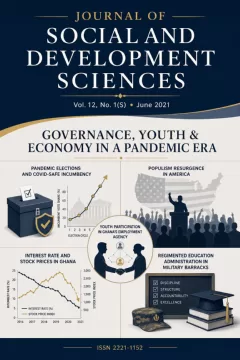 Vol. 12 No. 1(S) (2021)
Governance, Youth & Economy in a Pandemic Era
View issue contents
Published
Submissions
Have research to publish? Journal of Social and Development Sciences welcomes submissions.
Make a Submission