Abstract
Populism in the twenty-first century became prominent in scholarly circles following Brexit and the 2016 electoral victory of Donald Trump. As democracy and globalization enthusiasts least anticipated these two monumental events in modern history, much emphasis came to be placed on the nature of populism and what conditions led to its manifestation in contemporary times. Working within this background, this study aims to review the ideational, political strategy and discursive approaches to the populism phenomenon and unpack the relative utility of each approach. I offer a thoughtful perspective that while the ideational approach’s “thin-centered” strand has the tendency to blur the boundaries of populism and lead scholars to accept “anything” as populism; it nevertheless enables us to comprehensively capture populism usage in multiple contexts. Further, I advance the notion that the 2020 electoral defeat of Donald Trump should not be misconstrued as the end or weakening of right-wing populism; the present state of American politics makes it ripe for populism resurgence.
Keywords
- Populism Search this journal for Populism (opens in a new tab)
- Ideational Approach Search this journal for Ideational Approach (opens in a new tab)
- Democracy Search this journal for Democracy (opens in a new tab)
- Elections Search this journal for Elections (opens in a new tab)
- Policy Search this journal for Policy (opens in a new tab)
References
- Acemoglu, D., Egorov, G. & Sonin, K. (2011). A Political Theory of Populism. NBER Working Papers 17306. National Bureau of Economic Research, Inc. DOI: https://doi.org/10.3386/w17306
- Alomran, I. & Winter, E. (2021). Trump’s approval rating dropping among Independents, Republicans. Data for Progress. https://www.dataforprogress.org/blog/2021/1/13/trumps-approval-rating-droppingamong-independents-republicans
- Arter, D. (2010). The breakthrough of another West European populist radical right party? The case of the True Finns. Government and Opposition , 45(4), 484–504. DOI: https://doi.org/10.1111/j.1477-7053.2010.01321.x
- Aslanidis, P. (2016). Is populism an ideology? A refutation and a new perspective. Political Studies , 64(1_supple), 88–104. DOI: https://doi.org/10.1111/1467-9248.12224
- Barr, R. R. (2018). Populism as a political strategy. In Routledge handbook of global populism (pp. 44–56). Routledge. DOI: https://doi.org/10.4324/9781315226446-4
- Bokat-Lindell, S. (2021). Why Can’t the Republican Party Quit Donald Trump? New York Times. https://wwwnytimes-com.udel.idm.oclc.org/2021/05/18/opinion/cheney-trump-republicans.html
- Bonikowski, B. & Gidron, N. (2016). The populist style in American politics: Presidential campaign discourse, 1952-1996. Social Forces , 94(4), 1593–1621. DOI: https://doi.org/10.1093/sf/sov120
- Bradner, E. & Warren, M. (2021, March 26). Mike Pompeo visits Iowa as Republicans start to position themselves for 2024. CNN. https://www.cnn.com/2021/03/26/politics/mike-pompeo-iowa- trip/index.html
- Brubaker, R. (2017). Why populism. Theory and Society , 46(5), 357–385. DOI: https://doi.org/10.1007/s11186-017-9301-7
- Calhoun, C. (2017). Populism, national and Brexit. Brexit: Sociological Responses, 57–76. DOI: https://doi.org/10.1177/1468795X17729233
- Cheeseman, N. & Larmer, M. (2015). Ethnopopulism in Africa: Opposition mobilization in diverse and unequal societies. Democratization , 22(1), 22–50. DOI: https://doi.org/10.1080/13510347.2013.809065
- Colvin, J. (2021). Republican 2024 presidential hopefuls are making early moves as Trump mulls another run. Chicago Tribune. https://www.chicagotribune.com/nation-world/ct-aud-nw-republican-2024presidential-candidates-20210418-4thphwda55dkbivarabl7zp6fe-story.html
- Donatelli, F. (2021, January 20). Trump Has Left the Building. Now the GOP Must Move On From HIm-Fast. Newsweek. https://www.newsweek.com/trump-has-left-building-now-gop-must-move-himfastopinion-1562810
- Dorman, J. (2021, April 17). A nicer version of Trump: Ron DeSantis is sized up by GOP donors ahead of potential 2024 presidential bid. Insider. https://www.businessinsider.com/desantis-trumprepublican-donors-2024-presidential-talk-2021-4
- EFF. (2013). Economic Freedom Fighters Founding Manifesto: Radical Movement towards Economic Freedom in our Lifetime. https://effonline.org/wp-content/uploads/2019/07/FoundingManifesto.pdf
- Esen, B. & Yardımcı-Geyikçi, Ş. (2019). An Alternative Account of the Populist Backlash in the United States: A Perspective from Turkey. PS: Political Science & Politics , 53(3), 445–450. DOI: https://doi.org/10.1017/S1049096519000180
- Finchelstein, F. (2019). From Fascism to populism in history. University of California Press. DOI: https://doi.org/10.1525/9780520974302
- Forgey, Q. (2021, March 4). Pompeo teases 2024 run: I’m always up for a good fight. Politico. https://www.politico.com/news/2021/03/04/pompeo-2024-run-473606
- Galston, W. (2018). A populist challenge to liberal democracy. Journal of Democracy , 29(2), 5–19. DOI: https://doi.org/10.1353/jod.2018.0020
- Gest, J. (2016). The new minority: White working-class politics in an age of immigration and inequality. Oxford University Press.
- Gidron, N. & Bonikowski, B. (2013). Varieties of populism: Literature review and research agenda. Weatherhead Center for International Affairs. https://wcfia.harvard.edu/files/wcfia/files/gidron_bonikowski_populismlitreview_2013.pdf DOI: https://doi.org/10.2139/ssrn.2459387
- Goodhart, D. (2017). The road to somewhere: The populist revolt and the future of politics. Oxford University Press.
- Halon, Y. (2021, February 15). Hume: GOP needs to move away from Trump without alienating his supporters. Fox News. https://www.foxnews.com/media/brit-hume-gop-move-away-from-trumpwithout-alienating-his-supporters
- Harsch, E. (2014). Thomas Sankara: An African Revolutionary. Ohio University Press.
- Hawkins, K. A. (2018). The ideational approach. In Routledge Handbook of Global Populism (pp. 57–72). Routledge. DOI: https://doi.org/10.4324/9781315226446-5
- Hawkins, K. A. & Kaltwasser, C. R. (2018). Introduction: The ideational approach. In The Ideational Approach to Populism: Concept, theory, and analysis (pp. 1–24). Routledge. DOI: https://doi.org/10.4324/9781315196923-1
- Hennessey, M. (2021, March 13). Cancel culture is out of control—And Gen X is our only hope. Fox News. www.foxnews.com/opinion/cancel-culture-is-out-of-control-and-gen-x-is-our-only-hope.amp Heydarian, R. J. (2017). The rise of Duterte: A populist revolt against elite democracy. Springer.
- Jones, J. M. (2021, February 15). Support for Third U.S. Political Party at High Point. GALLUP. https://news.gallup.com/poll/329639/support-third-political-party-high-point.aspx Kazin, M. (1995). The Populist Persuasion: An American History. Cornell University Press.
- Laclau, E. (2005). On populist reason. Verso.
- Lahut, J. (2020, October 21). Tom Cotton is already laying the groundwork in New Hampshire for a 2024 presidential run. Insider. https://www.businessinsider.com/tom-cotton-laying-groundwork-2024presidential-run-new-hampshire-2020-10
- Lahut, J. (2021, April 6). Fox News is betting big on the “cancel culture” wars post-Trump. Insider. www.businessinsider.com/fox-news-cancel-culture-tucker-carlson-gutfeld-new-show-20214%3Famp
- Larmer, M. & Fraser, A. (2007). Of cabbages and Kind Cobra: Populist politics and Zambia’s 2006 election. African Affairs, 106(425), 611–637. DOI: https://doi.org/10.1093/afraf/adm058
- Lendvai, P. (2017). Orbán: Hungary’s Strongman. Oxford University Press.
- Levitsky, S. & Ziblatt, D. (2018). How democracies die. Broadway Books.
- Lipset, S. M. (1959). Some social requisites of democracy: Economic development and political legitimacy. American Political Science Review , 53(1), 69–105. DOI: https://doi.org/10.2307/1951731
- Madrid, R. L. (2008). The rise of ethnopopulism in Latin America. World Politics , 60(3), 475–508. DOI: https://doi.org/10.1017/S0043887100009060
- McCarthy, N. (2018). Historically, The President’s Party Performs Poorly. In the Midterms (Infographic). Forbes. https://www.forbes.com/sites/niallmccarthy/2018/10/09/historically-the-presidentsparty-performs-poorly-in-the-midterms-infographic/?sh=2e9c6b526732
- Moran, L. (2021, April 2). Fox News Host Puts The Blame For “Woke” Military on Michelle Obama. HuffPost. Huffpost.com/us/entry/us_6066dc18c5b68872efe564cc/amp Mounke, Y. (2018). The people vs. Democracy: Why our freedom is in danger and how to save it. Harvard University Press.
- Mouzelis, N. (1985). On the concept of populism: Populist and clientelist modes of incorporation in semiperipheral polities. Politics & Society , 14(3), 329–348. DOI: https://doi.org/10.1177/003232928501400303
- Mudde, C. (2004). The populist zeitgeist. Government and Opposition , 39(4), 541–563. DOI: https://doi.org/10.1111/j.1477-7053.2004.00135.x
- Mudde, C. (2007). Populist radical right parties in Europe (Vol. 22). Cambridge University Press. DOI: https://doi.org/10.1017/CBO9780511492037
- Mudde, C. (2017). An ideational approach. In The Oxford handbook of populism (p. 27). Oxford University Press. DOI: https://doi.org/10.1093/oxfordhb/9780198803560.013.1
- Mudde, C. & Kaltwasser, C. R. (2017). Populism: A very short introduction. Oxford University Press. DOI: https://doi.org/10.1093/actrade/9780190234874.001.0001
- Müller, J. W. (2017). What is populism? Penguin. DOI: https://doi.org/10.9783/9780812293784
- Ndlovu-Gatsheni, S. J. (2009). Making sense of Mugabeism in local and global politics: So Blair, keep your England and let me keep my Zimbabwe. Third World Quarterly , 30(6), 1139–1158. DOI: https://doi.org/10.1080/01436590903037424
- Norris, P. & Inglehart, R. (2019a). Cultural backlash: Trump, Brexit and authoritarian populism. Cambridge University Press.
- Norris, P. & Inglehart, R. (2019b). Cultural backlash: Trump, Brexit, and authoritarian populism. Cambridge University Press. DOI: https://doi.org/10.1017/9781108595841
- Pankowski, R. (2010). The populist radical right in Poland: The patriots. Routledge. DOI: https://doi.org/10.4324/9780203856567
- Pappas, T. (2019). Populists in power. Journal of Democracy , 30(2), 70–84. DOI: https://doi.org/10.1353/jod.2019.0026
- Pauwels, T. (2011). Measuring Populism: A Quantitative Text Analysis of Party Literature in Belgium. Journal of Elections, Public Opinion and Parties , 21(1), 97–119. DOI: https://doi.org/10.1080/17457289.2011.539483
- Posel, D. (2014). Julius Malema and the post-apartheid public sphere. Acta Academica , 46(1), 32–54. DOI: https://doi.org/10.38140/aa.v46i1.1430
- Resnick, D. (2017). The Oxford Handbook of Populism. In Populism in Africa (p. 101). Oxford University Press. DOI: https://doi.org/10.1093/oxfordhb/9780198803560.013.4
- Rodrik, D. (2018). Populism and the Economics of Globalization. Journal of International Business Policy , 1(1– 2), 12–33. DOI: https://doi.org/10.1057/s42214-018-0001-4
- Sartori, G. (1970). Concept misinformation in comparative politics. American Political Science Review , 1033– 53(64), 4. DOI: https://doi.org/10.2307/1958356
- Scheppele, K. L. (2016). Worst Practices and the Transnational Legal Order (Or How to Build a Constitutional “Democratorship” in Plain Sight). Background Paper: Wright Lecture, University of Toronto.
- Sishuwa, S. (2017). I am Zambia’s redeemer: Populism and the rise of Michael Sata 1955-2011 [Ph.D. dissertation]. University of Oxford.
- Skinner, E. P. (1988). Sankara and the Burkinabe revolution: Charisma and power, local and external dimensions. Journal of Modern African Studies , 26(3), 437–455. DOI: https://doi.org/10.1017/S0022278X0001171X
- Taggart, P. (2000). Populism: Concepts in the social sciences. Open University Press.
- Wagner, M., Macaya, M. & Rocha, V. (2021). House GOP picks Stefanik to replace Cheney as conference chair. CNN. https://www.cnn.com/politics/live-news/liz-cheney-replacement-gop-vote-05-1421/h_a4f3bc7152ba5656dae273c6595a203f
- Weyland, K. (1996). Neo-populism and neoliberalism in Latin America: Unexpected affinities. Studies in Comparative International Development, 31(3), 3–31. DOI: https://doi.org/10.1007/BF02738987
- Weyland, K. (2001). Clarifying a contested concept: Populism in the study of Latin American politics. Comparative Politics, 1–22. DOI: https://doi.org/10.2307/422412
- Weyland, K. (2017). A Political-Strategic Approach. In The Oxford handbook of populism (p. 48). DOI: https://doi.org/10.1093/oxfordhb/9780198803560.013.2
Downloads
Full-text downloads recorded for this article, by month.
No downloads have been recorded for this article yet. Figures appear here once readers begin downloading the full text.
How to Cite
Share this article
License
Copyright (c) 2021 Daniel Abankwa (Author)

This work is licensed under a Creative Commons Attribution 4.0 International License.
Author (s) should affirm that the material has not been published previously. It has not been submitted and it is not under consideration by any other journal. At the same time author (s) need to execute a publication permission agreement to assume the responsibility of the submitted content and any omissions and errors therein. After submission of revised paper in the light of suggestions of the reviewers, the editorial team edits and formats manuscripts to bring uniformity and standardization in published material.
This work will be licensed under Creative Commons Attribution 4.0 International (CC BY 4.0) and under condition of the license, users are free to read, copy, remix, transform, redistribute, download, print, search or link to the full texts of articles and even build upon their work as long as they credit the author for the original work. Moreover, as per journal policy author (s) hold and retain copyrights without any restrictions.
Keywords
- Populism Search this journal for Populism (opens in a new tab)
- Ideational Approach Search this journal for Ideational Approach (opens in a new tab)
- Democracy Search this journal for Democracy (opens in a new tab)
- Elections Search this journal for Elections (opens in a new tab)
- Policy Search this journal for Policy (opens in a new tab)
Section
Published in
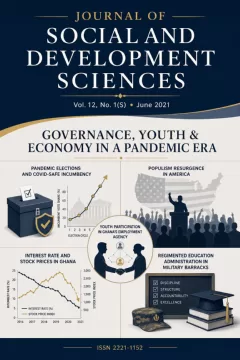 Vol. 12 No. 1(S) (2021)
Governance, Youth & Economy in a Pandemic Era
View issue contents
Published
Submissions
Have research to publish? Journal of Social and Development Sciences welcomes submissions.
Make a Submission