The Ascent of Money: A Financial History of the World
- Author: Shiva Kumar Srinivasan
Development, Governance & Consumer Culture
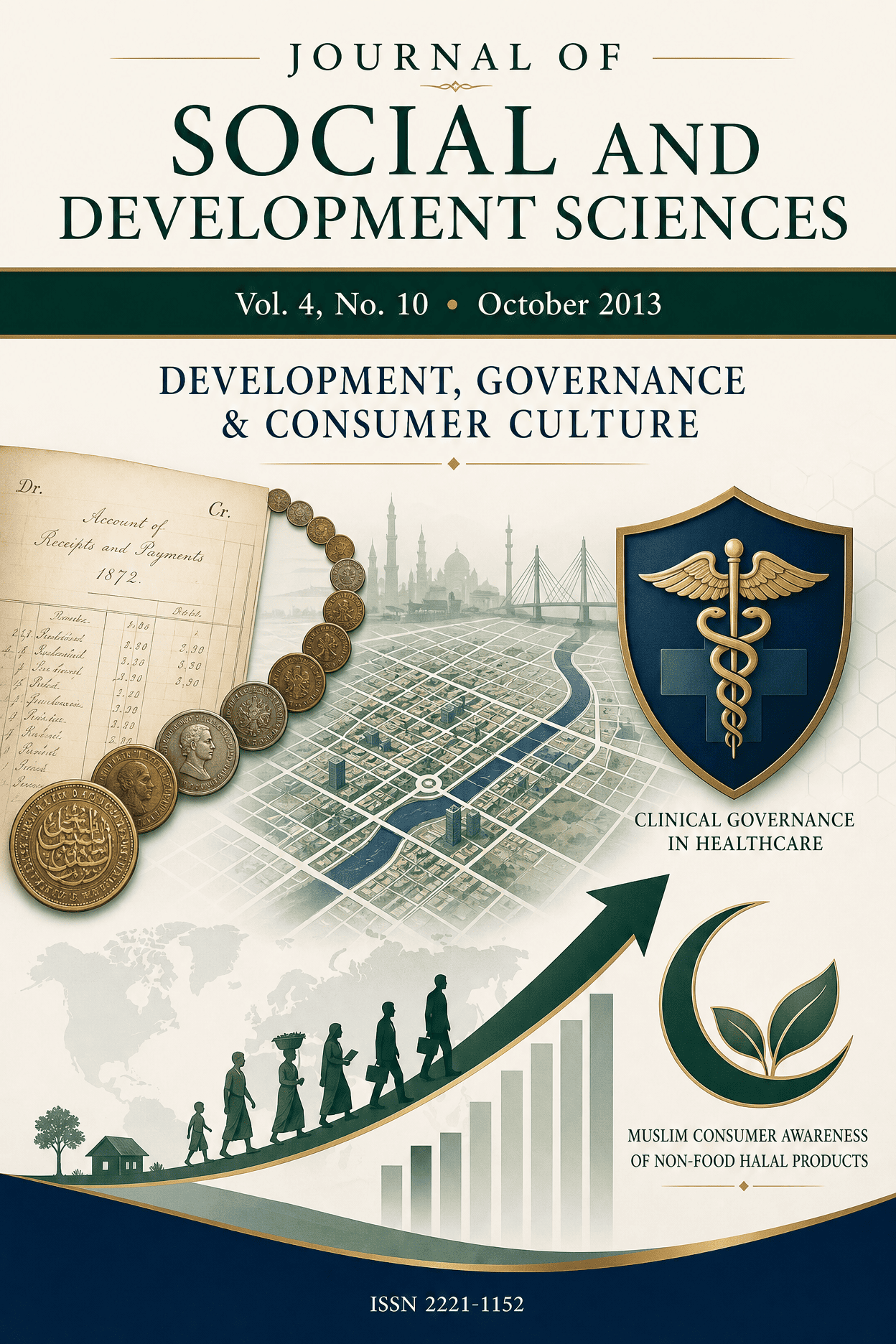
This issue brings together perspectives on financial history, urban and health governance, and consumer culture. Contributions include a review of The Ascent of Money: A Financial History of the World, a critical reflection on the failure of the 1917 Geddes and 1959 Minoprio–Spencely–Macfarlane master plans for Dhaka, an analysis of clinical governance in Thailand's health management system, a re-examination of economic development progress in developing countries, and an empirical study of Muslim consumers' awareness and perception of non-food Halal products in Malaysia.
Urban planning is inherently a political process addressing social justice and social coherence concerns. However, planners are fixated with the physical and superficial social aspects of planning, overlooking its deeper interrelationships. This paper discusses two master plans for the city of Dhaka. The first is the 1917 plan by Patrick Geddes, and the second is the 1959 Minoprio, Spencely and Mcfarlane Plan. Both plans were developed after a phase of social upheaval and unrest orchestrated to suppress the desires and wishes of the people of Dhaka. In both instances, the cross cultural planners lack cultural awareness, failing to perceive the then current issues fronting Dhaka. In essence, they work in isolation as planners. These initiatives can be argued as representing ‘planning for planning’s sake’. In this setting, this paper articulates that the failure of the two master plans were due to a lack of awareness of the social and political realities by these ‘foreign’ planners.
Read more about The Failure of the 1917 Geddes Master Plan and 1959 Minoprio, Spencely, Macfarlane Master Plans: Some ReflectionsThe health industry in Thailand is changing as a result of several important changes in society and projected future changes. These include the need for political and social reasons to extend low cost and easy access health care further to every sector of society in all regions of the country, the continuing aspiration to become an international hub for health tourism, the need to adjust to the potential flow of professionals across Southeast Asia resulting from the projected 2015 ASEAN Economic Community and the restructuring of the labour force as part of the effort to exit from the Middle Income Trap. These changes are nation-wide and require cooperation from a range of ministries, as well as requiring the support of society as a whole; that support will result from fostering of social solidarity through, in part, better explanation of why policies are changing and what the objectives will be in the short, medium and long-terms. It is, of course, essential that proper management of quality and health care within involved organizations – i.e. clinical governance – is also fostered and maintained at the highest possible level in both the public and private sectors.
Read more about The Role of Clinical Governance in the Health Management Systems of ThailandEconomic development is a current phrase that seems so easy to define, but in truth is too equivocal word. Although this word was born after the Second World War, Smith’s invisible hand has already pointed the notion of economic development as growth in income per capita. Even today, economic development is synonym with the high level of income per capita and reduction of poverty to achieve the improved well-being and standard of living. It is the rational result of deep gap among poor and rich countries. Hence, development is not a word which we can put border for each especial dimensions. Development must include the other dimensions like social, economic, cultural and political development, all moving together. In this paper, we will show the usage of economic growth to explain a special filed of development is a mistake. A society will experience economic development when the whole of the dimensions of development is achieved along with economic growth. The final goal of this paper is to show a new viewpoint of development progress to prepare the background for human talent to flourish.
Read more about New Sight to Economic Development Progress in Developing CountriesHalal has become the lifestyle of Muslim consumers in the world. As the Muslim populations increasing throughout the world, the awareness on consuming Halal also goes in the same parallel trend. In Malaysia, Halal food certification and management are given a lot of attention by the consumers, producers and regulators. However, Halal is not only covering only food consumption but also for nonfood products such as cosmetics, toiletries, pharmaceuticals, leather products, perfume and fragrances, brushes and so on. The services such as banking, entertainment, tourism, and logistic also related to Halal requirements. Thus, this research paper aims to investigate the awareness and perception of Muslim consumers on non-food Halal products and to identify the factors that influence the awareness and perception of consumers to the non-food Halal products. Moreover, this research also aims to confirm whether the identified variables have the strong influence to the level of awareness and perception of Muslim consumers on non-food Halal product. The samples of the research consisted of 236 government servants in the state of Selangor. The data are collected through questionnaire and analysed using the descriptive statistics, factor analysis and multiple regression. The results of the study revealed that the factors derived from factor analysis are: Halal information (X1), Availability (X2), Halal on media (X3) and Halal programmes(X4). Based on correlation and regression analysis, it is predicted that all factors are significant except for Halal programmes (X4). This study implicates that Halal-related programmes by related organisations in Halal industry is still lacking in promoting the Halal awareness and perception on non-food products .
Read more about Awareness and Perception of Muslim Consumers on Non-Food Halal Product