Articles

  • Article 1 in this issue

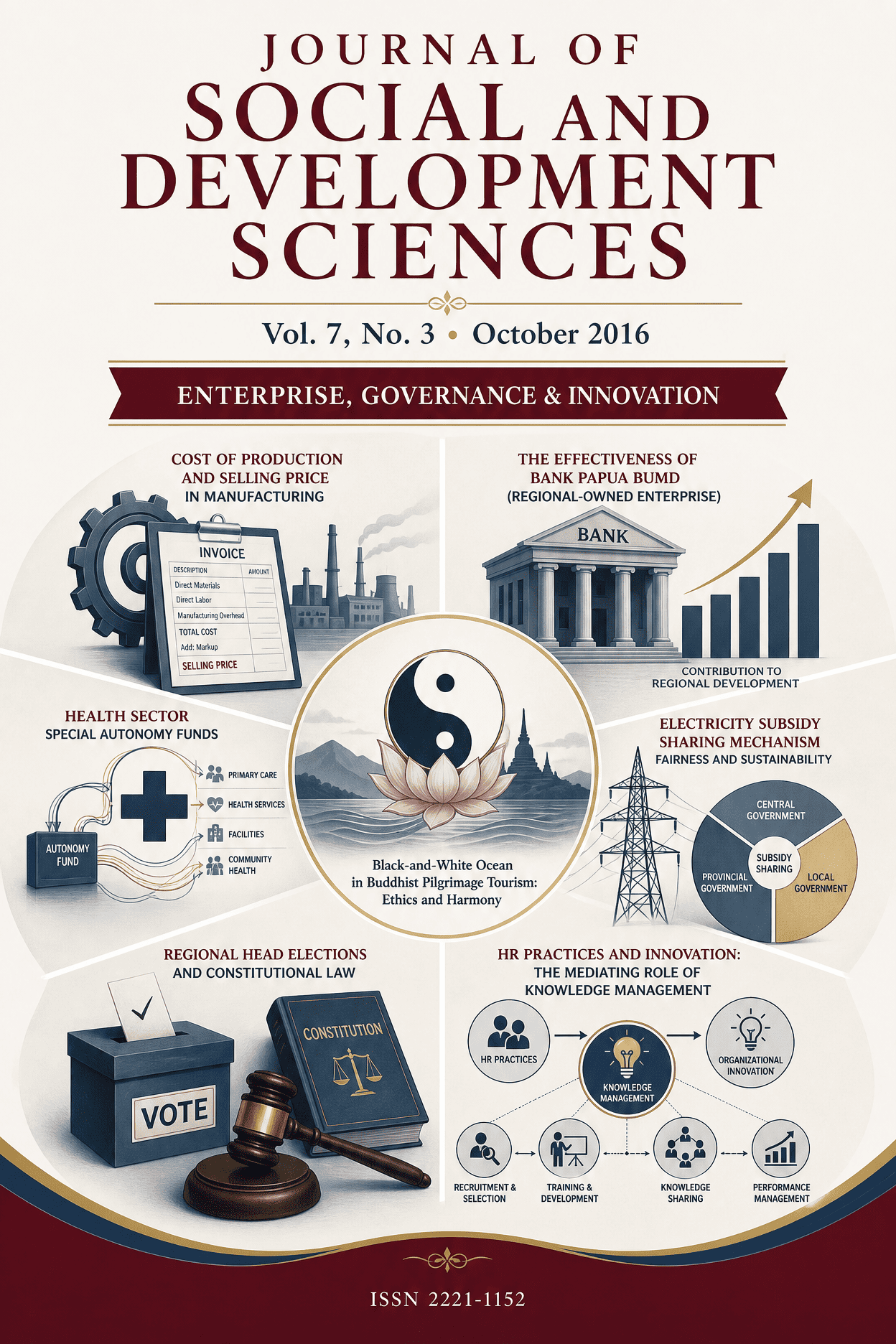
    Effect of Calculation of Cost of Production on Selling Price of Products Manufacturing Companies in Papua (Case Study CV. Sagita Grafika)

    • Author: Mugiati, Bosta Sihombing

    This study aims to determine how the effect of calculating the cost of an order made by the company and the method of calculation of full costing of the product selling price fixing mold. The data used is primary data, order data produced in the period from January 2013 to December 2013, the secondary data obtained from interviews and literature. From these results it can be seen that CV. Sagita Grafika calculate the cost of the product by using the order cost method that produces cost price and the selling price that is incompatible with existing theory, in which the charging of indirect labor and overhead costs shared equally on all types of orders in the amount of Rp. 11.78825 million for indirect labor costs and Rp. 3.1243 million for overhead costs so that volume orders will bear fewer overhead costs equal to the volume of orders more. By using a full costing analysis generated calculation method that the volume of orders that more will earn imposition overhead costs more, because in this calculation loading overhead costs charged by direct labor hours incurred for each order. So that orders with a total volume that many will use a lot of labor hours and vice versa. So in this study that most large orders received charging overhead is the order BS-02 Rp. 31,115,590.92 and most orders received little overhead loading is KK-01 orders in the amount of Rp. 2,208,622.32. Results of a comparison between the cost of the company with the full costing is the total cost of less Rp. 27,499,540.57, the selling price of Rp. 5,866,543.90, while the larger profit generated by using the full costing method that is Rp. 21,632,996.67

    Pages 6-10

    PDF - Effect of Calculation of Cost of Production on Selling Price of Products Manufacturing Companies in Papua (Case Study CV. Sagita Grafika) (opens in a new tab)
  • Article 2 in this issue

    The Thick Black and White Ocean among Buddhist Pilgrimage Tourist Operators in Thailand

    • Author: Kittichok Nithisathian, Lavanchawee Sujarittanonta, John C. Walsh

    The White Ocean strategy proposed by Thai scholar Danai Chanchaochai addresses management based on Buddhist philosophy, and emphasizes the society first before looking to oneself. At the same time, there is also the concept of Black Ocean, or Hòuhēixué ( 厚黑學 ) which translates to Thick Black Theory, proposed by Li Zongwu ( 李宗吾 ). Theoretically, an understanding of both white and black can lead the businessman to adjust his plans for better performance. Therefore, this research examines both Black and White concepts in the context of religious tourism, by collecting business data from tour operators that offer pilgrimage packages to Buddhists. It was found that the Buddhist aspect of the religious tour businesses puts “Blackness” profiteering goals in the background by building a “White” image of charity and donations, thus suggesting that the Black and White co-exists and are inseparable, similar to the middle path or yin-yang balance in nature.

    Pages 11-19

    PDF - The Thick Black and White Ocean among Buddhist Pilgrimage Tourist Operators in Thailand (opens in a new tab)
  • Article 3 in this issue

    Effectiveness and Contributions Analysis of PT. Bank Papua Owned Enterprises (BUMD) toward Regional Income (PAD) in Papua Province

    • Author: Elsyan Rienette Marlissa., SE.,M.Si

    Government of Papua Province by placing the regional enterprises as the one of the assets that will be used to provide a real contribution to the local economy, many steps and efforts put enterprises as an institution that has a chance to be an advance contributor to contribute to the economy and income for the region through the placement funds by the government in business institutions established under Regional Regulation. The placement of these funds will take a role in stimulating economic growth, which may create additional value, employment, and foreign exchange. This research is purposed to determine the effectiveness of the financial capacity of the PT.Bank Papua Owned Enterprises (Ind: BUMD) toward the income target of PT.Bank Papua profit and find out how much the contribution of the Regional Owned Enterprises (Ind: BUMD) on PT.Bank Papua income of Papua Province. The method used is the analysis of the effectiveness and contribution analysis. The results shows that PT.Bank Papua profit is very effective based on the financial balance sheets and PT.Bank Papua income (loss), PT. Bank Papua Deposits have very effective category, PT.Bank Papua postal giro has effective category. PT. Bank Papua financial ratio analysis, liquidation analysis or LDR PT.Bank Papua has a category of highly effective, the analysis of acceptance or BOPO PT.Bank Papua has effective category. Bank of Papua contribution to regional income of Papua Province was the highest in 2010, reaching Rp.23.339.102.363 or 6.00%. Suggestion findings show that Bank of Papua in the growth and development of enterprises needs to be fostered and implemented, especially on the motivation to improve the regional company's operating profit reception for regional income. The efforts can be done through increasing the expertise and the professionalism of its staff and their directors in running the company as a purely commercial business that promotes/prioritize the efficiency considerations. PT.Bank Papua Directors and staff (enterprises) in achieving the profit should be continued to improve the development of the soul and spirit of entrepreneurship.

    Pages 20-24

    PDF - Effectiveness and Contributions Analysis of PT. Bank Papua Owned Enterprises (BUMD) toward Regional Income (PAD) in Papua Province (opens in a new tab)
  • Article 4 in this issue

    Effectiveness of Health Sector Special Autonomy Funds Management Program Supiori Regency, Papua

    • Author: Vince Tebay, WestimRatang, Elsyan Marlissa

    Under the Special Autonomy Law, indigenous Papuans receive special attention and are the main subject of development. The existence of the central government, provincial government, district/city governments, as well as subordinate institutions, are all geared to provide the best service to the indigenous people of Papua, in order that improvedsocial welfare can be realized, so that the lives of indigenous people of Papua can be in line with that of the rest of the population in Indonesia. There are four very important service sectors within the strategic mandate of the Special Autonomy Law to be implemented by the government in relation to the welfare of indigenous Papuans, namely: education, health and nutrition, village infrastructure, and economic empowerment. Supiori local government has yet to determine the performance indicators pertaining to implemented programs and activities funded by Special Autonomy. These conditions make the assessment of performance against the use of Special Autonomy funds difficult because indicators of achievement of the program/ activity are not available.Types of data collected in this study include both secondary and primary data. The data collection techniques used in this study are:Questionnaires and Distributed Questionnaires, In-Depth Interviews, Library Research, and Focus Group Discussions.Supiori Autonomy health sector funding of the programs and activities of the Department of Health in 2012 has been quite effective and beneficial for the Health Services Unit, which includes hospitals, health centers and Puskesmas Pembantu health center. In addition, medical personnel (nurses), Posyandu cadres, pregnant and nursing mothers, infants and toddlers, children and the community district also enjoy greater health benefits.There needs to be involvement and participation in the Health Services Unit Autonomy fund management, in areas ranging from planning to follow-up. Participation can be done through discussions about Health Services Unit needs, as well as the needs foundin the planning and budgeting of Special Autonomy funds in the Supiori health field.

    Pages 25-29

    PDF - Effectiveness of Health Sector Special Autonomy Funds Management Program Supiori Regency, Papua (opens in a new tab)
  • Article 5 in this issue

    Study of the Potential Sharing of the Electricity Subsidy by Regional Government

    • Author: Joko Tri Haryanto

    The electricity sector has a very important role as a source of energy that is vital for everyday life, industrial activities and other commercial activities. To keep electricity prices remain affordable to the public, government allocated electricity subsidy in the APBN. Unfortunately, every year electricity subsidy is more swollen. Therefore needs to consider funding the electricity subsidy sharing mechanism with regional governments. To support these mechanisms, necessary to study and trying to see the readiness level of funding in regional government and the division of authority. By using the methodology of mapping analysis, it can be concluded that the judicial authority of the electricity sector although it has been submitted to the region, but still the absolute authority of the Central Government. Based on the Regional Fiscal Capacity analysis, Jakarta Province, East Kalimantan Province, Papua Province of West and North Borneo are areas that deserve to be a top priority. By using the analysis of the development of regional economic growth from 2008 to 2012, the recommended area is the province of West Papua with an average economic growth, approximately 23.28% compared to Jakarta by 7.75% and by 5.08% in East Kalimantan.

    Pages 30-41

    PDF - Study of the Potential Sharing of the Electricity Subsidy by Regional Government (opens in a new tab)
  • Article 6 in this issue

    Democracy Establishment on Regional Head Election Observed from the Constitutional Law Perspective in Indonesia

    • Author: Sugianto

    The amendment of the 1945 Constitution had opened space for democratic realization process at local level. In Article 18 paragraph (4) mentioned that governors, regents and mayors respectively as the heads of provincial, regency and municipal elected democratically. The local elections were carried out simultaneously by the people show democratic electoral system embodiment. To analyze the phenomena, this study uses a qualitative method, which the data source derived from primary and secondary data. Primary data is data obtained from observations in field, while secondary data obtained from literature or news about the regional head elections. The results showed that in a democratic election, a guarantee of freedom is an absolute and normative requirement. However the normative requirements sometimes ignored either by contestants or supporters. Therefore, the presence of the Constitutional Court is very important for democracy and constitutionality of local elections. In the local elections, the Constitutional Court has the authority to resolve the election results dispute. Although the existence of the Constitutional Court is important, but to resolve the dispute over local elections, researchers assume about the necessary establishment judicial elections at any stage or process level.

    Pages 42-49

    PDF - Democracy Establishment on Regional Head Election Observed from the Constitutional Law Perspective in Indonesia (opens in a new tab)
  • Article 7 in this issue

    HR Practices and Organizational Innovation: The Mediating Role of Knowledge Management Effectiveness

    • Author: Muhammad Farooq, Irfan Ullah, Raja Mahzhar Hameed

    Organizational innovation has been recognized as an important instrument for organizations to compete in the competitive environment. Pakistan telecom sector strive to transform their business model from labour-intensive to knowledge-intensive, which intend to thrust themselves in higher value added activities such as, developing new products, processes, and services, to continual sustain the competitiveness. One of the means to increase the organizational innovation is through effective human resource management practices and effective knowledge management. This study examined the direct association between human resource management practices (performance appraisal, career management, training, reward system, recruitment and employee recognition) and organizational innovation. Moreover, it also observed the mediating role of knowledge management effectiveness on the direct relationship. Data was collected from a sample of 290 personnel of telecom sector of Pakistan. The regression results showed that human resource management practices generally had a positive impact on organizational innovation. Particularly, the results signify that training and employee recognition were positively related to three dimensions of organizational innovation. Performance appraisal also established to have a positive impact on administrative innovation. Additionally, this study also demonstrates that training, performance appraisal, and employee recognition were positively associated to knowledge management effectiveness.

    Pages 50-67

    PDF - HR Practices and Organizational Innovation: The Mediating Role of Knowledge Management Effectiveness (opens in a new tab)