Articles

  • Article 1 in this issue

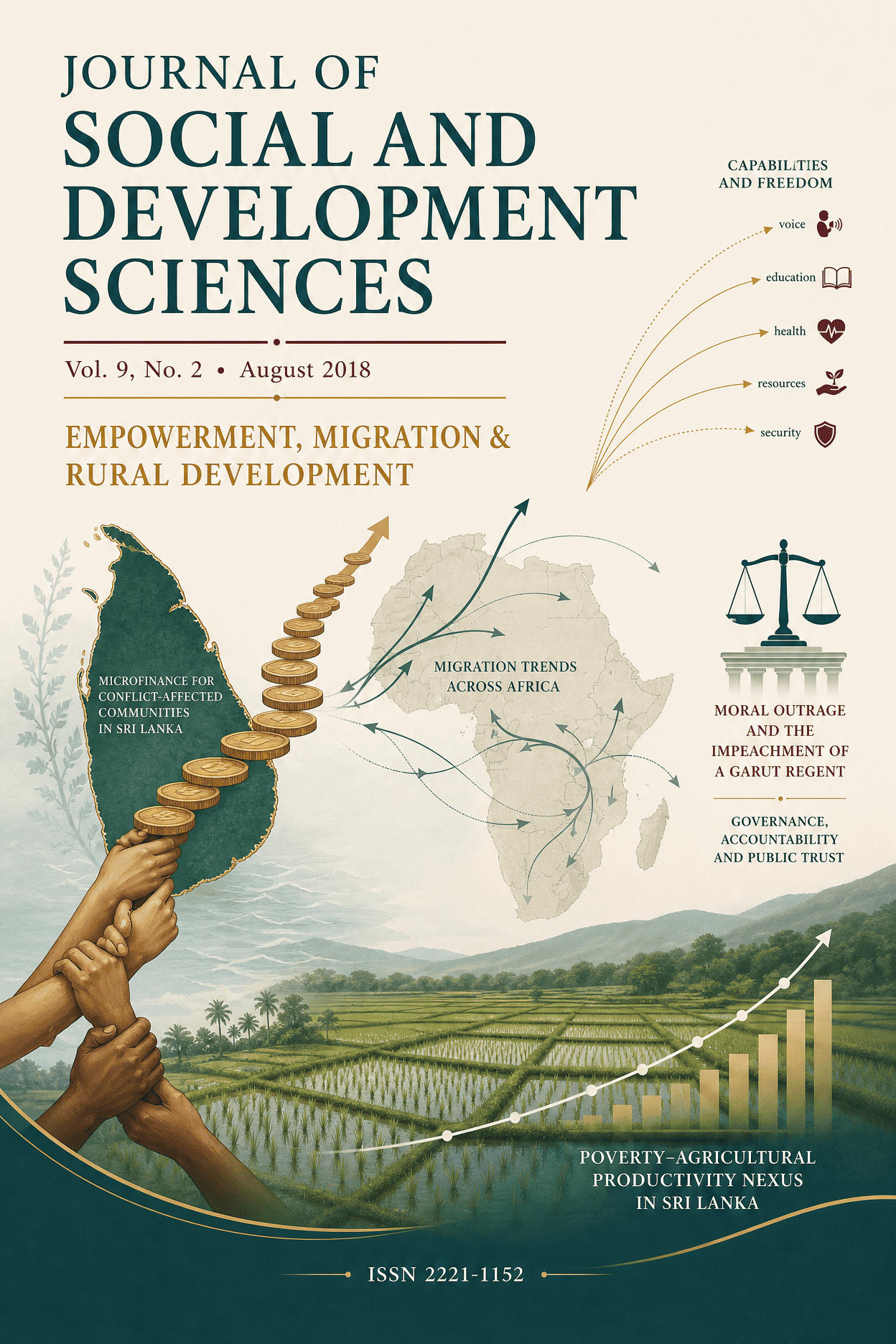
    Microfinance as a Strategy of Empowering the Conflict-Affected Communities in Sri Lanka

    • Author: H.M.W.A. Herath

    The objective of this paper is to assess the capability of microfinance as a tool of reconciliation through economic activity generation and empowerment in the conflict-affected communities in the Northern and Eastern regions of Sri Lanka. The principal data collection tools for this study were Focus Group Discussions and Key Informant Interviews. The impact of microfinance engagement is in varying degrees with certain areas and groups showing evidence of receiving more beneficial impacts compared to others. It also showed very high involvement of women and those women who are active namely, those from groups above the very poor and those who have comparatively better educational levels. We found that microfinance intervention has both tangible and also created other intangible benefits on clients. The post-conflict Northeastern region is not a monolithic entity and there are a number of diverse groups of potential beneficiaries with different needs, skills, capacities and opportunities. Therefore, microfinance initiatives need to consider these situations and develop their interventions accordingly.

    Pages 6-21

    PDF - Microfinance as a Strategy of Empowering the Conflict-Affected Communities in Sri Lanka (opens in a new tab)
  • Article 2 in this issue

    Continental Migration Trends: Its Implications from an African Perspective

    • Author: Daniel N Mlambo

    Migration is witnessed throughout the world, this is even true for a third world continent such as Africa, where individuals tend to move from one place to another propelled by diverse push and pull factors. This paper brings forward the degree of migration movements in Africa. Additionally, it seeks to understand the impact(s) of migration within the continent. It argues that migration in Africa is not a new phenomenon as it has been witnessed since colonialism often as a result of forced migration. However, post the colonial era, Africa has observed an upsurge of migration movements both documented and undocumented. This is manifested by the fact that Africa has remained an underdeveloped continent coupled with vast economic hindrances including unemployment, political instability, low growth rates, terrorism and corruption. In this vein, individuals move from place to place for better economic opportunities for themselves particularly to Western, Eastern and Southern African countries such as Nigeria, Ghana, Botswana, South Africa, Ivory Coast, Angola, Rwanda and Namibia. The paper concludes by outlining that if Africa is to limit and manage the evergrowing migration movements, then African heads of states should possibly improve their border patrol security, enhance rural agriculture and improve rural service delivery programmes. Moreover, to implement robust, well monitored and managed policies that intend to support and complement the policies of the African Union (AU), regional bodies and the Sustainable Development Goals (SDG’s) with regards to African migration.

    Pages 22-27

    PDF - Continental Migration Trends: Its Implications from an African Perspective (opens in a new tab)
  • Article 3 in this issue

    The Role of Moral Outrage on the Impeachment of Garut Regent in 2012-2013

    • Author: Nur Hidayat Sardini

    Moral and political are two things that cannot be separated. The marriage of a regent in Garut regency, Indonesia, with an underage girl eventually leads to community action, where people demand the regent to resign from his position as a regional head. It was not even four days of marriage the regent had divorced his young wife via a short message from his own mobile phone. Therefore, the people of Garut suddenly expressed their wrath through a large-scale demonstration which pushedthe Local House of Representative immediately to process the regent’s removal. This research utilized a qualitative approach with a case-study method, the data in this research relied on the practice of in-depth interviews, observations, and documentaries. This research succeeded to observe that the general factor which underlying the action of demonstration in Garut which demanded the resignation of the regent was caused by the political climate change of democratization in the national level which also impacted Garut Regency. The national politicalclimate change increased the unconventional public participation in Garut and provided political sphere for non-state actors to establish political-involvement balance between state actors and non-state actors themselves. In other hand, the specific underlying factor on this case is the regent’s behavior which was judged as the act of dishonorable humiliation on women’s dignity, especially his speech in some national television channels. The power of this study lies on its novelty, filling in lubrication and study originality, towards the moral and ethical behavior as the new object on Social Movement.

    Pages 28-37

    PDF - The Role of Moral Outrage on the Impeachment of Garut Regent in 2012-2013 (opens in a new tab)
  • Article 4 in this issue

    Poverty and Agricultural Productivity Growth Nexus in the Non-Plantation Agriculture in Sri Lanka

    • Author: H.M.W.A. Herath

    Not only there is a close relationship between poverty and agriculture productivity but also agriculture is considered as a significant means of plummeting poverty in the long-term and in the shortterm. While agriculture may not be central as the driver of economic growth in current global neo-liberal economic context it is generally accepted that the food security and livelihood development aspects for all still warrants developing agriculture, a situation that holds true for Sri Lanka too. Productivity in agriculture is determined by conditions in both the natural, socioeconomic and community factors. The productivity in the country’s agriculture sector is rooted in the farming system, namely, the farm and the farmer/farm operator. These two units are in an interacting whole which makes property of one a quality of another. Small plot size, the existing tenure system, low levels of education and skills of farm operators and behavior of two patrons (government and traders) in the sector are the major backward determinants affecting to place in the farmer into a vicious cycle of poverty. This background does not help to generate a dynamic, risk bearing and enterprising farmers for the economy and this leads to low productivity and then the continuation of poverty of farmers. The lack of attentiveness of overall situation and lack of holistic approach to problems providing appropriate solutions to individuals are constraints in agriculture development. Solution is the hallmark of policies and interventions in agriculture. Present focus is also on subsistence-based model and the approach is piecemeal.

    Pages 38-53

    PDF - Poverty and Agricultural Productivity Growth Nexus in the Non-Plantation Agriculture in Sri Lanka (opens in a new tab)
  • Article 5 in this issue

    Misunderstandings of Capability Approach: Towards Paradigm Pluralism

    • Author: Sylvain K. Cibangu

    Capability approach figures among the most prominent approaches of social science disciplines. One reason for this is that in a world plagued by daunting inequalities and repressions the term capability presents a whole host of potentials. Another reason is that the failures or shortcomings encountered in development studies the last several decades have created something of a vogue for capability approach both in academia and industry. In the meantime, however, capability approach represents one of the most misunderstood and misused approaches of modern day times. One most pervasive misunderstanding or misuse comes with the idea that capability approach is unable to provide a definite, exhaustive list of capabilities nor to achieve measurable units of development. This idea is further compounded by the fact that Sen (1999, 2009) himself the originator of capability approach has invariably dismissed the discussions concerned with list and measurability. The present paper aimed to highlight the core nature of capability approach, while dispelling the misunderstandings surrounding it. Content analysis was conducted to appraise how capability approach was presented. Sen works were thus perused in light of a wider social science literature, with a focus on methodology. This is mainly because development studies is an interdisciplinary field. In so doing the paper was able to reposition capability approach as an interpretive, qualitative approach. It was thus realized that authors continue to misuse and view capability approach through the lens of quantitative research. It was also realized that interpretivism is by no means defined or evaluated based on the ability to supply a list of specific items and the measurability thereof. The paper suggested some paths for future research.

    Pages 54-72

    PDF - Misunderstandings of Capability Approach: Towards Paradigm Pluralism (opens in a new tab)