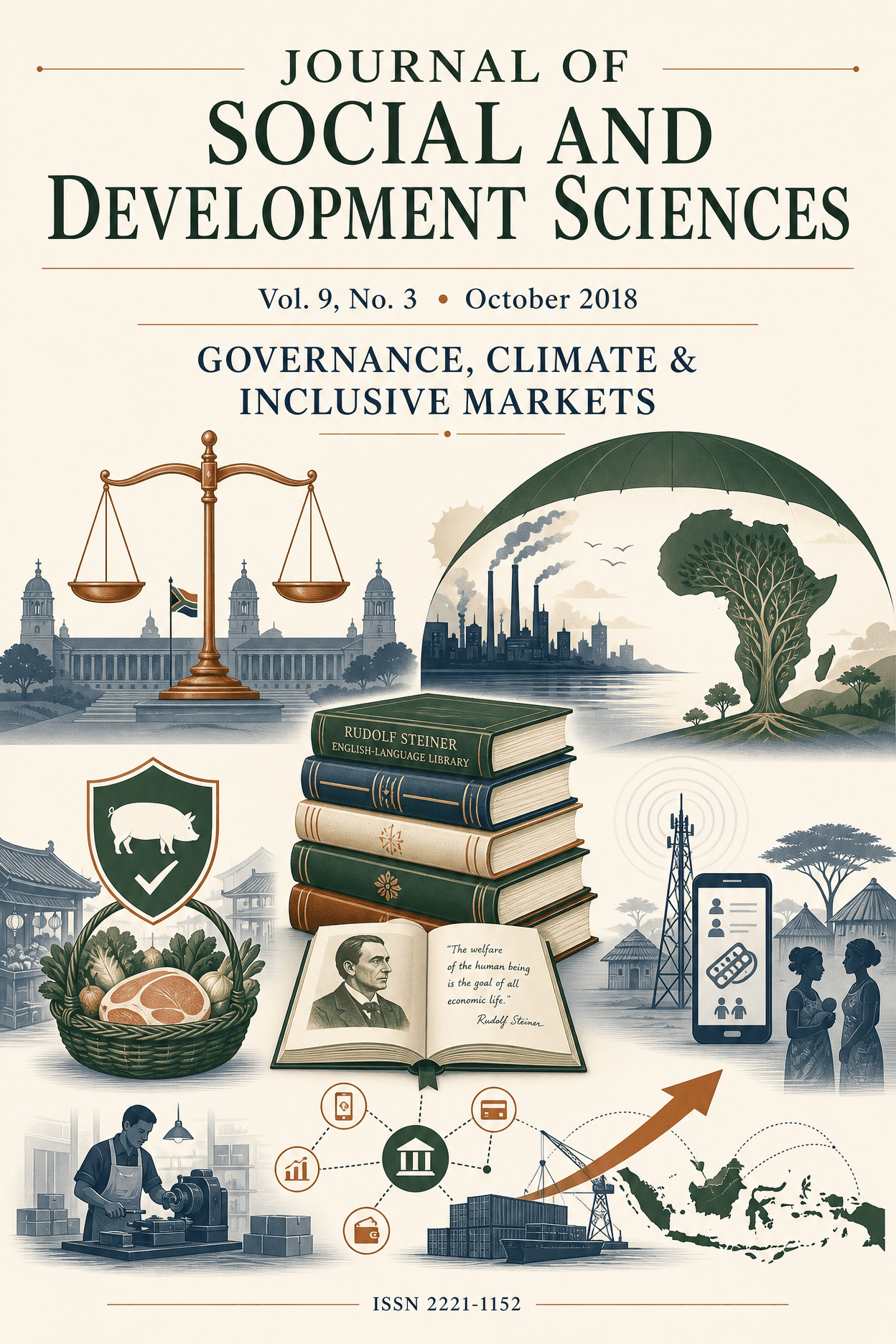
Articles

  • Article 1 in this issue

    Understanding Political Will and Public Corruption in South Africa

    • Author: Harris Maduku, Andrew Osehi Enaifoghe

    The objective of this paper is to extensively analyse if there is adequate political will to eradicate corruption in South Africa using existing literature. There has been a huge increase in the level of attention paid to corruption, measures to curb it as well as its socio-economic consequences. In South Africa, corruption has been at the focal point of development an obstruction and impediment of genuine improvement in the general public service delivery. South Africa’s public procurement system has been filled with corrupt practices, making the country to be one of the most degenerate on the continent of Africa. In the event that Africa is to be spared from this disease, the endemic presence of corrupt practices must be managed appropriately by the executive of the state. This paper addressed the concept of political will and normalized corruption in South Africa and proposed a route forward for the coveted change. We feel that corruption should be classified in the same category as crimes like treason, murder and rape and heavy sentences have to accompany corruption as a crime. A qualitative method was adopted in this study.

    Pages 6-14

    PDF - Understanding Political Will and Public Corruption in South Africa (opens in a new tab)
  • Article 2 in this issue

    Climate Change: Towards Compensating Africa for Economic Growth and Development by Industrialized Countries

    • Author: Monaheng Mahlatsi

    On one hand, anthropogenic climate change is real and affecting the world economy in general and Africa in particular. On the other hand, the policy of climate change adaptation as the solution to the problem of climate change is seriously unsuccessful in Africa. Even though climate change is affecting the whole world, Africa is the most vulnerable continent that is economically affected. This is due to a variety of interconnected consequences of climate change such as droughts, floods, desertification, diseases and poor agricultural system including other unknown factors. This article focuses on challenges facing the implementation of climate change adaptation policy in Africa. The implementation of the policy of mitigation of greenhouse gas emissions will not be discussed. The aim of the article is to investigate the underlying implications of climate change adaptation policy that hamper smooth growth and development of the African economy. To achieve this aim, the theoretical research method will be utilized. This article concludes that Africa cannot afford to adapt to climate change because of its extreme poverty and will remain economically poor and suffer the consequences of climate change if industrialized countries are reluctant to compensate it. Therefore, the article argues that industrialized countries have a moral duty to compensate Africa for the harm they have caused through industrialization. The compensation will boost the African economy that is necessary for climate change adaptation.

    Pages 15-20

    PDF - Climate Change: Towards Compensating Africa for Economic Growth and Development by Industrialized Countries (opens in a new tab)
  • Article 3 in this issue

    The Library of Rudolf Steiner: The Books in English

    • Author: John Paull

    The New Age philosopher, Rudolf Steiner (1861-1925), was the most prolific and arguably the most influential philosopher of his era. He assembled a substantial library, of approximately 9,000 items, which has been preserved intact since his death. Most of Rudolf Steiner’s books are in German, his native language however there are books in other languages, including English, French, Italian, Swedish, Sanskrit and Latin. His library hosts more books in English than in any other foreign language. Steiner esteemed English as “a universal world language”. The present paper identifies 327 books in English in Rudolf Steiner’s personal library. Fifty percent of the English-language books identified are categorized as Theosophy (n=164). Rudolf Steiner was the General Secretary of the German branch of the Theosophy Society from 1902, and he hived off his own Anthroposophy Society in 1912. The present study reveals that Steiner maintained his interest in theosophy throughout his life as he stayed up to date with the proliferating portfolio of Theosophy publications. The publication dates of Steiner’s Theosophy collection range from 1877 to 1923. The leading exponents of Theosophy in his day are well represented in Steiner’s collection, including Annie Besant (n=61), Charles Lead beater (n=13), William Westcott (n=13) and Helena Blavatsky (n=10). Of the other 50% of the Anglo-books identified, 20% are in the category of Religion (n=67), 10% are Social Science (n=33), 6% are Philosophy (n=21), 4% are Science (n=13), and 3% each are Anthroposophy (n=11), History (n=9) and Arts (n=9). The publication dates of Steiner’s Anglo-books span the period 1659 to 1925. This demonstrates that Steiner was acquiring Anglo-books right to the end of his life. Steiner’s library throws light on the development of the thoughts of this remarkable individual and the present paper reveals Steiner’s engagement throughout his life with the world of Anglo-publishing and thought.

    Pages 21-46

    PDF - The Library of Rudolf Steiner: The Books in English (opens in a new tab)
  • Article 4 in this issue

    The Demand of Urban Consumers for Safe Pork in the Vietnamese Mekong Delta

    • Author: Huynh Viet Khai, Tran Thi Thu Duyen, Huynh Thi Dan Xuan

    This study applied the contingent valuation method to analyze the consumers’ demand for the proposed safe pork. The data was collected by face-to-face interviewing 884 urban households in the Vietnamese Mekong Delta. The results revealed that the majority of consumers (about 64%) paid attention to the proposed safe pork. Their willingness to pay was about VND 176,000 ($ 7.65) per kg, nearly double compared to the market price of conventional pork. The results showed that the respondents who had higher household income, larger proportion of elderly and children in the family, paid higher price of a conventional pork, and get more knowledge score on the safe pork are more likely, while the respondents who have more number of family members are less likely to pay for the proposed safe pork.

    Pages 47-54

    PDF - The Demand of Urban Consumers for Safe Pork in the Vietnamese Mekong Delta (opens in a new tab)
  • Article 5 in this issue

    Access to Communication Channels and Use of Family Planning among Women in Tanzania: Spatial and Socio-demographic Analysis

    • Author: Zuena Kilugwe, Sosthenes Ruheza

    This study examined the relations and access to communication channels on the use of Family Planning (FP). Relationships between independent variables including access to communication channels and the use of FP services, and demographic characteristics were examined. This study used cross-sectional data from the Tanzania Demographic Health Survey and Malaria Indicator Survey (TDHS-MIS) of 2015-2016 from 11,127 women aged between 15-49 years. The sample was weighted to ensure representativeness. Univariate, bivariate and binary logistic regression analyses were used. Results in this study revealed a statically significant correlation between access to FP messages and use of family planning services (p<.001). Access to radio, television, printed media, and mobile phones was observed more among women who were never in a union, those with tertiary education, women in urban areas and among those within a high wealth index. Use of FP services increased with the fluency of access to FP messages. Printed media predicted more likelihood in the use of FP at  =0.460, p<0.001; radio at  = 0.368, p<0.001; health facilities at  =0.284, p<0.001 and education level at  =0.276, p<0.001. The study concludes that despite the fact that there was a correlation between access to FP messages and the use of FP, the use or not use of the same is also influenced by factors.

    Pages 55-65

    PDF - Access to Communication Channels and Use of Family Planning among Women in Tanzania: Spatial and Socio-demographic Analysis (opens in a new tab)
  • Article 6 in this issue

    The Role of Fintech Encourages the Export of Small Medium Enterprises in Indonesia

    • Author: Ragimun, Sri Yanthy Yosepha

    At present the development of financial technology (fintech) in Indonesia is very fast, many nonbank companies practice as fintech executors who channel loans to the public or Small Medium Enterprise (SMEs), this has the potential to lead to illegal banking practices (shadow banking). The next problem is how the government makes rules that can synergize fintech with the business world, banking, SMEs and others. In the future, it is expected that Fintech will play an active role in encouraging the export of the SME sector which is Indonesia's flagship sector. In this study a qualitative descriptive approach was used, which emphasized the discussion by examining the role of fintech to encourage the export of small and medium industries in Indonesia. Data sources that can be used are data from the Central Statistics Agency (BPS), the Financial Services Authority (OJK), Bank Indonesia and various relevant data sources. Fintech is currently very helpful in helping the financial literacy of the Indonesian people including SMEs as a mainstay of increasing exports in Indonesia. Several obstacles to the spread of the role of fintech continue to be overcome through various means including infrastructure improvements, socialization and financial literacy to the public and SMEs and fintech regulatory policies. The government needs to make harmonious rules to grow and to avoid risks in the financial services industry. This is crucial because the development of fintech in Indonesia is very fast. Licensing for the establishment of fintech companies from other countries must be monitored.

    Pages 66-77

    PDF - The Role of Fintech Encourages the Export of Small Medium Enterprises in Indonesia (opens in a new tab)