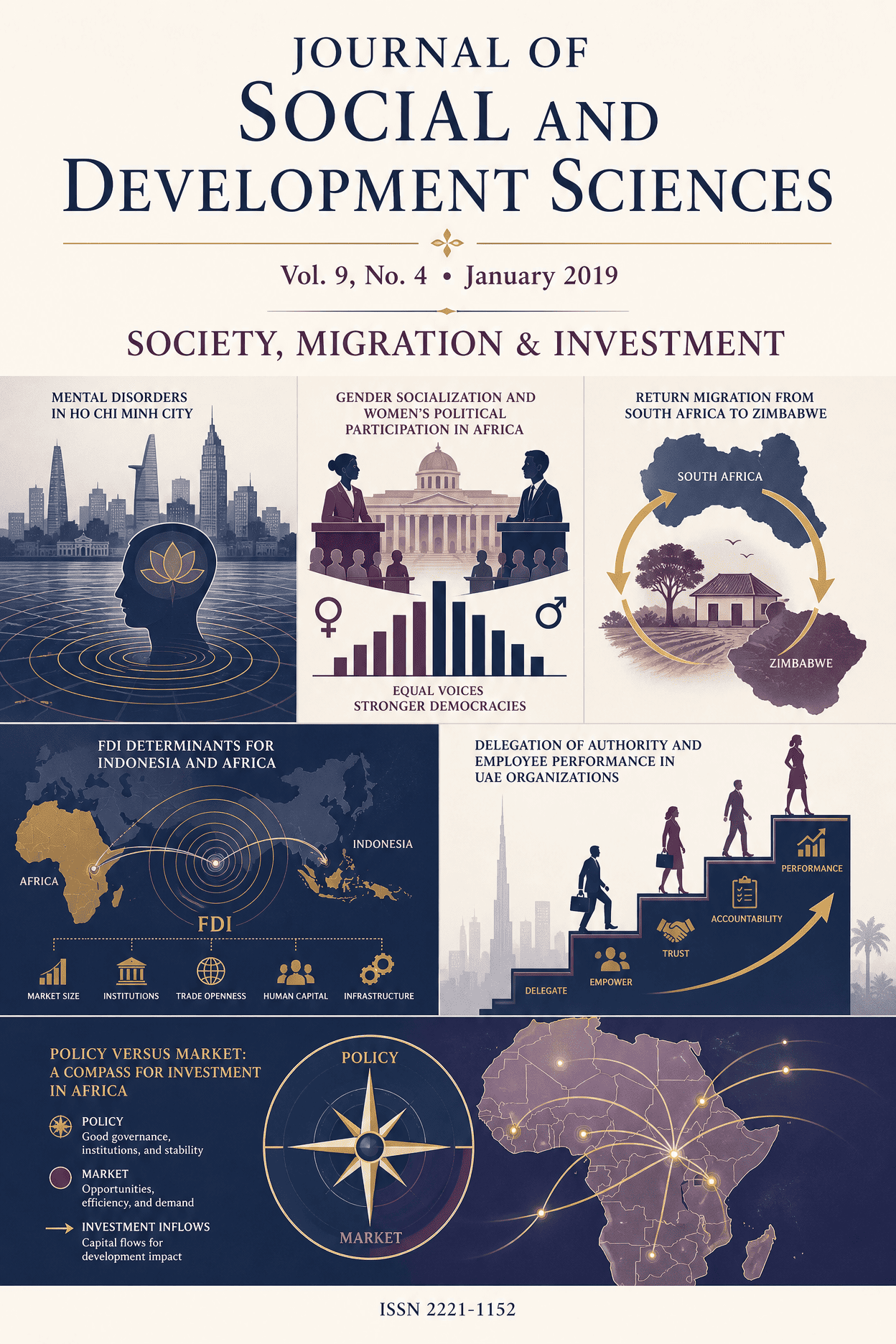
Articles

  • Article 1 in this issue

    Sociological Study of Mental Disorders in HCMC (Vietnam)

    • Author: Mohamad Tavakol, Le Thi Mai, Mina Mansouri

    The focus of this study is on the prevalence of mental disorders among the people aged between 18-64 years who are living in Saigon (HCMC), and an analysis of the sociological factors that affect the spread of these disorders. The theoretical framework of this research is a synthesis of the sociological theory of Anomie of Durkheim and the Strain theory of Merton. To determine the prevalence of mental disorders, the General Health Questionnaire (GHQ-28) is used, and to determine their effective sociological parameters we prepared a second Questionnaire, the sociological one, comprising questions derived from Durkheim and Merton's theories. The sample size was 384, using Cochran formula, and sampling was a multi-stage cluster sampling. The results from the analyses of the data showed that the overall prevalence of mental disorder in Saigon is 10.2%: in men 5.5% and in women 12.8%. Moreover, the components of immigration, job status, social status, structural and social pressures, family problems, and social capital, were shown to contribute to the risk of mental health and the occurrence of mental disorders. The sociological factors which were not confirmed were religion and ethnicity.

    Pages 1-13

    PDF - Sociological Study of Mental Disorders in HCMC (Vietnam) (opens in a new tab)
  • Article 2 in this issue

    Exploring Gender Socialization on African Political System and Women's Participation

    • Author: Andrew Enaifoghe

    This study explored the role of gender plays and the participation impacts of women on African politics, the religion and socio-cultural factors responsible for the underrepresentation of women through socialization in Africa. Obviously, past research has demonstrated that fundamentalist religious beliefs and affiliations are related to preservationist gender demeanours or attitude. This idea not only impacts gender gaps in political participation in cross-national examinations by belligerence that women's portrayal ought to be measured in an unexpected way or differently. Utilizing Fundamentalism and Modernization Theories, this paper shows that long haul impacts of women's representation are more indispensable than short-term measures in understanding gender gap in a mixture of political exercises. The timeframe since women have accessed the political framework discloses the gender gap to a more noteworthy degree than the presence of women in the governing body and cabinet at one point in time. Findings demonstrate that the suppositions of earlier work on women representation and political conduct or attitude may stretch out beyond Africa it also finds that gender grouping has in many ways impacted the low participation of women in African political system through socialization. At last, this study shows that the kind of political exercises matter and the implementation of policies that encourage give women level play ground to participate in politics while breaking down the impact of gender socialization as of the factors for women's representation in legislative issues crosswise over Africa. A qualitative approach was used in this study alongside with empirical investigation.

    Pages 14-25

    PDF - Exploring Gender Socialization on African Political System and Women's Participation (opens in a new tab)
  • Article 3 in this issue

    Determinants of the Return Migration of Household Heads from South Eastern Zimbabwe to South Africa During Prolonged Crisis, 2000-16

    • Author: Dick Ranga

    The study assessed return migration by heads of households that migrated during the prolonged crisis, 2000-16. It collected data among 166 households from four districts in South Eastern Zimbabwe. Most of the male household heads had previously migrated, half of them to South Africa. Non-migrant heads were mainly females who remained behind when their husbands migrated to South Africa or urban areas. Both heads who returned from migrating to South Africa and locally to urban areas came back during 2011-15 with the desire to reunite with families. This period was associated with severe retrenchments by Zimbabwean companies that attempted to survive the shrinking economy. Yet it was also an attractive period to return home for international migrants because of the stability brought by the adoption of multiple currencies. Xenophobic attacks in South Africa in 2015 also ‘pushed’ some of the heads into returning home. International return migrants were significantly younger and had lower levels of education than internal and non-migrants. Three-tenths of them returned into households having traditional huts as their main houses which suggested that migration was unsuccessful for them. There is a need for restoration of stability soon after a crisis since this helps attract back human capital.

    Pages 26-35

    PDF - Determinants of the Return Migration of Household Heads from South Eastern Zimbabwe to South Africa During Prolonged Crisis, 2000-16 (opens in a new tab)
  • Article 4 in this issue

    The Dominant Factors Influencing the Flow of Foreign Direct Investment to Indonesia

    • Author: Makmun Syadullah, Akhmad Yasin

    This paper aims to examine the impact the gross domestic product of the exporting country and the importing country, total tax rate to a commercial profit of exporting country, and importing. As for as, the object of research is the flow of FDI from four countries, namely the Netherlands, Malaysia, Singapore, and Japan to Indonesia. While the methodology used a gravity model specification to model bilateral FDI outflows. Our study finds most real GDP for both the exporting and importing country have consistently positive signs as expected, although generally, only the coefficient of the GDP of the importing country is significant. The coefficient percentage of the total tax rate to commercial profit, both in the exporting country and importing country, also in line with the theory, although both are insignificant.

    Pages 36-42

    PDF - The Dominant Factors Influencing the Flow of Foreign Direct Investment to Indonesia (opens in a new tab)
  • Article 5 in this issue

    Factors Affecting Delegation Authority toward Employees Performance

    • Author: Adnan Alhosani, Rosman Md Yusoff, Fadillah Ismail, Fazal Ur Rehman

    Employees are the key asset of every organization and their performance can influence the goals and objectives of organizations in a positive or negative way. The aim of this study is to develop a theoretical framework in relations to examine the effects of employee’s satisfaction and participation, delegation authority and empowerment on employee’s performance in UAE organizations. Specifically, to get an in-depth understanding of the linkage between delegation authority and employees performance with emphasize on (employee participation and employee satisfaction). This study is only limited to Dubai organizations and future research may be conducted in other countries as well as can assess the moderating role in the defined variables. By integrating employee’s satisfaction and participation, delegation authority and empowerment, and employee’s performance literature, the main contribution of this paper is the analysis of defined variables in Dubai organizations with emphasize on new challenges and to boost up the gap of relevant literature.

    Pages 43-48

    PDF - Factors Affecting Delegation Authority toward Employees Performance (opens in a new tab)
  • Article 6 in this issue

    Policy and Non-Policy Factors: What Determines Foreign Direct Investments in Africa?

    • Author: Olawumi Dele Awolusi

    Studies have been conducted on the determinants of foreign direct investment (FDI) destinations. However, there seem to be few studies on determinants in African countries. This paper evaluates the determinants of FDI inflows, by examining specific relationships between the determinants (policy and nonpolicy factors) and FDI inflows to Africa, using a panel dataset from 1980 to 2016. Ordinary Least Squares (OLS) and Generalized Method of Moments (GMM) were used as the estimation techniques. The dependent variable, FDI inflows, was represented by the ratio of FDI flows to GDP, while the independent variables were agglomeration effects, trade openness, fiscal balance-macroeconomic condition, market size, economic instability, exchange rate, foreign aid, human capital development, corporate tax, and natural resource endowment. First-year lag of FDI (agglomeration effects), trade openness, market size, economic instability, foreign aid, human capital development, and natural resources (oil and metals) endowment have positive and significant effects on FDI inflows to Africa, while there is a negative relationship between FDI inflows to the continent and fiscal balance (public debt), exchange rate, and corporate tax. Consequently, government policies and non-policy factors played significant roles in facilitating FDI inflow into Africa during the study period. The p-value of the estimation (0.0001) further attests to the statistical significance of the results. Consequently, African countries must improve their regulatory framework to be able to attract more inflow of FDI. Efforts should also be made to reform and improve macroeconomic policies, institutional quality, and natural comparative advantages.

    Pages 49-61

    PDF - Policy and Non-Policy Factors: What Determines Foreign Direct Investments in Africa? (opens in a new tab)