Articles

  • Article 1 in this issue

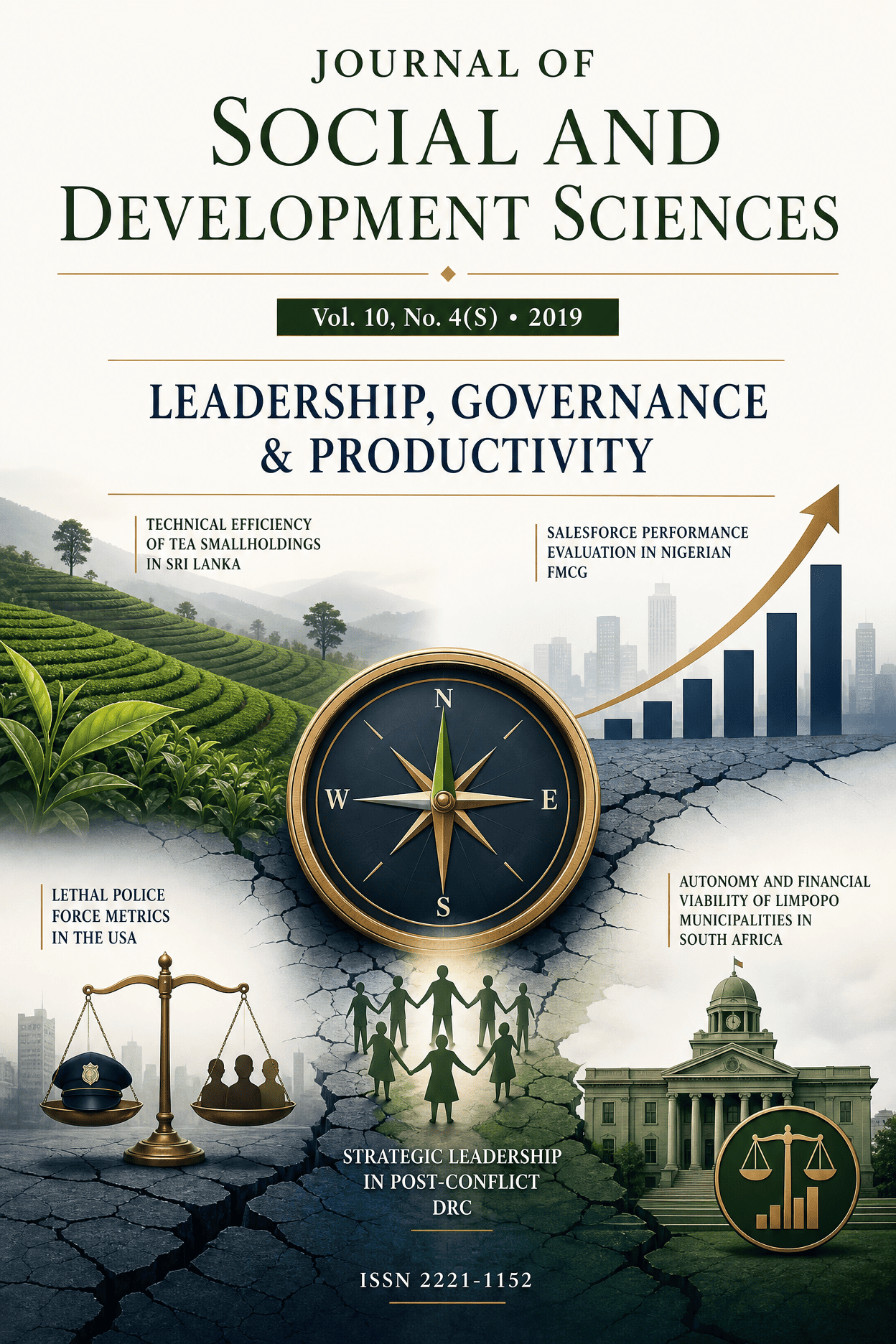
    An Estimation of Technical Efficiency of Tea Smallholdings in Ratnapura District of Sri Lanka

    • Author: Sandunika Jayakody, Sajitha Dishanka

    While accepting the fact that the tea smallholdings sector of Sri Lanka immensely contribute to the annual tea output of the economy, the sector still faces various deficiencies due to problems pertaining to input related issues. Measuring the level of efficiency and identifying the factors which are attributed to inefficiency are in utmost importance in introducing remedies for that. A cross sectional survey was conducted on a sample of tea smallholders in Ratnapura district where highest contribution to the total tea production of the country is made. In this study, the Cobb-Douglas Stochastic production frontier model was used by incorporating the technical inefficiency effect model to estimate the level of technical efficiency in tea smallholdings sector. The study revealed that average technical efficiency of tea smallholdings sector in the study area was 87.36 percent that keeps a margin of 12.64 percent for further improvements through better use of available resources and technology. The results of the Cobb-Douglas model revealed that the estimated coefficients of land, labor and fertilizer are positively and significantly affect the green leaves production of the sector. The findings of the inefficiency model disclosed that age, farming experience, level of education, occupation, age of tea plants, farming group membership and credit access have significant negative impact on technical inefficiency.

    Pages 1-11

    PDF - An Estimation of Technical Efficiency of Tea Smallholdings in Ratnapura District of Sri Lanka (opens in a new tab)
  • Article 2 in this issue

    Performance Evaluation and Improvement among Salesmen in the Nigerian Fast Moving Consumer Goods Sector

    • Author: Olutayo A. Olatunji, Olawumi D. Awolusi

    This study examined the impact of systematic performance evaluation on performance improvement among salesmen in the Fast Moving Consumer Goods Sector in Nigeria. This is occasioned by the peculiar nature of the job of the salesman which requires that specific attention be paid to the mode of performance evaluation deployed for them and its impact on their productivity. Using Yamane formula, convenience sampling method was used to select 263 respondents from the sales team of PZ Cussons Nigeria PLC. Four hypotheses were subsequently tested using correlation test. Based on the analysis, the study found a significant influence of clear, specific and challenging goals on the performance of salesmen in the Fast Moving Consumer Goods sector in Nigeria. It was also deduced that there is no significant influence of detailed and timely feedback on the performance of salesmen in the Fast Moving Consumer Goods sector in Nigeria. Furthermore, the study also revealed a significant influence of employee reward and recognition, as well as, training and development on the performance of salesmen in the Fast Moving Consumer Goods sector in Nigeria. Based on the findings, the study recommended a clear, complete and inspiring job requirement of all salesmen so that the employee can continuously improve performance. Furthermore, feedback from appraisal and evaluation should also inspire, encourage and motivate salesmen without including any form of threat and fear of job security. Finally, Fast Moving Consumer Goods sector in Nigeria should embark on capacity development of human resources through training and mentoring. This study therefore contributes to limited studies on performance evaluation, as well as, validation of both the conceptual and theoretical postulations in the context of Fast Moving Consumer Goods sector in Nigeria.

    Pages 12-29

    PDF - Performance Evaluation and Improvement among Salesmen in the Nigerian Fast Moving Consumer Goods Sector (opens in a new tab)
  • Article 3 in this issue

    The Use of Lethal Force by Police in the USA: Mortality Metrics of Race and Disintegration (2015-2019)

    • Author: John Paull

    Policing in the USA is dangerous for the US public. The objective of the present study is to determine the gross deaths due to lethal force by police and the racial distribution of those deaths compared to the racial distribution of the US population. Longitudinal data reveal that police in the USA kill one thousand people per year (n=1004 in 2019). Deaths by year and race are presented for the years 2015 through 2019. The racial distribution of victims of US police lethal force is not proportionate to the racial distribution of the US population. Whites account for the largest racial group of deaths, but are underrepresented, accounting for 45% of police killings (and 60% of the population). Blacks are over-represented, accounting for 24% of police killings (and 13% of the population). Hispanics are proportionately represented, accounting for 17% of police killings (and 18% of the population). Others (including Asian, Native American, and others) are under-represented, accounting for 4% of police killings (and 8% of the population). The rate of US police killings has been relatively stable for the past five years (with a low of 962 deaths in 2016 and a high of 1,004 deaths in 2019). The US police killing rate in The USA is 3.05 police killings per million of population. The US police killing rate of Blacks is 5.34 per million of Hispanics is 2.63 per million, of Whites is 1.87 per million, and of others is 1.5 per million of population. The US police killing rate of Blacks is 2.86 times the US police killing rate of Whites. US police killing rates compare unfavorably with other jurisdictions. The police fatal shooting rate in Australia is 0.17% per million of population, one eighteenth of the police killing rate in the USA (an Australian rate of police killings applied to the US population would produce 56 US police killings per year). The reasons for the high rate of police killings in the USA and for the racial disparities of those killings are multifactorial. The valorization of violence and the glamorization of guns are woven tightly into the history and culture of the USA. The metrics of US police killings are a symptom of larger issues within American society. Treating one symptom will not remedy the malady blighting the organism. Is it time for an American societal and rethink of its relationship with violence, in the light of these metrics of disintegration? Is Violent America fixable? Only time will tell.

    Pages 30-35

    PDF - The Use of Lethal Force by Police in the USA: Mortality Metrics of Race and Disintegration (2015-2019) (opens in a new tab)
  • Article 4 in this issue

    Strategic Leadership in Post-Conflict States: A Study of the Democratic Republic of Congo (DRC)

    • Author: Louis Muzinga Mukonga, Olawumi D. Awolusi

    The research examines the impact of strategic leadership in post-conflict states. This was achieved by comparing different leadership styles with the performance of the post-conflict state to identify which leadership style fits best with specific performance indicators in The Democratic Republic of Congo (DRC). The study explores the qualitative methodology to assess the impact of strategic leadership in post-conflict states through an explanatory view using an interpretive approach, participant contributions, direct observations, documents, and interviews. Data were analyzed using NVivo data analysis software. The research discovered leadership deficiency at all levels of society. The leadership lacks some essential characteristics to guarantee the well-being of the people. The study also observed an inadequate commitment to support the vision. Also, the mismanagement of country natural resources often causes insecurity and triggers the creation of many armed groups to exploit the resources illegally. The study, therefore, recommended strong committed leadership, the political will, and stable state institutions. One needs a committed leadership to set the vision which can make a change in people's lives, and we can gain the milestones and eventually achieve the vision with the support of the political will and stable state institutions. The study contributes to knowledge by developing a much more user-friendly formula that summarizes the strategic, leadership needed in post-conflict states.

    Pages 36-51

    PDF - Strategic Leadership in Post-Conflict States: A Study of the Democratic Republic of Congo (DRC) (opens in a new tab)
  • Article 5 in this issue

    Autonomy and Financial Viability of Local Authorities in the Limpopo Province Republic of South Africa

    • Author: Gezani Mazibuko

    Premised on the state’s capacity to govern ultimately derives from capacity to manage the budgetary process, this study relates to the autonomy and viability of municipalities in Limpopo Province. The autonomy and financial viability of the Limpopo Province local authorities poses a challenge to the provincial as well as national government. The purpose of the research was to examine whether local authorities in this Limpopo province are autonomous. In addition to determine if they are financially viable. A descriptive research was used to for this research. Based on the outcome of the study, the researched local authorities are not financial viable and autonomous as they depend on grants from national government.

    Pages 52-66

    PDF - Autonomy and Financial Viability of Local Authorities in the Limpopo Province Republic of South Africa (opens in a new tab)