Articles

  • Article 1 in this issue

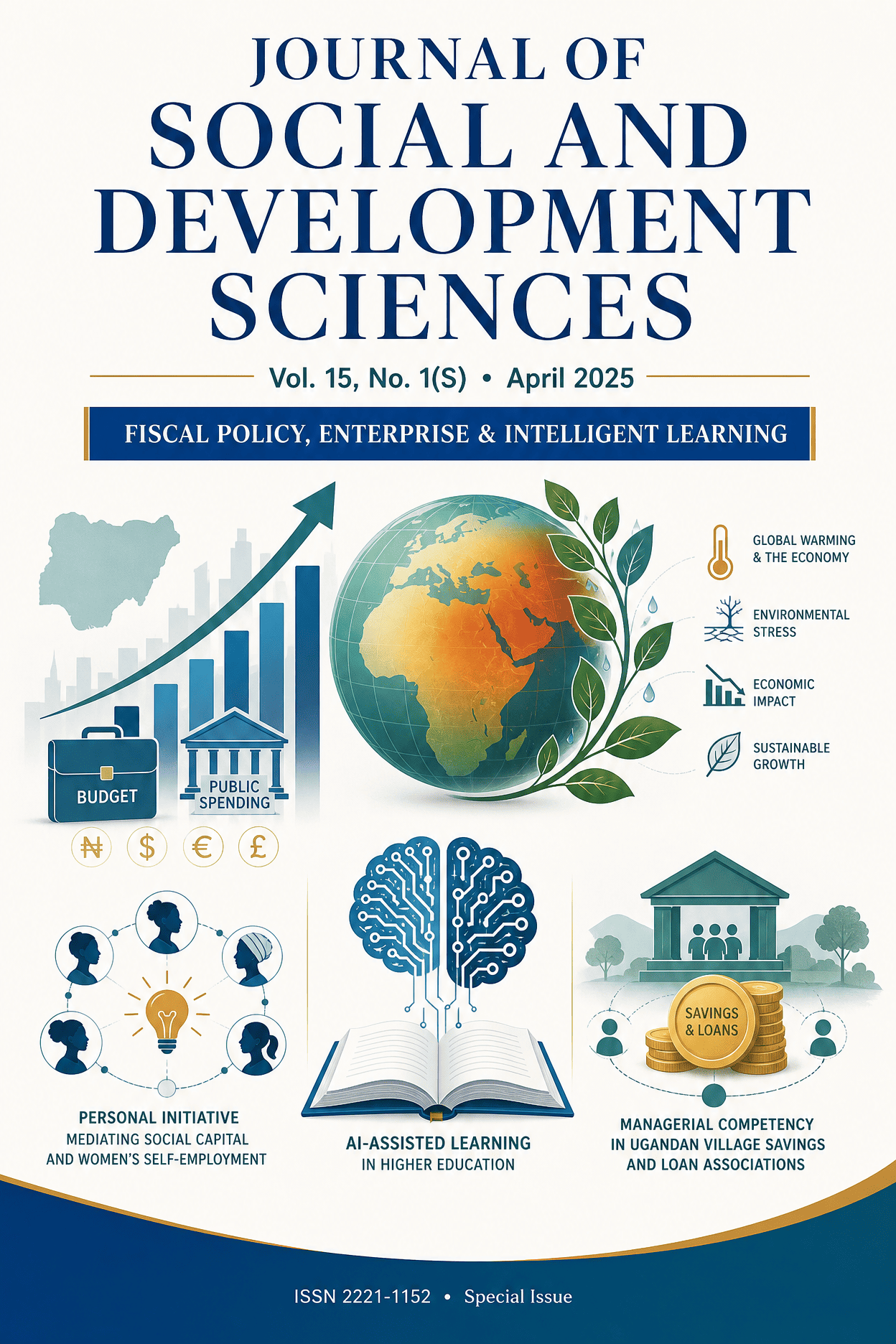
    Convergence of Fiscal Policy and Economic Growth in Nigeria

    • Author: Adesodun Isaac Adebayo, Isaac Babatope Taiwo

    This study investigates the convergence relationship between fiscal policy and economic growth in Nigeria over 38 years. Fiscal policy was captured with public expenditure, revenue, and debt, while economic growth was captured with gross domestic product. The study adopted an expo factor design and a quantitative research approach. Balanced secondary data from 1986 to 2023 were gathered through the National Bureau of Statistics and the Federal Inland Revenue Service. The collected data were subjected to statistical analysis using trend analysis, descriptive statistical analysis, and OLS regression analysis. The findings reveal that public spending significantly and positively impacts Nigeria’s economic growth. Specifically, a 1% increase in government expenditure results in an 8.62% increase in GDP, with a coefficient of 8.62 and a probability value of 0.000 (p < 0.05). This underscores the autonomous capacity of government spending to drive economic growth. Conversely, tax revenue, while positively related to GDP, has a minimal and statistically insignificant effect on economic growth (coefficient = 2.99, probability = 0.4072, p > 0.05), indicating that a 1% rise in tax revenue corresponds to a 3% increase in GDP. Furthermore, the analysis reveals that public debt exerts a negative but statistically insignificant impact on GDP, with a coefficient of -0.617 and a probability value of 0.6565 (p > 0.05), implying that a 1% rise in public debt leads to a 0.6% decline in GDP. The study concludes that government spending plays a critical role in stimulating economic growth in Nigeria, while the current contributions of tax revenue and public debt remain limited. These findings provide valuable insights for policymakers, emphasizing the need for effective fiscal strategies that prioritize productive public spending to enhance long-term economic development in Nigeria.

    Pages 1-13

    PDF - Convergence of Fiscal Policy and Economic Growth in Nigeria (opens in a new tab)
  • Article 2 in this issue

    Exploring Global Warming Impact on the Economy: The Nexus of Global Warming and the Economy in Perspective

    • Author: Lawrence Vorvornator

    This study explores global warming’s impact on the economy, recommending solutions to reduce poverty. Its most important implications are for policy economists who present global warming’s effects as impacting intergenerational equity. Grounded in production theory, the specific emphasis of this study is public-goods investment and agricultural productivity’s dependency on nature. A focus on these two areas is what sets this study apart from similar research. After conducting a meta-study of the relevant qualitative information on these areas, my findings reveal that global warming’s effects are always a trade-off between present and future generations’ consumption of resources. Since the global population increases while resources are limited, historical inequalities are likely to persist if concerted interventions are not widely adopted. I argue that if global warming’s effects are economic problems, the over-exploitation of limited resources needs to be addressed directly and that economic solutions without follow-through cannot fix the problem. Ultimately, the study recommends that reducing greenhouse gas (GHG) emissions, despite negative economic outcomes in the short term, will be beneficial over time. As a result, the present generation needs to invest wisely in environmentally sustainable technologies, rather than short-term goods, so that future generations will enjoy the economic benefits of a clean environment. Research confirms that restricting global warming will affect agricultural productivity now, but trillions of dollars will be recuperated by 2300 as a result. The sooner environmentally friendly technologies are adopted by businesses the better. Although these findings are not novel, they are timely because meta-studies such as this combat disinformation.

    Pages 14-23

    PDF - Exploring Global Warming Impact on the Economy: The Nexus of Global Warming and the Economy in Perspective (opens in a new tab)
  • Article 3 in this issue

    The Mediating Role of Personal Initiative in The Relationship Between Social Capital and Women's Self-Employment

    • Author: Benjamin Musiita, Atwine Daniel Wanito, Asaph Kaburura Katarangi, Sheila Akampwera

    This study examines the mediating role of personal initiative in the relationship between social capital and women's self-employment in Mbarara City, Uganda. The inquiry was driven by the persistent gender gap in economic participation and the growing importance of self-employment as a pathway to women’s economic empowerment in developing contexts. Grounded in Social Capital Theory and Gender Role Theory, the study conceptualizes personal initiative as a dynamic force that channels the benefits of social capital into tangible entrepreneurial action. A cross-sectional, quantitative design was employed, with data collected from 378 self-employed women across Mbarara City using stratified random sampling. Results from Pearson correlations, multiple regression, and mediation analyses reveal that both social capital and personal initiative have a significant and positive relationship with women's self-employment (β = .229 and β = .430, respectively). Moreover, personal initiative was found to partially mediate the relationship between social capital and women's self-employment, accounting for approximately 51.8% of the total effect. These findings highlight the necessity of fostering both structural support systems and internal motivational factors to enhance women's economic participation. Policy recommendations include integrating entrepreneurship training with network-building programs and addressing institutional barriers that constrain women's proactive engagement in business.

    Pages 24-35

    PDF - The Mediating Role of Personal Initiative in The Relationship Between Social Capital and Women's Self-Employment (opens in a new tab)
  • Article 4 in this issue

    The Role of AI-Assisted Learning Tools in Higher Education: Balancing Efficiency, Critical Thinking and Academic Integrity

    • Author: Hanafiah Hasin, Anita Jamil, Zaleha Mahat, Rahayu Sehat, Eka Fauzihardani

    This study examines the dual nature of AI-assisted learning tools in higher education. While AI tools enhance student learning efficiency and academic performance, they also present risks such as over-reliance, reduced critical thinking, and ethical concerns. This research investigates the benefits and drawbacks of AI adoption in higher education, using student survey responses to analyse perceptions. The findings indicate that AI tools contribute to improved efficiency and comprehension but highlight dependency and academic integrity concerns. A cross-sectional survey of 383 Malaysian university students was conducted to explore the academic and ethical dimensions of AI usage in learning.

    Pages 36-46

    PDF - The Role of AI-Assisted Learning Tools in Higher Education: Balancing Efficiency, Critical Thinking and Academic Integrity (opens in a new tab)
  • Article 5 in this issue

    Managerial Competency and Profitability of Village Savings and Loan Associations in Mitooma District

    • Author: Ronald Tugume, John Kule Baguma, Benjamin Musiita

    The research investigates how managerial competency affects the financial success of Village Savings and Loan Associations (VSLAs) operating in the Mitooma District of Uganda. The research investigates rural VSLA underperformance because these organizations serve as essential tools for financial inclusion and community development. The research uses human capital and resource-based theories to define managerial competency through its knowledge and skill, and ability dimensions while studying their effects on Return on Equity, Return on Assets, and Net Interest Margin financial performance metrics. The research used a crosssectional quantitative approach to gather data from 138 participants who including 124 VSLA chairpersons and 14 Community Development Officers, through structured questionnaires. The analysis of data through Pearson correlations and multiple regression analyses showed that all managerial competency components, including knowledge (β =.147), skills (β =.644), and abilities (β =.194), produced positive and significant predictions of VSLA profitability. The results show that managerial skills play the largest role in determining VSLA profitability. The regression model demonstrated that 48.6% of profitability variation exists, while other contextual elements influence the results. The research demonstrates that leadership capacity-building investments should be considered essential for improving financial outcomes in rural savings groups. The research supports the implementation of customized managerial training programs and practical financial governance modules, and structured mentorship initiatives to boost VSLA sustainability in low-resource settings.

    Pages 47-59

    PDF - Managerial Competency and Profitability of Village Savings and Loan Associations in Mitooma District (opens in a new tab)