Abstract
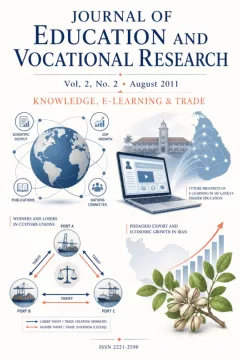
Pistachio is one of the most important agricultural sector products in Iran. This product is important because of creating exchange, employment, value added and other economic conditions. The purpose of this study is to determine the relationship between pistachio export and economic growth in Iran. The theoretical framework was designed based on this assumption that the total production in the economy is divided into two sections: production for inside and production for export. The data were collected from 1990 to 2003 and were analyzed using Auto Regressive Distributed Lag (ARDL) model. The result of the analyses showed that there was significant relationship between pistachio export and economic growth. Together the independent variables explained 89% of the variance in the dependent variables. The remaining 11% was due to unidentified variables. In relation to that, we can conclude that explanatory power is high for the equation. It showed that one percent change in pistachio export rate lead to 38% in economic growth. Therefore pistachio export is regarded as an important factor in Iran's economic growth.
Keywords
References
- Bakhtiari, S., & Haghi, Z. (2001). The effect of increase in oil incomes on agricultural sector in Iran. Quarterly Journal of EQTESAD-E KESHAVARZI VA TOWSE'E, 9 (35), 109-138.
- Banerjee, A., Dolado, J., Galbraith, J., W., & Hendry, D., F. (1993). Co-integration, Error Correction and the Econometric Analysis of Non-Stationary Data . Oxford: Oxford University Press.
- Banerjee, A., J., Dolado J., & Mestre R. (1998). Error-correction mechanism tests for cointegration in a single-equation framework. Journal of Time Series Analysis, 19 , 267–83.
- Esfahani, H., S. (1999). Export, Imports and Economic Growth in semi. Industrialized Countries Journal of Development Economics , 35, 93-116. Export Promotion Center of Iran 'EPCI' Different Reports between 2001 and 2002.
- Feder, G. (1982). On Exports and Economic Growth. Journal of Development Economics , 12, 59-73.
- Hamuda, A., M., Elbeidi, R., M., & Vladimir G. (2010). The Relationship between Export and Economic Growth in Libya Arab Jamahiriya. Theoretical and Applied Economics, 27(1), 69-76.
- Jordan, A., C. (2007). Eita Joel Hinaunye Export and Economic Growth in Namibia: A Granger Causality Analysis. South Africa Journal of Economic , 25, 540-547.
- Leaderman, D. & Maloney, W., F. (2003). Trade Structure and Growth, World Bank Policy Research Working Paper, 3025.
- Leamer, E. (1984). Sources of Comparative Advantage, Theory and Evidence. Cambridge Massachusetts: MIT Press.
- Pahlavani, M. (2005). Sources of Economic Growth in Iran: A Co-integration analysis in the presence of structural breaks. Applied Econometrics and international Development, 5(4), 83-94.
- Pahlavani, M., Valadkhani, A. & Worthington, A. (2005). The Impact of Financial Deregulation on Monetary Aggregates and Interest Rates in Australia Applied Financial Economics Letters , 1(3), 157-163.
- Panday, A., K. (2006). Export and Economic Growth in India: Causal Interpretation. Journal of Global Economy , 2, 245-277.
- Papapetrou, E., (2001). Oil price shocks, stock market, economic activity and employment in Greece. Energy Economics, 23(5), 511-532.
- Pesaran, M., H. (2000). Economic Trends and Macroeconomic Policies in Post Revolutionary Iran. Journal of Money and Banking , 1(2), 26-66.
- Pesaran, M. H. & Smith, R. (1998). Structural analysis of cointegrating VARs. Journal of Economic Surveys 471-506. Also published in L. Oxley and M. McAleer (eds) Practical Issues in Co-integration Analysis , (1999), chapter 3, Oxford, Basil Blackwell. ISBN 0 631 21198 5.
- Sachs, J. & Warner, A. (2001). Natural Resource Abundance and Economic Development, The Curse of Natural Resources. European Economic Review , 45, 827-838.
- Shan, J. & Sun, F. (1998). On the Export-led Growth Hypothesis for the little Dragons: An Empirical Reinvestigation. Atlantic Economic Journal , 26 (4), 353-371.
Downloads
No downloads have been recorded for this article yet. Figures appear here once readers begin downloading the full text.
How to Cite
Share this article
License
Copyright (c) 2011 Safdari Mehdi, Motiee Reza (Author)

This work is licensed under a Creative Commons Attribution 4.0 International License.
Author (s) should affirm that the material has not been published previously. It has not been submitted and it is not under consideration by any other journal. At the same time author (s) need to execute a publication permission agreement to assume the responsibility of the submitted content and any omissions and errors therein. After submission of revised paper in the light of suggestions of the reviewers, the editorial team edits and formats manuscripts to bring uniformity and standardization in published material.
This work will be licensed under Creative Commons Attribution 4.0 International (CC BY 4.0) and under condition of the license, users are free to read, copy, remix, transform, redistribute, download, print, search or link to the full texts of articles and even build upon their work as long as they credit the author for the original work. Moreover, as per journal policy author (s) hold and retain copyrights without any restrictions.
Keywords
Section
Published
Submissions
Have research to publish? Journal of Education and Vocational Research welcomes submissions.
Make a Submission