Review of Harvard Business Review on Collaborating Across Silos
- Author: Shiva Kumar Srinivasan
Knowledge, E-Learning & Trade
This issue connects knowledge production, digital education, and international trade. Papers examine the causal relationship between scientific output and GDP across 176 countries, the future prospects of e-learning in Sri Lankan higher education, winners and losers in customs unions through an experimental Ricardian model, and the contribution of pistachio exports to economic growth in Iran, alongside a review of Harvard Business Review on collaborating across silos.
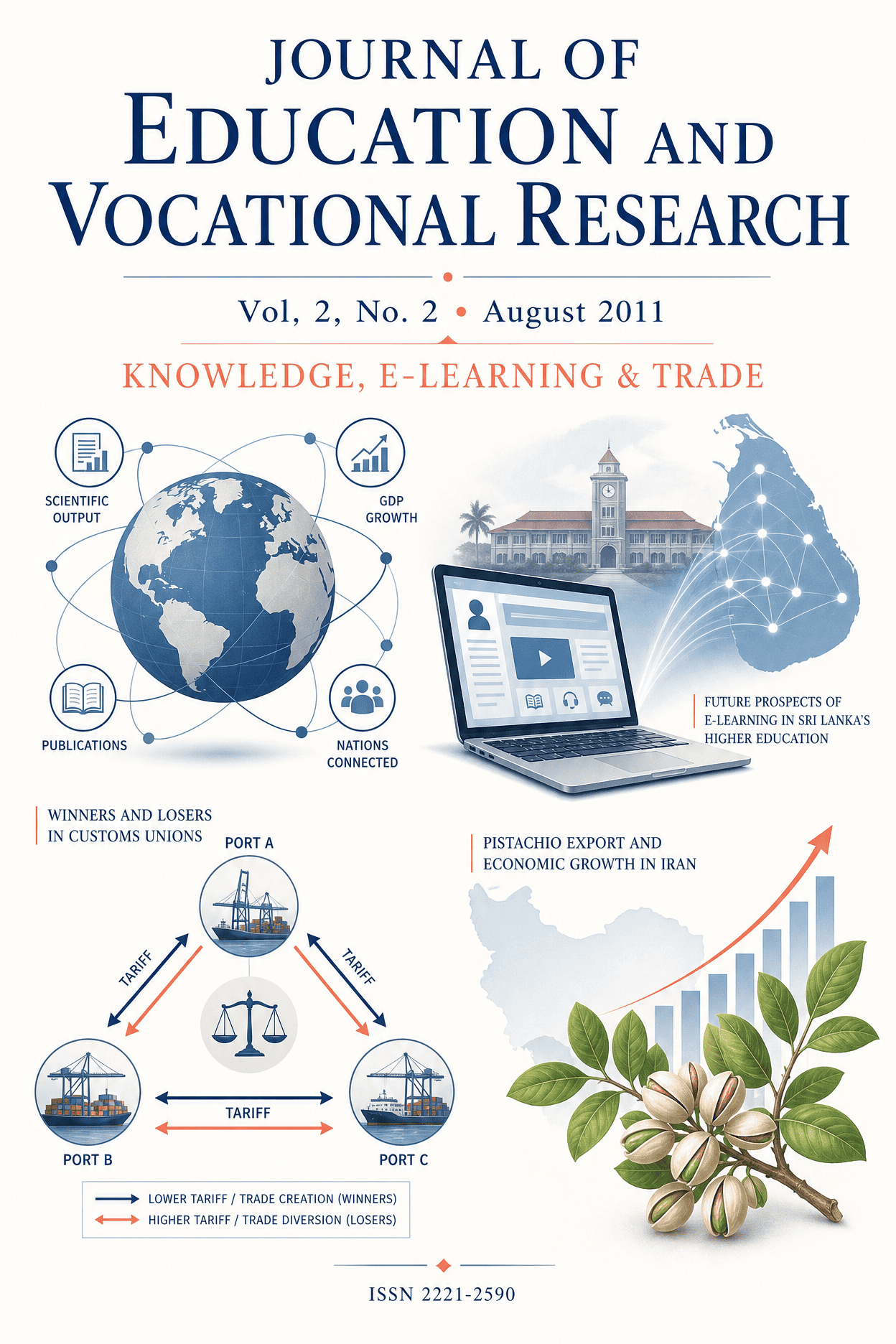
Scientific output is one of the important determinants of economic development in countries around the world. The extremely high scientific productivity of developing countries can be corrected by increased funding as investment on publications and also as a measure of scientific output. The purpose of the present paper is to examine the casual relationship between scientific output and GDP in 176 countries from both developing as well as developed countries. Our findings based on estimated regression models using a panel data for the periods 1996-2007 indicate that except in poor countries, there is a two-way and positive relationship between scientific output and GDP.
Read more about Scientific Output and GDP: Evidence from Countries around the WorldThe use of Information and Communication Technology (ICT) in higher education has created totally a new environment which is fundamentally different from the traditional learning methods. The objectives of the study were to get the view of the University Grants Commission (UGC) about e-learning system and to investigate the possibilities of formalizing its implementation in the universities in future. As it is an exploratory study, the case study method was deemed appropriate. The result of the study shows that the UGC is favorable on the implementation of a campus-wide e-learning system in all universities. Though there is no formal policy on the embarkation of e-learning mode so far, it encourages the universities to adopt the system. This paper has also highlighted the possible areas for the early implementation of the e-learning mode and other requirements that should be considered for the future adoption of e-learning system.
Read more about The Future Prospects of E-learning: The View of the Apex Body of Higher Educational Institutions (HEIs) in Sri LankaIn the context of a Competitive Ricardian Model (CRM), one can ask whether it is possible to relate winners and losers from a CU based on comparative advantage considerations. This was pursued by Venables (2003), who showed that careful consideration of a country’s comparative advantage – with the rest of the world relative to that with its partners in the CU- yields predictions about winners and losers. Starting from initial tariff equilibrium, in a 3 country model with a continuum of goods, he shows that a country with ‘extreme’ comparative advantage will be more vulnerable to trade diversion. In this experiment, the 3 x 3 Competitive Ricardian Model (CRM) in two scenarios multiple import tariffs and a customs union. We fully characterise the equilibrium under both. Starting from a tariff distorted situation, we find that when a customs union is formed there is an increase in trade flows among members; a rise in individual consumption of some goods; a clear terms of trade effect and the existence of trade diversion. Our experimental results support the simulation findings of Venables (2003), who showed that countries which have ‘extreme’ comparative advantage in a customs union will generally be more vulnerable to trade diversion.
Read more about Winners and Losers in Customs Unions: An Experimental InvestigationPistachio is one of the most important agricultural sector products in Iran. This product is important because of creating exchange, employment, value added and other economic conditions. The purpose of this study is to determine the relationship between pistachio export and economic growth in Iran. The theoretical framework was designed based on this assumption that the total production in the economy is divided into two sections: production for inside and production for export. The data were collected from 1990 to 2003 and were analyzed using Auto Regressive Distributed Lag (ARDL) model. The result of the analyses showed that there was significant relationship between pistachio export and economic growth. Together the independent variables explained 89% of the variance in the dependent variables. The remaining 11% was due to unidentified variables. In relation to that, we can conclude that explanatory power is high for the equation. It showed that one percent change in pistachio export rate lead to 38% in economic growth. Therefore pistachio export is regarded as an important factor in Iran's economic growth.
Read more about A Study Examining the Effect of Pistachio Export in Iran