Abstract
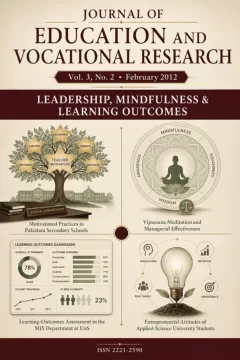
This empirical study investigated the efforts of two Pakistani school administrators in dealing with the issues related to teachers’ motivation. This study exclusively examined how the two administrators embedded in their practices different ways of increasing the productivity of their staff. The researcher used the following three lenses to examine the motivational behavior adopted by the school leaders: 1) degree of teachers’ empowerment; 2) nature of rewards and recognition to honor teachers; and 3) pattern of communication between administrators and school staff. The study maintained that the private school administrator, unlike his public school counterpart, had a more updated knowledge in the field of education due to his exposure to professional development programs. This knowledge, which gave him a better understanding of the link between the motivational level of the teachers and the teachers’ productivity, led him to initiate certain measures. Unfortunately, only a limited quantity of research explores different dimensions of school leadership in the educational context of Pakistan. Therefore, this study attempted to address related issues, such as the recruitment of school leaders and the availability of professional development opportunities.
Keywords
- Pakistan Search this journal for Pakistan (opens in a new tab)
- School Administrators Search this journal for School Administrators (opens in a new tab)
- Government School Search this journal for Government School (opens in a new tab)
- Private School Search this journal for Private School (opens in a new tab)
References
- Alderman, H., Orazem, P. F., & Paterno, E. M. (2001). School quality, school cost, and the public/private school choices of low-income households in Pakistan. Journal of Human Resources , 36(2), 304-326.
- Andrabi, T., Das, J. & Khwaja, A. I. (2008). A dime a day: The possibilities and limits of private schooling in Pakistan. Comparative and International Education Society , 52(3), 329-355.
- Begley, P. T. (2008). The nature and specialized purposes of educational leadership. In J. Lumby., G, Crow. & P.Pashiardis (Eds.), International handbook on the preparation and development of school leaders (21-42). New York: Routledge Taylor and Francis.
- Bush, T. (2008). Leadership and Management Development in Education. Los Angeles: Sage Publications.
- Castillo, J. (2009). Convenience sampling applied to research. Retrieved from http://www.experimentresources.com/convenience-sampling.htm
- Constas, M. A. (1992). Qualitative analysis as a public event: The documentation of category development procedures. American Educational Research Association , 29(2), 253-266.
- Corbin, J. & Strauss, A. (2008).Basics of qualitative research. Techniques and procedures for developing grounded theory. Los Angeles, CA: Sage Publications.
- Dalin, P., Rolff, G. & Kleekamp, B. (1993). Changing the school culture. New York: The Imtec Foundation.
- Evans, L. (2001). Delving deeper into morale, job satisfaction, and motivation among education professional: Re-examining the leadership dimension. Educational Management Administration Leadership , 29(3), 291-306.
- Garrett, R. M. (1999). Teacher job satisfaction in developing countries. ERIC documents no 459150.
- Grassie, M. C. & Carss, B. W. (1973). School structure, leadership quality and teacher satisfaction. Educational Administration Quarterly , 9(15), 15-26.
- Griffith, J. (2004). Relation of administrator transformational leadership to school staff job satisfaction, staff turnover, and school performance. Journal of Educational Administration , 42(3), 333-356.
- Hallinger, P. & Murphy, J. (1985). Assessing the instructional management behavior of principals. The Elementary School Journal , 86(2), 217-247.
- James, C. & Vince, R. (2001). Developing the leadership capability of head teachers. Educational Management Administration Leadership , 29(3), 307-317.
- Khan, A. (2010). A case study exploring perceived professional development needs for secondary school administrators in Pakistan. (Unpublished PhD dissertation). Administrative and Policy Studies, School of Education, University of Pittsburgh, Pennsylvania.
- Khan, H. (2004). Better school management in the Islamic Republic of Pakistan: The role of head teacher. In M. Kandasamay & L.Blaton (Eds.). School Administrators: Core actors in educational improvement, an analysis of seven Asian countries (59-113). Paris: International Institute for Educational Planning.
- Khan, S. R. (2005). Basic education in rural Pakistan. A comparative institutional analysis of government private and NGO Schools. Karachi: Oxford University Press.
- Kizilbash, H. H. (1998). Teaching teacher to teach. In P.Hoodbhoy (Ed.), Education and state, fifty years of Pakistan (102-135). Karachi: Oxford University Press.
- Lincoln, Y. S. & Guba, E. G. (1981). Naturalistic inquiry. Beverly Hilla, CA: Sage Publications.
- Lee, V. E., Dedrick, R. F. & Smith, J. B. (1991). The effect of the social organization of schools on teachers efficacy and satisfaction. Sociology of Education , 64, 190-208.
- Maehr, M. L., Midgley, C. & Urdan, T. (1992). School leader as motivator. Educational Administration Quarterly , 28(3) 410-429.
- McDowelle, J. O. & Buckner, K. G. (2002). Leading with emotion. Reaching balance in educational decision making. Lanham, Maryland: The Scarecrow Press.
- Memon, M. (2000). Re-conceptualizing the role of head teachers as pedagogical leaders in Pakistan: implication for policy reforms. Education , 3(12), 6-10.
- Memon, M. & Bana, Z. (2005). Pedagogical leadership in Pakistan: Two head teachers from the Northern Areas. In J. Retallick, & I.Farah (Eds). Transforming schools in Pakistan. Towards the learning community. Karachi: Oxford University Press.
- Memon, M., Ali, R. N., Simkins, T. & Garrett, S. (2000). Understanding the head teachers’ role in Pakistan: Emerging role demands constrains and choices. International Studies in Educational Administration , 28(2), 48-56.
- Mertens, D. M. (2005). Research and evaluation in education and Psychology. (2nd Ed).Thousand Oaks: Sage publications.
- Miles, B. M. & Huberman, M. A. (1984). Qualitative data analysis. A source book of new methods. Newbury Park, CA: Sage publications.
- Ogawa, R. T. & Malen, B. (1991). Towards rigor in review of multivocal literatures. Applying the exploratory case study method. Review of Educational Research , 61(3), 265-286.
- Peterson, K. D. (1987). Administrative control and instructional leadership. In: Greenfield, W. (Ed.), Instructional Leadership: Concepts, Issues, and Controversies. Boston, MA: Allyn and Bacon, Inc.
- Patton, M. Q. (2002). Qualitative research and evaluation methods. Thousand Oak, CA: Sage Publications.
- Pounder, D. G. (1993). Organizational orientation in public and private elementary schools. Journal of Educational Research , 87(2), 86-93.
- Rizvi, M. (2008). The role of school administrators in enhancing teacher professionalism: Lessons from Pakistan. Educational Management Administration and Leadership , 36(1), 85-100.
- Sergiovani, T. (1967). Factors, which affect satisfaction and dissatisfaction of teachers. The Journal of Educational Administration , 5(1), 66-82.
- Simkins, T. Sisum, C. & Memon, M. (2003). School leadership in Pakistan: Exploring the head teacher’s role. School Effectiveness and School Improvement , 14(3), 275-291.
- Stainback, S. & Stainback, W. (1988). Understanding and conducting qualitative research. Dubuque, IA: Kendall/ Hunt Publishing Company.
- Stake, E. R. (1995). The art of case study research. Thousand Oaks: Sage Publications.
- Papanastasiou, E. & Zembylas, M. (2005). Job satisfaction among school teachers in Cyprus. Journal of Educational Administration , 42(3), 357-374.
- Warwick, D. P. & Reimers, F. (1995). Hope or Despair: Learning in Pakistan’s Primary Schools. CT: Praeger Publisher.
- Yin, R. K. (2009). Case study research. Design and methods. Los Angeles: Sage Publications.
Downloads
No downloads have been recorded for this article yet. Figures appear here once readers begin downloading the full text.
How to Cite
Share this article
License
Copyright (c) 2012 Asif Khan (Author)

This work is licensed under a Creative Commons Attribution 4.0 International License.
Author (s) should affirm that the material has not been published previously. It has not been submitted and it is not under consideration by any other journal. At the same time author (s) need to execute a publication permission agreement to assume the responsibility of the submitted content and any omissions and errors therein. After submission of revised paper in the light of suggestions of the reviewers, the editorial team edits and formats manuscripts to bring uniformity and standardization in published material.
This work will be licensed under Creative Commons Attribution 4.0 International (CC BY 4.0) and under condition of the license, users are free to read, copy, remix, transform, redistribute, download, print, search or link to the full texts of articles and even build upon their work as long as they credit the author for the original work. Moreover, as per journal policy author (s) hold and retain copyrights without any restrictions.
Keywords
- Pakistan Search this journal for Pakistan (opens in a new tab)
- School Administrators Search this journal for School Administrators (opens in a new tab)
- Government School Search this journal for Government School (opens in a new tab)
- Private School Search this journal for Private School (opens in a new tab)
Section
Published
Submissions
Have research to publish? Journal of Education and Vocational Research welcomes submissions.
Make a Submission