Articles

  • Article 1 in this issue

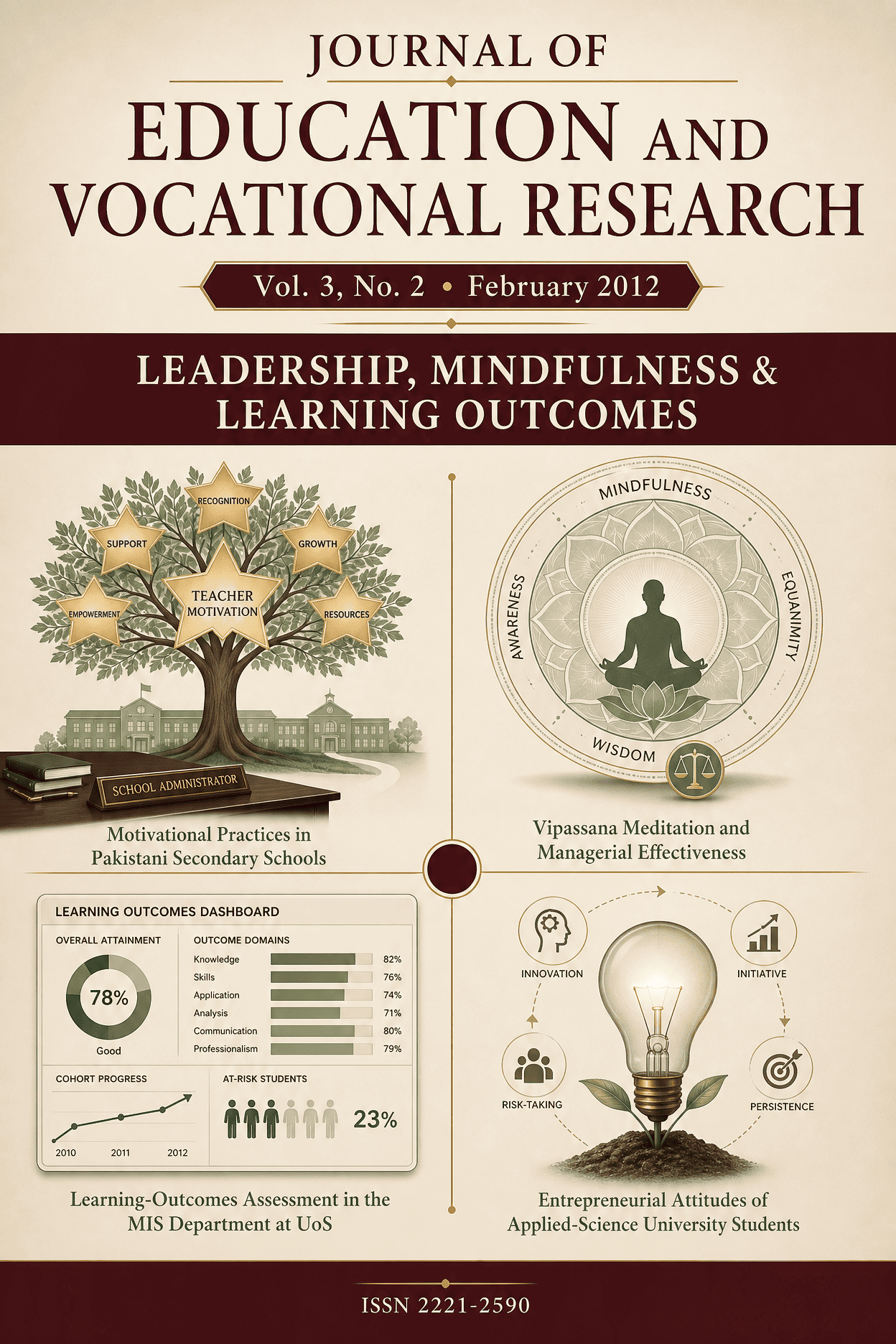
    The Effectiveness of Motivational Practices in Public and Private Secondary Schools in Pakistan: A Case Study of Two Administrators

    • Author: Asif Khan

    This empirical study investigated the efforts of two Pakistani school administrators in dealing with the issues related to teachers’ motivation. This study exclusively examined how the two administrators embedded in their practices different ways of increasing the productivity of their staff. The researcher used the following three lenses to examine the motivational behavior adopted by the school leaders: 1) degree of teachers’ empowerment; 2) nature of rewards and recognition to honor teachers; and 3) pattern of communication between administrators and school staff. The study maintained that the private school administrator, unlike his public school counterpart, had a more updated knowledge in the field of education due to his exposure to professional development programs. This knowledge, which gave him a better understanding of the link between the motivational level of the teachers and the teachers’ productivity, led him to initiate certain measures. Unfortunately, only a limited quantity of research explores different dimensions of school leadership in the educational context of Pakistan. Therefore, this study attempted to address related issues, such as the recruitment of school leaders and the availability of professional development opportunities.

    Pages 35-47

    PDF - The Effectiveness of Motivational Practices in Public and Private Secondary Schools in Pakistan: A Case Study of Two Administrators (opens in a new tab)
  • Article 2 in this issue

    Vipassana Meditation and Life Effectiveness

    • Author: Dileep Kumar. M

    the present study is aimed at understanding the influence of Vipassana Meditation among business managers who did Vipassana Meditation during their management education or after. How far Vipassana Meditation process influences life effectiveness of these young managers. Quantitative-multidimensional analysis of attitudinal and behavioral variables is the primary focus of this study. Exploratory study is conducted to arrive at appropriate variables in relation the professional and personal dimensions selected for the study. Data collection made from 176 junior level managers, who have passed out from five business schools in Pune, India. Independent and dependent variables are analyzed into with correlation and multiple regression models. The findings indicate that the Vipassana meditation process is having high influence on professional and personal effectiveness of managers. This research study envisages the importance of holistic education to the management graduates that ensure the development of physically stable, mentally alert and professionally matured students for better operations and business excellence.

    Pages 48-57

    PDF - Vipassana Meditation and Life Effectiveness (opens in a new tab)
  • Article 3 in this issue

    Effective Learning Outcomes Assessment: The Case of the MIS Department at the UoS

    • Author: Nadia Rifaat, Oualid Ben Ali, Waleed M. Al Sabhan, Mohammed Nour

    Accrediting organizations now mandate the development of learning outcomes (LO) and the methods to assess those learning outcomes for national and international institutions of higher learning. Because of this, academic institutions pay greater attention to the development and assessment of these LO. There are two types of learning outcomes: course outcomes and program outcomes. This paper presents an empirical study that examines both kinds of LO in a case study of one course (title: Database Fundamental and Applications, number: 0303331) within the Management Information System (MIS) department at the University of Sharjah (UoS), United Arab Emirates and presents the following with regard to this case study: 1) the development process of the LO for this specific course; 2) the data collection process, and 3) the data collected related to the assessment instruments for both the course and program LO ( course learning instructions, course exams, course projects, students’ records, students’ grades, course reports, course evaluation, instructor evaluation, exit surveys, employer surveys, and job placement indicators ); 4) the methods of assessment of the LO based on the analysis of the collected data using a variety of analysis technique and tools; and 5) the usage of the analysis results in successive semesters in order to improve the MIS courses and program. The findings of this empirical study suggest several areas for improvement. One improvement is the addition of more practice-based learning components. Additionally, the study shows that the enhancement of the course material, the improvement of teaching strategies, and the usage of technology and its infusion into the learning process are areas that can improve LO. Overall, the method of LO development and assessment described in this empirical examination has shown a positive effect on the courses and program in the MIS department, and it is believed that the results can be generalized for use by others in developing and assessing LO in other learning institutions.

    Pages 58-70

    PDF - Effective Learning Outcomes Assessment: The Case of the MIS Department at the UoS (opens in a new tab)
  • Article 4 in this issue

    An Examination and Analysis of Municipal Scientific and Applied University Students Entrepreneurial Attitude

    • Author: Peyman Pournasr Khakbaz

    At the time, entrepreneurship training has evolved into of the main and expansive academic activities, and developing academic students' abilities owes to expanding and upbringing entrepreneurship capabilities. Accordingly, examining entrepreneurial attitude of university students which itself is the most significant alternatives of launching new businesses and knowledge-based, can be helpful in purposeful entrepreneurship trainings and lead them to proper trend. In this study, entrepreneurial attitude of Municipal Scientific and Applied University students was examined at individual level regarding major indices such as entrepreneurial attitude, proactiveness, risk-taking, creativity and innovation, autonomy, and competitive aggressiveness, and it was demonstrated that the students were at suitable level considering entrepreneurial attitude. In addition, since many of them were interested in attending entrepreneurship courses, it is possible to actualize the potential attitude and tendency by including entrepreneurship-training courses at different faculties and lead them to establish businesses in a purposeful way.

    Pages 71-79

    PDF - An Examination and Analysis of Municipal Scientific and Applied University Students Entrepreneurial Attitude (opens in a new tab)