Abstract
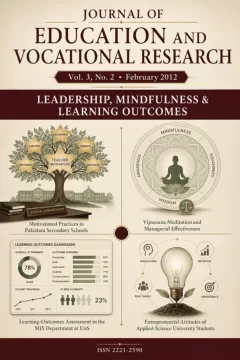
At the time, entrepreneurship training has evolved into of the main and expansive academic activities, and developing academic students' abilities owes to expanding and upbringing entrepreneurship capabilities. Accordingly, examining entrepreneurial attitude of university students which itself is the most significant alternatives of launching new businesses and knowledge-based, can be helpful in purposeful entrepreneurship trainings and lead them to proper trend. In this study, entrepreneurial attitude of Municipal Scientific and Applied University students was examined at individual level regarding major indices such as entrepreneurial attitude, proactiveness, risk-taking, creativity and innovation, autonomy, and competitive aggressiveness, and it was demonstrated that the students were at suitable level considering entrepreneurial attitude. In addition, since many of them were interested in attending entrepreneurship courses, it is possible to actualize the potential attitude and tendency by including entrepreneurship-training courses at different faculties and lead them to establish businesses in a purposeful way.
Keywords
- Entrepreneurial Attitude Search this journal for Entrepreneurial Attitude (opens in a new tab)
- Risk-Taking Search this journal for Risk-Taking (opens in a new tab)
- Success-Centeredness Search this journal for Success-Centeredness (opens in a new tab)
- Innovation Search this journal for Innovation (opens in a new tab)
- Autonomy Search this journal for Autonomy (opens in a new tab)
- Competitive Aggressiveness Search this journal for Competitive Aggressiveness (opens in a new tab)
References
- Autio, E., Keeley, R., Klofsten, M., Parker, G. & Hay, M. (2001). Entrepreneurial Intent among Students in Scandinavia and in the USA. Enterprise and Innovation Management Studies , 2(2), 145-160.
- Chen, Y. F. & Lai, M. C. (2010). Factors influencing the entrepreneurial attitude of Taiwanese tertiary-level business students. Social Behavior and Personality , 38(1), 1-12.
- Covin, J. G. & Slevin, D. P. (2002). The entrepreneurial imperatives of strategic leadership. In M.A. Hitt, R.D. Ireland, S.M. Camp, & D.L. Sexton (Eds.). Strategic entrepreneurship: Creating a new mindset (309– 327). Oxford: Blackwell.
- Erich, J. S., Malgorzata, A., Wdowiak, D. A., Almer, J. & Robert, J. (2009). Breitenecker the effects of attitudes and perceived environment conditions on students ’entrepreneurial intent. Education Training , 51(4), 272-291.
- Fazio, R. H. (1990). Multiple processes by which attitudes guide behavior: the MODE model as an integrative framework. In M.P. Zanna (Ed.). Advances in experimental social psychology, 23, 75109). San Diego, CA: Academic Press. Frontiers of Entrepreneurship Research, 566-587.
- Gibson, L., Gibson, R. & Zhao, S. (2011). Factors affecting entrepreneurial attitudes of American and Chinese business students, USASBE_2011_Proceedings-Page1021
- Gibson, L., Shanan, G., Harris, M. & Harris, D. (2010). Investigating the Entrepreneurial Attitudes of African Americans: a study of young. Small Business Institute® National Conference Proceedings
- Gibson, S. G., Harris, M. & Harris, D. (2010). Investigating the Entrepreneurial Attitudes of African Americans: a study of young. Small Business Institute® National Conference Proceedings
- Harris, M. L. & Gibson, S. H. (2008). A Comparison of Entrepreneurial Attitudes in the U.S. And China. United States association of small business and entrepreneurship (USASBE) Annual National Conference.
- Henderson, R. & Robertson, M. (2000). Who Wants To Be an Entrepreneur? Young Adult attitudes to entrepreneurship as a career. Career Development International, 5 (6), 279-287.
- Florin, J., Karri, R. & Rossiter, N. (2007). Fostering Entrepreneurial Drive in Business Education: An Attitudinal Approach. Journal of Management Education, 31, 17-25.
- Kundu, S. & Rani, S. (2008) .Human resources’ entrepreneurial attitude orientation by gender and background: a study of Indian Air Force trainees. Int. J. Management and Enterprise Development , 5(1).
- Liñán, F., Urbano, D. & Guerrero, M. (2010). Regional variations in entrepreneurial cognitions: Start-up intentions of university students in Spain. Entrepreneurship and Regional Development.
- McCline, R. L., Bhat, S. & Baj, P. (2000). Opportunity recognition: An exploratory investigation of a component of the entrepreneurial process in the context of the health care industry. Entrepreneurship Theory and Practice , 25 , 81–144.
- Mentoor, E. & Friedrich, C. (2007). Is entrepreneurial education at South African universities successful? An empirical example. Industry and Higher Education , 21(3), 231-232.
- Michael, L. H. & Shanan, G. G. (2008); examining the entrepreneurial attitudes of US business students. Education þ Training , 50(7), 568-581
- Naffziger, D. W., Hornsby, J. S. & Kuratko, D. F. (1994). A proposed research model of entrepreneurial motivation. Entrepreneurship Theory and Practice, 17 (1), 49 – 55.
- Olson, P. D. & Bosserman, D, A. (1984). Attributes of the entrepreneurial type. Business Horizons, 2, 53-56.
- Peterman, N. E. & Kennedy, J. (2003). Enterprise education: Influencing student’s perceptions of entrepreneurship. Entrepreneurship Theory and Practice , 28 , 129–144.
- Ramsdal, G. H. (2008). Differential relations between two dimensions of self-esteem and the Big Five? Scandinavian Journal of Psychology, 49 , 333-338.
- Robinson, P. B., Stimpson, D. V., Huefner, J. C. & Hunt, H. K. (1991). An attitude approach to the prediction of entrepreneurship. Entrepreneurship Theory and Practice. Summer, 13-31.
- Rosenberg, M. J. & Hovland, C. I. (1960). Cognitive, affective, and behavioral components of attitudes. In M. J. Rosenberg, C. I. Hovland, W. J. McGuire, R. P. Abelson, & J. W. Brehm (Eds.), Attitude organization and change: An analysis of consistency among attitude components. New Haven, CT: Yale University.
- Schwarz, E. J., Wdowiak, M. A., Almer-Jarz, D. A. & Breitenecker, R. J. (2009). The effects of attitudes and perceived environment conditions on students' entrepreneurial intent. Education + Training , 51(4).
- Shariff, M. & Saud, M. B. (2009.) An Attitude Approach to the Prediction of Entrepreneurship on Students at Institution of Higher Learning in Malaysia. International Journal of Business and Management , 4(4).
- Stormer, F., Kline, T. & Goldenberg, S. (1999). Measuring entrepreneurship with the General Enterprising Tendency (GET) test: criterion-related validity and reliability. Human Systems Management , 18(1), 47-52.
- Vecchio, R. P. (2003). Entrepreneurship and leadership: Some common trends and threads. Human Resource Management Review , 13, 303–327.
Downloads
No downloads have been recorded for this article yet. Figures appear here once readers begin downloading the full text.
How to Cite
Share this article
License
Copyright (c) 2012 Peyman Pournasr Khakbaz (Author)

This work is licensed under a Creative Commons Attribution 4.0 International License.
Author (s) should affirm that the material has not been published previously. It has not been submitted and it is not under consideration by any other journal. At the same time author (s) need to execute a publication permission agreement to assume the responsibility of the submitted content and any omissions and errors therein. After submission of revised paper in the light of suggestions of the reviewers, the editorial team edits and formats manuscripts to bring uniformity and standardization in published material.
This work will be licensed under Creative Commons Attribution 4.0 International (CC BY 4.0) and under condition of the license, users are free to read, copy, remix, transform, redistribute, download, print, search or link to the full texts of articles and even build upon their work as long as they credit the author for the original work. Moreover, as per journal policy author (s) hold and retain copyrights without any restrictions.
Keywords
- Entrepreneurial Attitude Search this journal for Entrepreneurial Attitude (opens in a new tab)
- Risk-Taking Search this journal for Risk-Taking (opens in a new tab)
- Success-Centeredness Search this journal for Success-Centeredness (opens in a new tab)
- Innovation Search this journal for Innovation (opens in a new tab)
- Autonomy Search this journal for Autonomy (opens in a new tab)
- Competitive Aggressiveness Search this journal for Competitive Aggressiveness (opens in a new tab)
Section
Published
Submissions
Have research to publish? Journal of Education and Vocational Research welcomes submissions.
Make a Submission