Abstract
There is always a gap between practitioners’ perception on business graduate competencies as compared to academicians’ perception on the similar topic. Hence, the task to bridge the gap is very necessary in order to equipped business graduates with a more competent set of skills. This study aims to empirically identify the practitioners’ perception on important competencies should possessed by Malaysia business graduates. The second objective is to identify the practitioners’ perception on important competencies should possessed by Malaysia business graduates. Last objective is to identify if there is a gap exist between both group’s perception on important competencies should possessed by Malaysia business graduates. A survey questionnaire was designed and administered to determine the perceptions of employers about the perceived important competencies and hiring preferences. A total of 45 questionnaires were distributed to managers of nine main local commercial banks in Malaysia in the period of six months. The gap between employer needs and graduate competencies were able identified. The findings from this study can be a significant help to the universities in producing competitive business graduates and industries at improving human capital capabilities.
Keywords
- Academicians Search this journal for Academicians (opens in a new tab)
- Practitioners Search this journal for Practitioners (opens in a new tab)
- Malaysian Business Graduates Search this journal for Malaysian Business Graduates (opens in a new tab)
- Competencies Search this journal for Competencies (opens in a new tab)
References
- Abd-Ghafar, M. N. 2003. Rekabentuk Tinjauan Soal Selidik Pendidikan. Universiti Teknologi Malaysia: Penerbit UTM.
- Asma, A. & Lim, L. (2000). Cultural dimensions of Anglos, Australians and Malaysians. Malaysian Management Review , 4, 9-17.
- Azami, Z. (2008). A Gap Study between Employers’ Perception and Expectation of Engineering Graduates in Malaysia. Paper presented to IASME International Conference on Engineering Education (EE'08), Greece, 22-24 July.
- Barnett, R. (1990).The Idea of Higher Education. Buckingham: Society for Research into Higher Education & Open University Press.
- Bernama, F. (2009). Graduates do no lack of talent, Bernama, 14 May.
- Hair, J. F. J., Bush, R. P. & Ortinau, D. J. (2006). Marketing research: Within a changing information environment, McGraw Hill International Edition.
- Hazmilah, H., Dunn, I. & Jones, R. (2008). Engineer’s employability competency: employer perspective. Paper presented to the International Conference on the Roles of the Humanities and Social Sciences in Engineering 2008, Perlis Malaysia, 5-6 December.
- Hesketh, A. J. (2000). Recruiting Elite? Employers’ perceptions of graduates education and training. Journal of Education and Work , 13(3).
- Jacob, S. M., Lee, M. H. & Su, S. I. (2006). Employer Satisfaction with Graduate Skills - A Case Study from Malaysian Business Enterprises. Paper presented to the International Conference on Business and Information (BAI 2006), Singapore, 6231(1)-6231(6).
- Kanapathy, V. (2001). Building Malaysia’s IT society. Raffles Review , 5(1), 1-14.
- Khoo, H. C. (2001). Graduating into the IT Industry. Education Quarterly, 19, 14-15.
- Kumar, M., Kee, F. T. & Manshor, A. T. (2009). Determining the relative importance of critical factors in delivering service quality of banks. An application of dominance analysis in SERVQUAL model. Managing Service Quality , 19(2), 211-228.
- Lai, W. S. (2011). Unemployment among graduates: Study of Employer’s perception on graduates. Paper presented to the International Conference on Social Science, Economics and Art 2011, Malaysia, 14-15 January.
- Lee, S. K. V. (2000). The demand for business and management education in Hong Kong beyond1997, Frank Cass, London.
- Lim, D. (2002). Improving our PR graduates. New Straits Times, 14 December, 06.
- Minister of Education. (2000). Science and technology education: challenges in the new millennium. 10th Public Lecture, Confederation of Scientific and Technological Association, Malaysia (COSTAM), Selangor.
- Ministry of Education Malaysia. (2009). List of University in Malaysia, viewed 24 October 2009, < http://www.etawau.com/edu/IndexUniversity.htm>.
- Mohd-Majid, K., Norfaryanti, K. & Nor-Azirawani, M. (2009). Quality Assurance in Higher Education Institutions: Exist Survey among Universiti Putra Malaysia Graduating Students. International Education Studies, 2(1), 25-31.
- Mustafa, Z., Norkisme, Z. A., Suradi, N. R. M., Ismail, W. R., Shahabuddin, F. A. A., Ali, Z. M. & Zaharim, A. (2008). Engineering Education, Profession and Employer: Perception of Engineers in Electronic Sector. Paper presented to IASME International Conference on Engineering Education (EE'08), Greece, 22-24 July.
- New Straits Times. (2003). Where Intelligence of Students is Not Tested, New Straits Times, 27 February.
- Nunnally, J. C. (1978). Psychometric theory , Mc-Graw Hill.
- Nurita, S. & Ainon, P. (2004). A survey of students’ employability skills: A case of Unitar. Unitar e-Journal , 4(1).
- Nurita, S. & Ainon, P. (2004). Perceived employability skills of graduating students: Implications for SMEs. Unitar e-Journal , 4(1).
- Quah, C. H., Aizzat, N., Guok, E. C. & Ignatius, J. (2009). Employers’ Preference for Foreign Trained Graduates – Myth or Reality? European Journal of Scientific Research , 34(3), 372-383.
- Quek, A. H. (2000). Career choice and vocational fitness. Asian Psychologist , 2(1), 56-8.
- Quek, A. H. (2005). Learning for the workplace: a case study in graduate employees’ generic competencies. Journal of Workplace Learning , 17(4), 231-242.
- Sani, M. S. M., Noor, M. M., Kadirgama, K., Rahman, M. M., Senawi, A., Rejab, M. R. M., Taib, M. Y. & Abdullah, I. (2009). Exit Surveys Assessment of Bachelor Mechanical Engineering Programs at Universiti Malaysia Pahang. Paper presented to the Malaysian Technical Universities Conference on Engineering and Technology, Pahang, Malaysia.
- The Star (2009). Special focus, The Star, 8 February.
- Vasudevan, V. (2002). Job-hunting grads should groom up, Malay Mail, 14 December.
- Woo, K. Y. (2006). Malaysian private higher education: A need to study the different interpretations of quality. Journal for the Advancement of Science and Arts , 1(1), 17-21.
Downloads
No downloads have been recorded for this article yet. Figures appear here once readers begin downloading the full text.
How to Cite
Share this article
License
Copyright (c) 2012 Shirley Ken Tzu Ting, Cheah Yeh Ying (Author)

This work is licensed under a Creative Commons Attribution 4.0 International License.
Author (s) should affirm that the material has not been published previously. It has not been submitted and it is not under consideration by any other journal. At the same time author (s) need to execute a publication permission agreement to assume the responsibility of the submitted content and any omissions and errors therein. After submission of revised paper in the light of suggestions of the reviewers, the editorial team edits and formats manuscripts to bring uniformity and standardization in published material.
This work will be licensed under Creative Commons Attribution 4.0 International (CC BY 4.0) and under condition of the license, users are free to read, copy, remix, transform, redistribute, download, print, search or link to the full texts of articles and even build upon their work as long as they credit the author for the original work. Moreover, as per journal policy author (s) hold and retain copyrights without any restrictions.
Keywords
- Academicians Search this journal for Academicians (opens in a new tab)
- Practitioners Search this journal for Practitioners (opens in a new tab)
- Malaysian Business Graduates Search this journal for Malaysian Business Graduates (opens in a new tab)
- Competencies Search this journal for Competencies (opens in a new tab)
Section
Published in
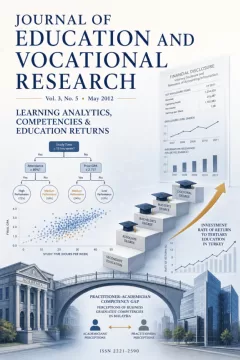 Vol. 3 No. 5 (2012)
Learning Analytics, Competencies & Education Returns
View issue contents
Published
Submissions
Have research to publish? Journal of Education and Vocational Research welcomes submissions.
Make a Submission