Articles

  • Article 1 in this issue

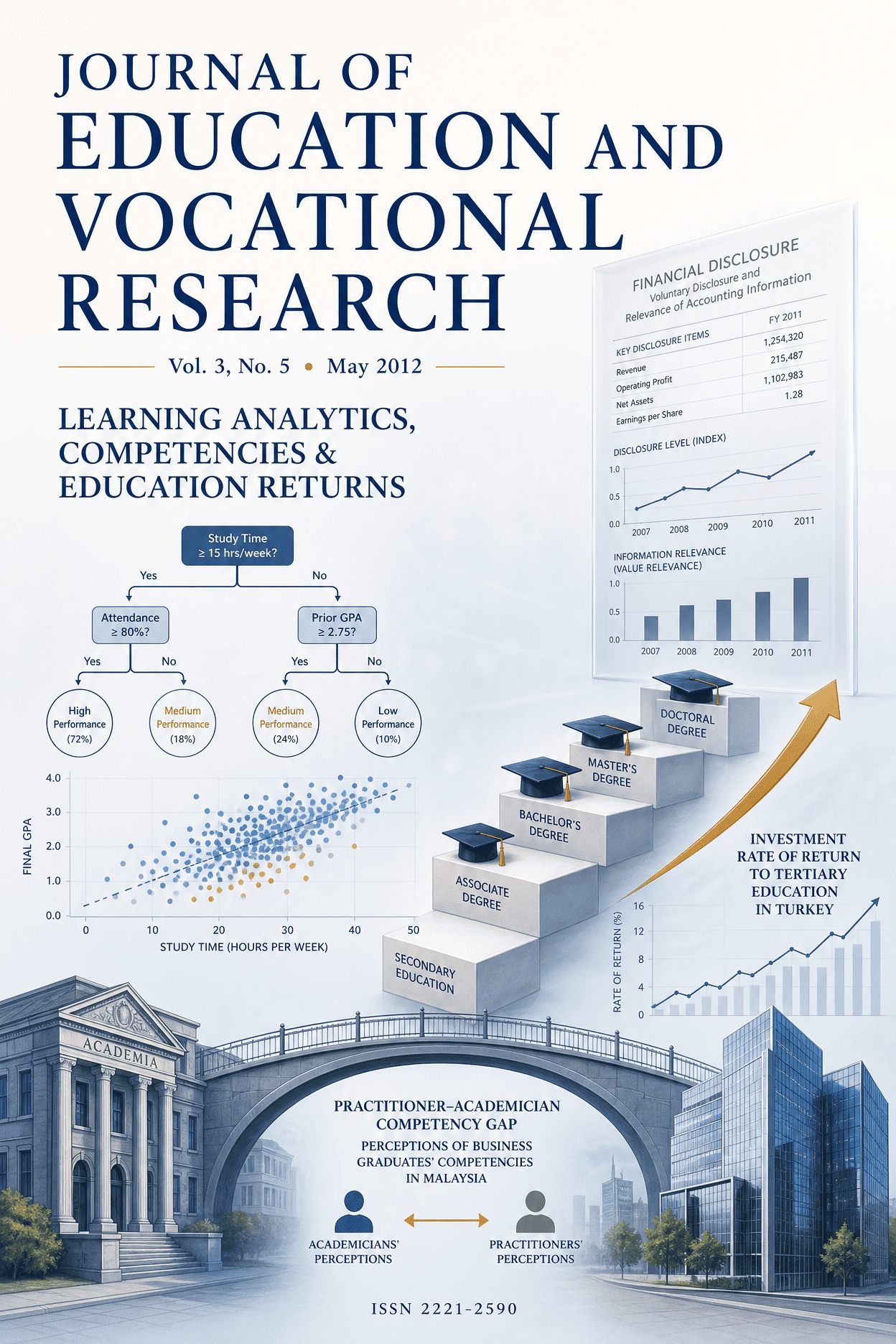
    Measuring Students’ Performance with Data Mining

    • Author: Jean Pierre Atanas

    Understanding the true reasons behind students’ failure, and bringing preventive measures to this issue at early stages are invaluable in the educational learning process. Preventing problems such as language deficiency or misclassification of the students in the appropriate academic levels is primordial for any educational institution. Many factors influence the learning process of the students, such as the demographic characteristics, educational background as well as language barrier. This work highlights the most preponderant factors affecting students’ advancement in the learning process and provides support to academic administrators. It uses some of state of the art classification and regression algorithms in the application domain of predicting students’ progress. Datasets were filtered and trained using predictive algorithms. It is shown that Science learning and English language skills are highly correlated. Datasets are not always suitable for data mining unless it is preprocessed and well adapted to the context being studied. A tool has been developed to preprocess the data provided that feeds into Weka Data Mining Software to profile students’ performance.

    Pages 132-137

    PDF - Measuring Students’ Performance with Data Mining (opens in a new tab)
  • Article 2 in this issue

    Impact of Voluntary Disclosure on the Relevance of Accounting Information

    • Author: Jihene Chedlia Soussi, Mounira Ben Arab

    Information disclosure by firms has grown considerably. The increased level of firms’ disclosure has been accompanied by the loss of relevance of accounting information over time (Lev, 1989, Ramech and Thiagarajan, 1995, Lev and Zarowin, 1999, Brown and al, 1999, Chang, 1999 and Chalmers and al, 2011). Our objective is to determine whether the voluntary disclosure explains the low relevance of accounting information. We find that medium-technology companies have the highest level of relevance of accounting information. However, the relevance of the accounting model is low for lowtechnology firms and high technology firms. The introduction of the overall disclosure index and subindexes of disclosure has an effect on the relevance of the accounting model (this effect is significant only in some cases for low-tech firms). Furthermore, the addition of variables of disclosure to the accounting model makes the accounting variables relevant to investors for low-tech firms. For medium-tech firms, book values and earnings are relevant. While, for high technology firms, only the earnings are relevant. We also show that the introduction of intangible expenses, the weight of intangibles and the index of disclosure on intangibles is growing, but not significantly the relevance of the accounting model.

    Pages 138-153

    PDF - Impact of Voluntary Disclosure on the Relevance of Accounting Information (opens in a new tab)
  • Article 3 in this issue

    The Investment Rate of Return (IRR) to Tertiary Education in Turkey

    • Author: John Taskinsoy

    Most scholars, professionals, parents, governments, and societies strongly believe that education, especially tertiary education, provides important economic and social benefits to everyone involved. Furthermore, tertiary education is recently considered as an important investment. Students usually think of higher education in more personal terms, therefore they tend to pay less attention to the broader societal benefits, however tertiary education received immediately after secondary school can have considerable positive influence in countries’ economic development, further business growth, expansion to international markets and increase in living standards. Robert B. Zoellick, President of the World Bank Group 2010, said: “Improved learning leads to better jobs, greater productivity, and higher incomes in every society. ”1 This paper examines the IRR on tertiary education to first degrees, master’s degrees, and PhDs in Turkey using previously published data. The purposes of this research are to study and identify whether or not increase in tertiary education leads to increase in wages. Knowledge and advanced skills are critical determinants of a country's economic growth and standard of living as learning outcomes are transformed into goods and services, greater institutional capacity, a more effective public sector, a stronger civil society, and a better investment climate2

    Pages 154-164

    PDF - The Investment Rate of Return (IRR) to Tertiary Education in Turkey (opens in a new tab)
  • Article 5 in this issue

    Is There a Gap between Practitioners’ and Academicians’ Perceptions on Business Graduates’ Competencies in Malaysia?

    • Author: Shirley Ken Tzu Ting, Cheah Yeh Ying

    There is always a gap between practitioners’ perception on business graduate competencies as compared to academicians’ perception on the similar topic. Hence, the task to bridge the gap is very necessary in order to equipped business graduates with a more competent set of skills. This study aims to empirically identify the practitioners’ perception on important competencies should possessed by Malaysia business graduates. The second objective is to identify the practitioners’ perception on important competencies should possessed by Malaysia business graduates. Last objective is to identify if there is a gap exist between both group’s perception on important competencies should possessed by Malaysia business graduates. A survey questionnaire was designed and administered to determine the perceptions of employers about the perceived important competencies and hiring preferences. A total of 45 questionnaires were distributed to managers of nine main local commercial banks in Malaysia in the period of six months. The gap between employer needs and graduate competencies were able identified. The findings from this study can be a significant help to the universities in producing competitive business graduates and industries at improving human capital capabilities.

    Pages 167-172

    PDF - Is There a Gap between Practitioners’ and Academicians’ Perceptions on Business Graduates’ Competencies in Malaysia? (opens in a new tab)