Abstract
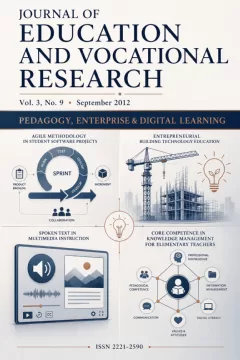
Entrepreneurial and functional building technology education, if well positioned has the potentials of launching Nigeria into the first 20 world economies by the year 2020. This paper integrates the industrial, educational and entrepreneurial activities that results in increased productivity. Functional building technology career broadly categorised into professional and non-professional. The paper reviewed the entrepreneurial prospects open to the non-professional builders trained in the technical institutions equipped with the knowledge and skills to competently perform in the building construction sites as craftsmen, technicians and technologist. Also, other entrepreneurial activities in the public and private sectors at both small and medium scale capacity. The review presented inadequate budgetary allocation to the education sector, dearth of infrastructural facilities, also, the gap existing between the construction industry and the technical institutions. It recommended, increased funding and acquisition of modern equipment/machine and adequate infrastructural facilities. Also, establish a sustainable linkage between the construction industry and technical institutions. Implementation of these will result in increased productivity, robust economy and actualization of the nation’s vision 2020.
Keywords
- Entrepreneurial Search this journal for Entrepreneurial (opens in a new tab)
- Functional Building Technology Education Search this journal for Functional Building Technology Education (opens in a new tab)
- Vision 2020 Search this journal for Vision 2020 (opens in a new tab)
- Nigeria Search this journal for Nigeria (opens in a new tab)
References
- Adebayo, S. A. (2005). Technology education as a vehicle for Nigeria industrial transformation and youth development. A paper presented at the 18th Annual National Conference of Nigerian Association of Teachers of Technology (NATT), Rivers State.
- Anderson, D. (2002). Productivism, Sustainable Development and Vocational Education and training. International conference on post-compulsory education and training. 10th Australia, 2002 Brisbane Australian Academic Press. Retrieved on 15/7/2008 from http://www.avetra.org.au/conference Archives/2003/documents/PA 066 Anderson.pdf.
- Atsumbe, B. N. (2002). Needed improvement in the curriculum of technical college mechanical engineering curriculum. Unpublished PhD Thesis. Department of vocational teacher education, University of Nigeria, Nsukka.
- CORBON. (2010) List of Registered Builders Entitled to practice in the Federal Republic of Nigeria. CORBON Publication, Abuja, Nigeria.
- Ekong, A. O. (2008). Entrepreneurship Education; a positive redirection for Nigeria’s national development. Journal of Educational Innovators, 1(1), 1-16.
- Evans, M. O. (2000). Trend and uses it in gifted education programme New York. Me Graw Hill.
- Federal Republic of Nigeria (FGN). (2004). National Policy on Educations, Lagos Nigeria: Federal Government Press.
- Haan, C. (2006). Training for work in the informal micro-enterprise sector: fresh evidence from subSahara Africa. Dordrecht, Netherland: Springer.
- Hisrich, P. & Shepherd, D. (2008). Entrepreneurship. McGraw-Hill/Irwin. New York.
- Igwe, C. O. (2008). Entrepreneurship Education: Nigeria imperative for achieving millennium development goals. Journal of Vocation Technical and Business Education, 3(1), 271-276.
- Igwe, C. O. (2008). Technology Education: A vehicle for sustainable youth empowerment in Nigeria. Applied Psychology Selected Reading , 5(1), 88 - 94.
- Imoko, I. O. (2002). Improving on practical skill content of senior secondary school metalwork curriculum. Unpublished B.Tech Thesis. Federal University of Technology, Minna.
- Industrial Training Fund (ITF). (2000). Students Industrial Work Experience Scheme (SIWES) in human development in Nigeria. Jos. ITF Publication.
- Michael, R. (2005). China’s technological and entrepreneurial advancement. MSNBC.
- Nicks, L. (2008). The history of entrepreneurship in Nigeria. May, 24th .
- Ogalanya, G. A. O. (2000). Strategies for extending school industry relationship to technical college programmes. Unpublished PhD thesis, University of Nigeria, Nsukka.
- Onanaye, A. S. & Ebenezer, O. S. (2008). Information and Communication Technology (ICT) in Education: Implications for entrepreneurship education for national development. Journal of Education Innovations, 1, 81-105.
- Orji, N. S. (2011). The new senior secondary curriculum: Trade/Entrepreneurship. A paper presented at a 2-day sensitization and advocacy workshop for teachers in Adamawa State held in Yola 21-22 September.
- Wapmuk, L. S. (2011) Education and self-reliance in 21st century Nigeria. A Keynote address presented at the conference organised by academic fund of the Federal College of Education, Pankshin, on 8th June.
- Yahaya, H. (2011). Education reforms in Nigeria: past, present and future. Reform in Nigeria. 22-29. Lagos: Stirling-Horden Publisher Ltd.
- Yar’Adua U. M. (2008). President’s address at the inauguration. Official website 1.0.0 Nigeria vision 2020 Downloaded on 15/07
Downloads
No downloads have been recorded for this article yet. Figures appear here once readers begin downloading the full text.
How to Cite
Share this article
License
Copyright (c) 2012 Igwe, C.O, Puyate, S.T, Onoh, C.E.C, Eze, C.J (Author)

This work is licensed under a Creative Commons Attribution 4.0 International License.
Author (s) should affirm that the material has not been published previously. It has not been submitted and it is not under consideration by any other journal. At the same time author (s) need to execute a publication permission agreement to assume the responsibility of the submitted content and any omissions and errors therein. After submission of revised paper in the light of suggestions of the reviewers, the editorial team edits and formats manuscripts to bring uniformity and standardization in published material.
This work will be licensed under Creative Commons Attribution 4.0 International (CC BY 4.0) and under condition of the license, users are free to read, copy, remix, transform, redistribute, download, print, search or link to the full texts of articles and even build upon their work as long as they credit the author for the original work. Moreover, as per journal policy author (s) hold and retain copyrights without any restrictions.
Keywords
- Entrepreneurial Search this journal for Entrepreneurial (opens in a new tab)
- Functional Building Technology Education Search this journal for Functional Building Technology Education (opens in a new tab)
- Vision 2020 Search this journal for Vision 2020 (opens in a new tab)
- Nigeria Search this journal for Nigeria (opens in a new tab)
Section
Published
Submissions
Have research to publish? Journal of Education and Vocational Research welcomes submissions.
Make a Submission