Articles

  • Article 1 in this issue

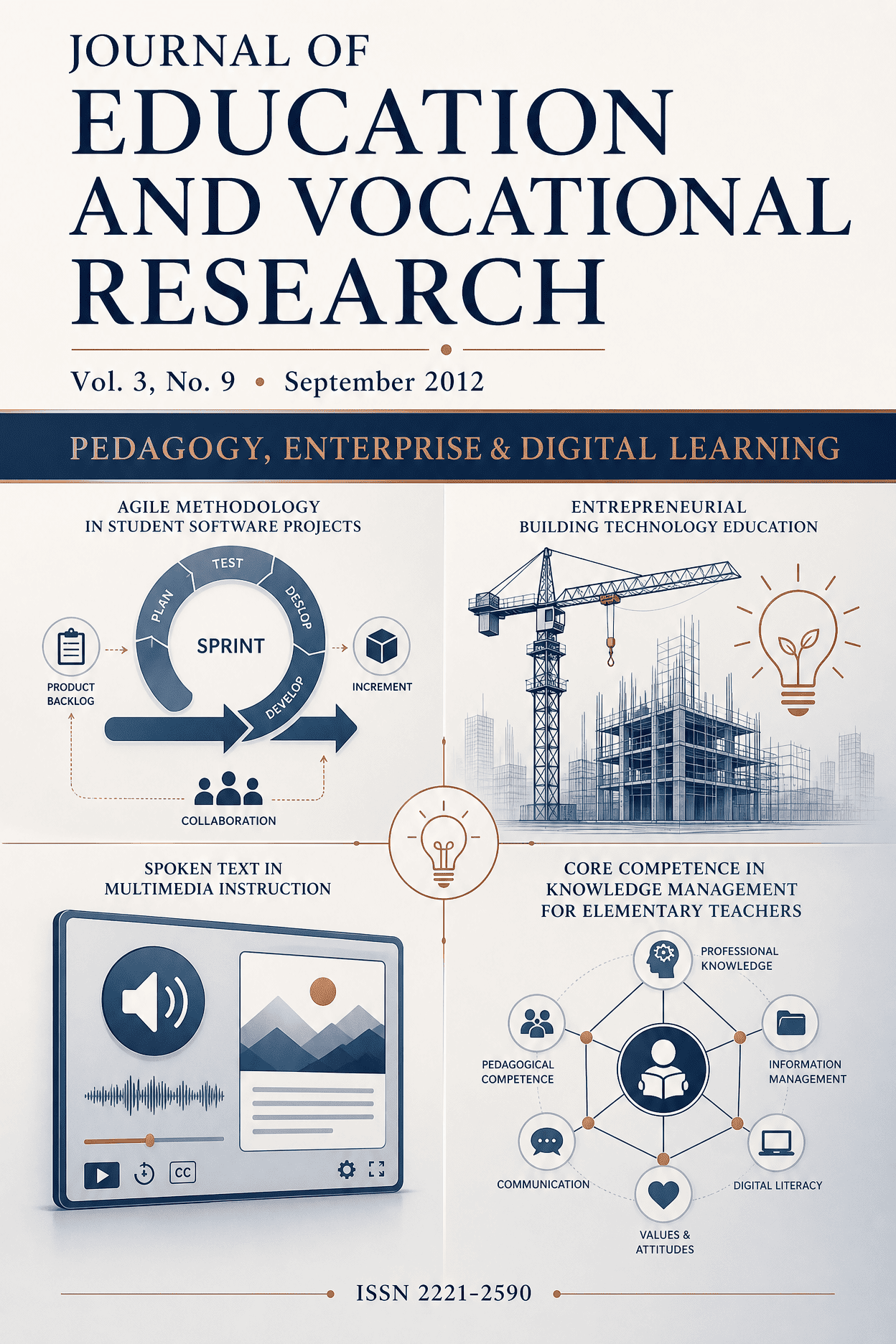
    Using Agile Practice for Student Software Projects

    • Author: Fernando Almeida, AntónioCandeias

    Agile methodology as a relatively new approach to software engineering is becoming more popular in both industry and academia. Learning agile software development methodologies will unquestionably increase the capabilities and competences of our students as entry-level software engineers. However, how agile methods and techniques should be taught at the undergraduate level in additional to traditional approaches is still being debated. This study was conducted on a studentprogramming project, with sample size of 23 students from the Informatics Engineering course. The Scrum methodology was adopted and 28 user stories and 4 sprints were created. The results indicate a significant impact on students’ skill improvement and let them to have the first contact with real projects and clients. Besides that, the students agree that the adoption of the Scrum methodology helped them to improve the participation and collaboration. However, some issues were also detected in terms of communication and tasks planning. Therefore, we proposed some polities that could help and boost the software development process inside a classroom.

    Pages 280-290

    PDF - Using Agile Practice for Student Software Projects (opens in a new tab)
  • Article 2 in this issue

    Entrepreneurial and Functional Building Technology Education as a Means of Achieving Vision 2020 in Nigeria

    • Author: Igwe, C.O, Puyate, S.T, Onoh, C.E.C, Eze, C.J

    Entrepreneurial and functional building technology education, if well positioned has the potentials of launching Nigeria into the first 20 world economies by the year 2020. This paper integrates the industrial, educational and entrepreneurial activities that results in increased productivity. Functional building technology career broadly categorised into professional and non-professional. The paper reviewed the entrepreneurial prospects open to the non-professional builders trained in the technical institutions equipped with the knowledge and skills to competently perform in the building construction sites as craftsmen, technicians and technologist. Also, other entrepreneurial activities in the public and private sectors at both small and medium scale capacity. The review presented inadequate budgetary allocation to the education sector, dearth of infrastructural facilities, also, the gap existing between the construction industry and the technical institutions. It recommended, increased funding and acquisition of modern equipment/machine and adequate infrastructural facilities. Also, establish a sustainable linkage between the construction industry and technical institutions. Implementation of these will result in increased productivity, robust economy and actualization of the nation’s vision 2020.

    Pages 291-296

    PDF - Entrepreneurial and Functional Building Technology Education as a Means of Achieving Vision 2020 in Nigeria (opens in a new tab)
  • Article 3 in this issue

    Presents Spoken Texts in Multimedia Instructions as an Alternative to Printed Texts

    • Author: Khayrazad Kari Jabbour

    Multimedia instructions refer to presentations that contain graphics and texts information. The graphics can include pictures, drawings, diagram, chart, animation, video, or simulations. In addition, texts can include printed texts or spoken texts. Multimedia education occurs when learners create mental representations caused by combining texts and relevant graphics simultaneously in lessons. Research evidence shows that not all multimedia instructions are equally useful. How can we use multimedia instructional to help learners to grasp knowledge? Do learners learn better when multimedia instructions present spoken text in multimedia instructions as an alternative to printed text principle? This article examines whether there is any benefit on supplementing spoken text with multimedia. Specifically, do learners learn more from spoken text and graphics, rather than from printed text and graphics? Meaningful learning engages the learner into excessive cognitive load processing during learning; on the other hand, the learner’s cognitive capacity is limited. For that, reasons multimedia instructional designers must take into account the learner's cognitive load processing. One of the obstacles of multimedia instructions is the possibility of overloading the learners’ cognitive capacity. Multimedia instructional designers must design multimedia instruction in ways that minimize the possibility of overloading the learners’ cognitive capacity. Also will examines the limitations of presenting spoken rather than printed texts; Reasons for presenting spoken rather than printed texts; Evidence for Using Spoken Rather Than Printed Text; And when this principle applies.

    Pages 297-302

    PDF - Presents Spoken Texts in Multimedia Instructions as an Alternative to Printed Texts (opens in a new tab)
  • Article 4 in this issue

    An Evaluation of Core Competence on Knowledge Management for Elementary Schools’ Teachers: A Case Study of Remote Rural Area in Taiwan

    • Author: Ya-Ching Yeh, Tzung-Hsien Huang, Chia-Chun Hsiao

    In the knowledge economy era, teachers’ core competencies for knowledge management have an important impact on the development of school education. It is an important issue to explore how to evaluate core competencies of knowledge management for elementary schools’ teachers. This requires a thorough investigation to gain core competencies. Hence, the main purpose of this paper is to present a Matrix Analysis (MA) approach for evaluating core competencies of knowledge management and to describe the applications of the MA approach for elementary schools’ teachers. An empirical analysis is performed to demonstrate the computational process of the MA approach adopted by this paper. Study results show that eleven core competencies are identified. They are ‘finding problems,’ ‘flexibility,’ ‘interpersonal communication,’ ‘oral communication skills,’ ‘knowledge selection,’ ‘activities recording,’ ‘knowledge application on work planning,’ ‘research data application,’ ‘transforming knowledge into concrete actions,’ ‘interpreting results,’ and ‘judging knowledge value,’ respectively. It is suggested that more attentions should be paid to exploit these core competencies effectively and then develop the solutions, which should continuously strengthen the perspective of teachers in order to obtain the competitive advantages in the future.

    Pages 303-312

    PDF - An Evaluation of Core Competence on Knowledge Management for Elementary Schools’ Teachers: A Case Study of Remote Rural Area in Taiwan (opens in a new tab)