Abstract
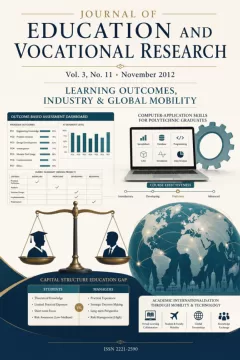
Malaysia Polytechnic Transformation Program was launched to improve the quality of vocational and technical education in Malaysia and form a quality human capital capable of increasing productivity significantly. H uman capital that produced should be the ICT literacy groups and will contribute to the needs of industry. Hence, Computer Application course that offered to the students must be revised from time to time and updated content to fulfill the needs of industry. The purpose of this study is to investigate the relevance of Computer Application course to the polytechnic graduates from the perceptions view of students and employers. Review and survey involved 375 students who have completed their six months industrial training and was continue study in the final semester currently on five polytechnics which have been identified through cluster sampling and purposive sampling. In order to get the perception of the employers, convenient sampling was used in this study. The instruments used are two sets of questionnaires adapted from University Putra Malaysia, the Exit Survey for Graduating Students and Stakeholders Survey for Outcome Based Education (OBE) - Industry / Employer / Alumni developed by Professor Dato Ir. Dr. Radin Umar Radin Sohadi. The pilot test obtained the Alpha Cronbach value of 0.962. The data was analyzed using descriptive statistics, mean, standard deviation, and percentage. Through this study, the highest mean value on attributes of the graduate attainment is derived from students’ perceptions is Lifelong Learning and information management, which was 3.74. Next, the research showed the lowest mean value of 3.60 on the thinking and scientific skills approach. The findings also show that the perception of the employers on polytechnic graduates that they have the ability to apply their knowledge of computer literacy into careers with the highest mean value of 4.20. However, only 52% of employers give opinion that’s Polytechnic graduates are able to act as a manager / leader with a mean value of 3.36. The findings also showed that 96% of employer agrees that BC101 course is relevant and fulfills market needs.
Keywords
References
- Rasul, S. M., Ismail, Y. M., Ismail, N., Rajuddin, R. & Rauf, A. R. (2009). Aspek Kemahiran ‘Employability’ Yang Dikehendaki Majikan Industri Pembuatan Masa Kini. Jurnal Pendidikan Malaysia , 34(2), 67–79.
- Awang, H. A., Ismail, R., Hamzah, A., Ahmad, A. & Uli, U. (2008). Kompetensi Tenaga Kerja: Keseimbangan Antara Tuntutan Majikan & Penguasaan Pelatih. Jurnal Pembangunan Belia Malaysia , 1, 135 – 164.
- Boon, Y. & Ngatimin, S. (2011). Penggunaan Makmal Komputer Dalam Kalangan Guru-guru Sekolah Kebangsaan Zon Jementah, Daerah Segamat Dalam Pengajaran & Pembelajaran: Satu Tinjauan . Journal of Technical, Vocational & Engineering Education , 3, 132 – 147.
- Shing, K. T. (2007). Kajian Mengenai Penggunaan E-Pembelajaran Di Kalangan Pelajar Jurusan Pendidikan Teknologi & Vokasional Di IPTA Negeri Johor . Tesis Ijazah Sarjana. Universiti Teknologi Malaysia.
- Bunn, C. P. & Stewart, L. D. (1998). Perceptions of Technical Committee Members Regarding the Adoption of Skill Standards in Vocational Education Programs . Journal of Vocational and Technical Eduation , 14, 7 – 17.
- Buntat, Y. (2004). Integrasi Kemahiran ‘Employability’ Dalam Program Pendidikan Vokasional Pertanian & Industri Di Malaysia. Disertasi Ph.D. Universiti Teknologi Malaysia.
- De Leon, E. J. & Borchers, E. R. (1998). High School Graduate Employment Trends and The Skills Graduates Need to Enter Texas Manufacturing Industries . Journal of Vocational and Technical Eduation , 15(2).
Downloads
No downloads have been recorded for this article yet. Figures appear here once readers begin downloading the full text.
How to Cite
Share this article
License
Copyright (c) 2012 Cr. Ling Ying Leh (Author)

This work is licensed under a Creative Commons Attribution 4.0 International License.
Author (s) should affirm that the material has not been published previously. It has not been submitted and it is not under consideration by any other journal. At the same time author (s) need to execute a publication permission agreement to assume the responsibility of the submitted content and any omissions and errors therein. After submission of revised paper in the light of suggestions of the reviewers, the editorial team edits and formats manuscripts to bring uniformity and standardization in published material.
This work will be licensed under Creative Commons Attribution 4.0 International (CC BY 4.0) and under condition of the license, users are free to read, copy, remix, transform, redistribute, download, print, search or link to the full texts of articles and even build upon their work as long as they credit the author for the original work. Moreover, as per journal policy author (s) hold and retain copyrights without any restrictions.
Keywords
Section
Published
Submissions
Have research to publish? Journal of Education and Vocational Research welcomes submissions.
Make a Submission