Articles

  • Article 1 in this issue

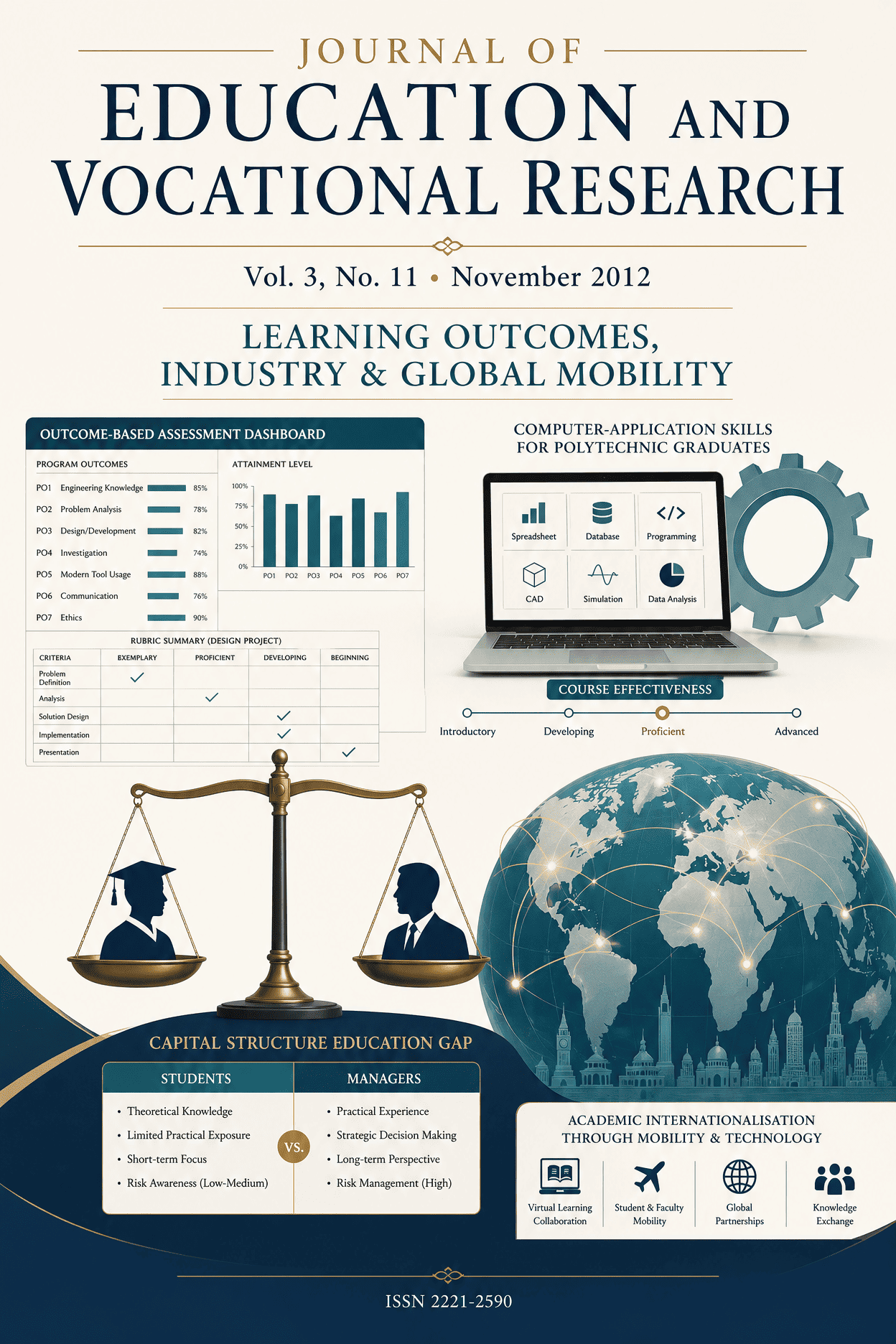
    An Evaluation of Assessment Tools in Outcome-based Education: A Way Forward

    • Author: Shamsul Mohamad, Zarina Tukiran, Rafizah Mohd Hanifa, Afandi Ahmad, Mohamad Md Som

    With the existing manual-based of outcome based education (OBE) systems, data complexity appears as the main problem to be solved. In this paper, a critical discussion of the manual-based system and a way forward with the online version of the OBE systems in the Faculty of Electrical and Electronic Engineering (FKEE), Universiti Tun Hussein Onn Malaysia (UTHM) have been discussed. Two assessment tools of programme learning outcomes (PLOs) as well as course learning outcomes (CLOs) have been used to measure and analyse manually both achievements of the PLOs and CLOs. However, results obtained have shown that these processes require a better system, to deal with various parameters such as different cohort of students and various courses. Obviously, the online-based version and further improvement of the manualbased system that have been proposed are expected to resolve these issues, hence it will be fruitful for the FKEEs’ OBE administrator.

    Pages 336-343

    PDF - An Evaluation of Assessment Tools in Outcome-based Education: A Way Forward (opens in a new tab)
  • Article 2 in this issue

    Study on the Effectiveness of Computer Application Course to the Polytechnics Students in the Working Environment

    • Author: Cr. Ling Ying Leh

    Malaysia Polytechnic Transformation Program was launched to improve the quality of vocational and technical education in Malaysia and form a quality human capital capable of increasing productivity significantly. H uman capital that produced should be the ICT literacy groups and will contribute to the needs of industry. Hence, Computer Application course that offered to the students must be revised from time to time and updated content to fulfill the needs of industry. The purpose of this study is to investigate the relevance of Computer Application course to the polytechnic graduates from the perceptions view of students and employers. Review and survey involved 375 students who have completed their six months industrial training and was continue study in the final semester currently on five polytechnics which have been identified through cluster sampling and purposive sampling. In order to get the perception of the employers, convenient sampling was used in this study. The instruments used are two sets of questionnaires adapted from University Putra Malaysia, the Exit Survey for Graduating Students and Stakeholders Survey for Outcome Based Education (OBE) - Industry / Employer / Alumni developed by Professor Dato Ir. Dr. Radin Umar Radin Sohadi. The pilot test obtained the Alpha Cronbach value of 0.962. The data was analyzed using descriptive statistics, mean, standard deviation, and percentage. Through this study, the highest mean value on attributes of the graduate attainment is derived from students’ perceptions is Lifelong Learning and information management, which was 3.74. Next, the research showed the lowest mean value of 3.60 on the thinking and scientific skills approach. The findings also show that the perception of the employers on polytechnic graduates that they have the ability to apply their knowledge of computer literacy into careers with the highest mean value of 4.20. However, only 52% of employers give opinion that’s Polytechnic graduates are able to act as a manager / leader with a mean value of 3.36. The findings also showed that 96% of employer agrees that BC101 course is relevant and fulfills market needs.

    Pages 344-352

    PDF - Study on the Effectiveness of Computer Application Course to the Polytechnics Students in the Working Environment (opens in a new tab)
  • Article 3 in this issue

    Managers versus Students: New Approach in Improving Capital Structure Education

    • Author: Anton Miglo

    According to Graham and Harvey (2001), an immense gap exists between capital structure theories and practice. By analyzing students’ perception of capital structure theories and the differences between their opinion and that of the current CEO’s and managers this paper argues that this can be partially explained by current educational practices. Educators mostly focus on one or maybe two most popular theories and students have much smaller knowledge about other theories. Secondly educational practices favor trade-off theory to asymmetric information based theories. The paper provides some suggestions regarding capital structure education and future research.

    Pages 353-369

    PDF - Managers versus Students: New Approach in Improving Capital Structure Education (opens in a new tab)
  • Article 4 in this issue

    Academic Internationalization: The Impact of Mobility and Technology

    • Author: Charlotte B. Broaden, Daria C. Crawley

    The education industry has been transformed, in part, due to the impact of globalization. Globalization has created shifting paradigms in the way educational services are designed, how they are delivered and where they are located. For academic institutions to deal with these shifts; they will need to develop strategies, policies, and procedures that address issues related to globalization, the movement of resources (human, financial and physical) and the application of technology. Faculty, and how they perceive their role in shaping an internationalized academy, will be crucial in this process. In this paper, we examine academic roles, opportunities, and challenges, in an era of global change, while proposing a model of institutional internationalization that addresses the impact of mobility and technology on the academy.

    Pages 370-386

    PDF - Academic Internationalization: The Impact of Mobility and Technology (opens in a new tab)