Abstract
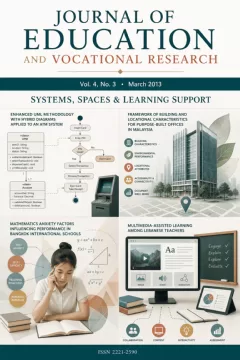
The objectives of this study were: 1) To determine the level of Performance in Mathematics of Grade 4 students in selected international schools in Bangkok in terms of Knowledge skills, Comprehension skills, Application skills, Analysis skills, Synthesis Skills, and Evaluation skills; 2) To determine the level of Mathematics Anxiety of Grade 4 students in terms of Cognitive factors, Psychological factors, Physical factors, and Environmental factors; 3) To investigate the influence of Math Anxiety factors on Performance in Mathematics. The study utilized the descriptive method. The instrument employed for collecting the data was a Math Anxiety Opinionnaire (MARS) developed by Richardson and Suinn (1972), and its many shorter derivations (Alexander & Martray, 1989; Plake & Parker, 1982; Rounds &Hendel, 1980; Suinn & Winston, 2003). The Math Test was based on the curriculum of Grade 4. The statistics used for the treatment of the data were mean, standard deviation(s.d.), standard error mean (s.e.mean), coefficient of variation(C.V.),rank and ANOVA. The results showed that the highest level of Performance in Mathematics is in the Comprehension skills and the lowest is Knowledge skills. Environmental factors produce the highest level of anxiety among the students. Physical factors had the highest influence on Performance in Mathematics.
Keywords
- Mathematics Anxiety Search this journal for Mathematics Anxiety (opens in a new tab)
- Mathematics Performance Search this journal for Mathematics Performance (opens in a new tab)
- International Schools Search this journal for International Schools (opens in a new tab)
- Anxiety Factors Search this journal for Anxiety Factors (opens in a new tab)
- Anxiety Level Search this journal for Anxiety Level (opens in a new tab)
References
- Alexander, L. & Martray, C. (1989). The development of an abbreviated version of the Mathematics Anxiety Rating Scale. Measurement and Evaluation in Counseling and Development , 22, 143-150.
- Ashcraft, M. H. & Faust, M. W. (1994). Mathematics anxiety and mental arithmetic performance: An exploratory investigation. Cognition and Emotion, 8 , 97-125.
- Ashcraft, M. H. & Kirk, E. P. (2001). The relationships among working memory, math anxiety, and performance. Journal of Experimental Psychology – General, 130(2), 224-237.
- Brady, P. & Bowd, A. (2005). Mathematics anxiety, prior experience and confidence to teach mathematics among pre-service education students. Teachers and Teaching: Theory and Practice , 11(1), 37–46.
- Cockcroft, W. H. (1982). Mathematics counts: report of the commission of inquiry in to the teaching of mathematic in school, Her Majesty’s office, London
- Fennema, E. (1977). Influence of selected cognitive, affective and educational variableson sex related differences in Mathematics learning and studying(National Institute of education papersin Education and work ,No.8,US.Department of Health, Education and Welfare)
- Fennema, E. & Sherman, J. A. (1976). Fennema-Sherman Mathematics Attitudes Scales: Instruments designed to measure attitudes toward the learning of mathematics by males and females. Catalog of Selected Documents in Psychology , 6(1), 31.
- Fox, L. H. (1977). The effects of sex role socialization on mathematics participation and achievement (National Institute of education papers in Education and work, No.8, U.S, department of Health, Education and welfare)
- Furner, J. M. & Berman, B. T. (2003). Confidence in their ability to mathematics: The need to eradicate math anxiety so our future students can successfully compete in a high-tech globally, competitive world Florida Atlantic University and Contra Costa County Office of Education
- Hembree, R. (1990). The nature, effects and relief of mathematics anxiety. Journal for Research in Mathematics Education , 21(1)33-46.
- Institute for the Promotion of Teaching Science and Technology. (1997). Report Research and Evaluation with the Third International Mathematics and Science Study. Education journal in 12 years , 2, 6475.
- Jackson, C. D. &Leffingwell, R. J. (1999).The role of instructors in creating math anxiety in students from kindergarten through college. Mathematics teacher , 92(7), 583.
- Kindermann, T. A. & Skinner, E. A. (2008). How do naturally existing peer groups shape children’s academic development during sixth grade? European Journal of Developmental Science , 2(14).
- Kogelman, S. & Warren, J. (1978). Mind over Math. New York: McGraw Hill.
- Lewis, L. (2001). Add it up; Using research to improve education for low income and minority students.
- McNaught, K. (2007). The power of writing for all pre-service mathematics teachers. Mathematics: Essential Research. Essential Practice , 2, 473-481.
- Mercer, C. D. & Mercer, A. R. (1998). Teaching students with learning problems (5th ed.). Upper Saddle River, NJ: Prentice-Hall Inc
- Mercer, C. D., Lane, H. B., Jordan, L, Allsopp, D. H. & Eisele, M. R. (1996). Empowering teachers and students with instructional choices in inclusive settings. Remedial and Special Education , 17, 226236.
- Mercer, C. D., Jordan, L. & Miller, S. P. (1996). Constructivistic math instruction for diverse learners. Learning Disabilities Research and Practice, 11 , 147–156.
- Miller, S. P. & Mercer, C. D. (1997).Educational aspects of mathematics disabilities . Journal of Learning Disabilities, 30 , 47–56.
- Montagano, J. (2010). Educational and counseling Psychology Department, Andrew University, Barrien Springs, MI 49104-0104.
- Natcha, P. & Satoshi, N. (2006). Analysis of Mathematics Performance of Grade Five Students in Thailand Using Newman Procedure “ICE Hiroshima University. Journal of International Cooperation in Education , 9(1), 111-122.
- Oxford, J. & Vordick, T. (2006). Math anxiety at Tarleton State University: An empirical report. Tarleton State University.
- Plake, B. S. & Parker, C. S. (1982). The development and validation of a revised version of the Mathematics Anxiety Rating scale. Educational and Psychological measurement , 42(2),551-557
- Richardson, F. C. & Suinn, R. M. (1972).The Mathematics Anxiety Rating Scale. Journal of Counseling Psychology , 19, 551–554.
- Richardson, F. C. & Woolfolk, R. L. (1980).Mathematics anxiety. In I. G. Sarason (Ed.), Test anxiety: Theory, research and application (pp. 271-288). Hillsdale, NJ: Erlbaum.
- Rossnan, S. (2006).Overcoming math anxiety. Mathitudes , 1(1), 1-4.
- Rounds, J. & Hendel, D. (1980). Measurement and dimensionality of mathematics anxiety. Journal of Counseling Psychology , 27, 138-149.
- Sakorn, P., Tayruakham, S. & Nuangchalerm. P. (2009). Factors Influencing Mathematic Problem-Solving Ability of Sixth Grade Students. Journal of Social Sciences , 10, 381-385
- Shields, D. J. (2006). Causes of math anxiety: The student perspective. Unpublished doctoral dissertation, Indiana University of Pennsylvania, Indiana.
- Silva, D. L., Tadeo, M. C., Reyes, C. R. & Dadigan, R. M. (2006). Factors associated with non-performing Filipino students in Mathematics: A vision of student’s cognitive and behavior management. In the Proceedings of the 2nd IMT-GT Regional Conference of Mathematics, Statistics and Applications, University Sains Malaysia, Penang, June 13-15, 2006 (pp. 2-3).
- Suinn, R. M., Edie, C. A., Nicoletti, J. & Spinelli, P. R. (1972). The MARS, a measure of mathematics anxiety: Psychometric data. Journal of Clinical Psychology , 28, 373-375
- Suinn, R. M. & Winston, E .H. (2003). The Mathematic Anxiety Rating Scale, brief version, Psychometric data. Psychological reports , 92, 167-173.
- Tobias, S. (1978). Overcoming Math Anxiety. Boston: Houghton Mifflin.
- Tobias, S. & Weissbrod, C. (1980). Anxiety and mathematics: An update. Harvard Educational Review , 50, 63-70.
- UNESCO. (1990). Meeting Basic Learning Needs. Retrieved March, 2004 from http://www.unesco.org/education/efa/ed_for_all/background/jomtien_declaration.shtmahttp:/ /www.mentoringminds.com/research/critical-thinking-educator-wheel
- Waanders, C., Mendez, J. L. & Downer, J. T. (2007). Parent characteristics, economic stress and neighborhood context as predictors of parent involvement in preschool children’s education. Journal of School Psychology , 45(6), 619-636.
- WHO (1999-2000). Thailand Health Profile-Ministry of Public Health. Retrieved March, 2004 from 2004from http://w3.whosea.org/eip/thf/English/tex%20english_pdf/CHA4_2.pdf
Downloads
No downloads have been recorded for this article yet. Figures appear here once readers begin downloading the full text.
How to Cite
Share this article
License
Copyright (c) 2013 Shamim Nisar Shaikh (Author)

This work is licensed under a Creative Commons Attribution 4.0 International License.
Author (s) should affirm that the material has not been published previously. It has not been submitted and it is not under consideration by any other journal. At the same time author (s) need to execute a publication permission agreement to assume the responsibility of the submitted content and any omissions and errors therein. After submission of revised paper in the light of suggestions of the reviewers, the editorial team edits and formats manuscripts to bring uniformity and standardization in published material.
This work will be licensed under Creative Commons Attribution 4.0 International (CC BY 4.0) and under condition of the license, users are free to read, copy, remix, transform, redistribute, download, print, search or link to the full texts of articles and even build upon their work as long as they credit the author for the original work. Moreover, as per journal policy author (s) hold and retain copyrights without any restrictions.
Keywords
- Mathematics Anxiety Search this journal for Mathematics Anxiety (opens in a new tab)
- Mathematics Performance Search this journal for Mathematics Performance (opens in a new tab)
- International Schools Search this journal for International Schools (opens in a new tab)
- Anxiety Factors Search this journal for Anxiety Factors (opens in a new tab)
- Anxiety Level Search this journal for Anxiety Level (opens in a new tab)
Section
Published
Submissions
Have research to publish? Journal of Education and Vocational Research welcomes submissions.
Make a Submission