Articles

  • Article 1 in this issue

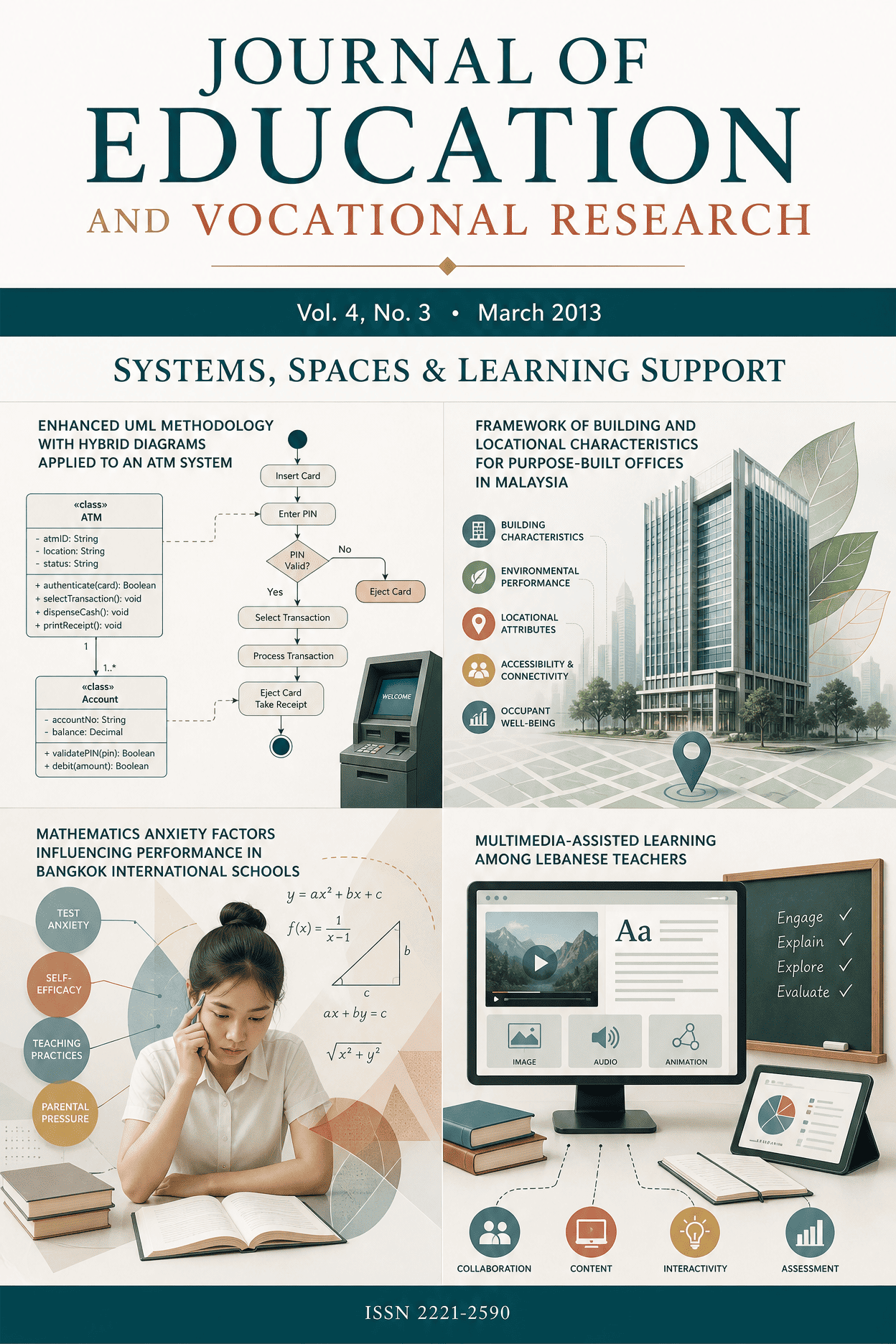
    Enhanced UML Methodology with New Hybrid Diagrams: An ATM Application

    • Author: Sherif Magdy Mohamed Abd Elaziz Barakat, Debashish Das

    Object oriented proved to be the most important software engineering tools. The main reason behind the importance is that, Object Oriented covers the most powerful programming languages such as Java and C++. UML is a modeling language which is a part of object oriented and it was created to provide the software development industry with analysis and design techniques based on some diagrams. The most common UML diagrams in use are Class and Activity diagram. To implement any system using object oriented UML, the programmer needs at least two or three diagrams beside the Use Case diagram in order to understand a full picture of the system. There is no diagram which can show the full picture of the system. In this research, new methodology called “Touch and Go” has been generated by the researchers to implement the system. In this methodology, analysis and design are merged in one stage called Touch. Implementation and testing stage are merged in one stage called Go. The Class and Activity diagram are merged to introduce new integrated diagram called Enhanced Class Activity (ECA) diagram and the normal Activity diagram will be modified and improved as Activity Remarked Class (ARC) diagram. Analytical analysis of the new methodology is implemented in ATM machine system which can be later implemented using Java language or any other Object Oriented language. A powerful system like ATM is chosen to apply the new technique and it has been shown clearly how the methodology is working perfectly with such system. This study helps to reduce the number of diagrams that are being used to implement the system, reducing total time of implementation and making the coding stage easier by using only few numbers of diagrams.

    Pages 60-68

    PDF - Enhanced UML Methodology with New Hybrid Diagrams: An ATM Application (opens in a new tab)
  • Article 2 in this issue

    A Framework of Building and Locational Characteristics Ranking for Purpose-built Offices in Malaysia

    • Author: Edie Ezwan Mohd Safian, Abdul Hadi Nawawi

    The development of purpose-built office market in Malaysia is primarily resolved by a supplydemand market. Since the office market in Malaysia has displayed significance improvement due to increasing level of competitiveness, many characteristics of purpose-built office have appeared and become prominent during the process of assessment. These characteristics were generally used as indicators in property valuation, building performance as well as office market appraisal. Based on these characteristics, property market participants can evaluate their property proficiently based on their requirements, especially in decision making during business planning, investment or property management. Technology growth and national policy also gave contribution factors on revealing newly characteristics of purpose-built office such as green building, intelligent building and sustainable development model. The purpose of this article is to identify suitable characteristics of purpose-built office that can be used in Malaysia. Integral to achieving this objective, exploration on purpose built office characteristics in a global and local context will be reconsidered. As a result, a building and locational framework of purpose-built office’s characteristics in Malaysia will be diagnosed and verified appropriately.

    Pages 69-76

    PDF - A Framework of Building and Locational Characteristics Ranking for Purpose-built Offices in Malaysia (opens in a new tab)
  • Article 3 in this issue

    Mathematics Anxiety Factors and Their Influence on Performance in Mathematics in Selected International Schools in Bangkok

    • Author: Shamim Nisar Shaikh

    The objectives of this study were: 1) To determine the level of Performance in Mathematics of Grade 4 students in selected international schools in Bangkok in terms of Knowledge skills, Comprehension skills, Application skills, Analysis skills, Synthesis Skills, and Evaluation skills; 2) To determine the level of Mathematics Anxiety of Grade 4 students in terms of Cognitive factors, Psychological factors, Physical factors, and Environmental factors; 3) To investigate the influence of Math Anxiety factors on Performance in Mathematics. The study utilized the descriptive method. The instrument employed for collecting the data was a Math Anxiety Opinionnaire (MARS) developed by Richardson and Suinn (1972), and its many shorter derivations (Alexander & Martray, 1989; Plake & Parker, 1982; Rounds &Hendel, 1980; Suinn & Winston, 2003). The Math Test was based on the curriculum of Grade 4. The statistics used for the treatment of the data were mean, standard deviation(s.d.), standard error mean (s.e.mean), coefficient of variation(C.V.),rank and ANOVA. The results showed that the highest level of Performance in Mathematics is in the Comprehension skills and the lowest is Knowledge skills. Environmental factors produce the highest level of anxiety among the students. Physical factors had the highest influence on Performance in Mathematics.

    Pages 77-85

    PDF - Mathematics Anxiety Factors and Their Influence on Performance in Mathematics in Selected International Schools in Bangkok (opens in a new tab)
  • Article 4 in this issue

    Multimedia-Assisted Learning among Lebanese Teachers

    • Author: Khayrazad Kari Jabbour

    Multimedia learning consists of graphics and texts. Learning occurs when the learners create mental representations from combining the text and relevant graphics in the lessons. Incorporation of multimedia learning in teaching can lead education to a higher level than traditional teaching techniques. The aim of this study is to investigate the extent to which multimedia is incorporated in classroom teaching among Lebanese educators. A small scale survey from 50 middle school teachers of 10 different schools selected from various areas in Lebanon was undertaken. The survey results were compared and tested in order to evaluate whether or not the teachers integrate multimedia in classroom teaching. If they do, this study aims to identify the multimedia elements they frequently use. However, if not, this study aims to find out the causes for not adopting multimedia in their classroom teaching.

    Pages 86-90

    PDF - Multimedia-Assisted Learning among Lebanese Teachers (opens in a new tab)