Abstract
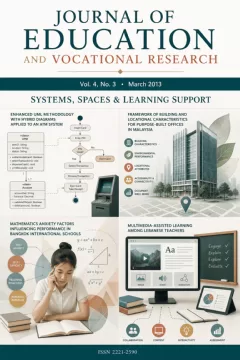
Multimedia learning consists of graphics and texts. Learning occurs when the learners create mental representations from combining the text and relevant graphics in the lessons. Incorporation of multimedia learning in teaching can lead education to a higher level than traditional teaching techniques. The aim of this study is to investigate the extent to which multimedia is incorporated in classroom teaching among Lebanese educators. A small scale survey from 50 middle school teachers of 10 different schools selected from various areas in Lebanon was undertaken. The survey results were compared and tested in order to evaluate whether or not the teachers integrate multimedia in classroom teaching. If they do, this study aims to identify the multimedia elements they frequently use. However, if not, this study aims to find out the causes for not adopting multimedia in their classroom teaching.
Keywords
- Active Learning Search this journal for Active Learning (opens in a new tab)
- Cognitive Theory Search this journal for Cognitive Theory (opens in a new tab)
- Instruction Search this journal for Instruction (opens in a new tab)
- Graphics Search this journal for Graphics (opens in a new tab)
- Learning Engagement Search this journal for Learning Engagement (opens in a new tab)
- Multimedia-Assisted Instruction Search this journal for Multimedia-Assisted Instruction (opens in a new tab)
- Technology Education Search this journal for Technology Education (opens in a new tab)
References
- Mayer, R. E. (2009). Multimedia learning (2nd Ed.). New York: Cambridge University Press.
- Moreno, R. & Mayer, R. E. (2000a). A coherence effect in multimedia learning: The case for minimizing irrelevant sounds in the design of multimedia instructional messages. Journal of Educational Psychology , 92, 117–125.
- Stillings, N. A., Weisler, S. E., Chase, C. H., Feinstein, M. H., Garfield, J. L. & Rissland, E. L. (1995). Cognitive science: An introduction (2nd Ed.). Cambridge, MA: MIT Press.
Downloads
No downloads have been recorded for this article yet. Figures appear here once readers begin downloading the full text.
How to Cite
Share this article
License
Copyright (c) 2013 Khayrazad Kari Jabbour (Author)

This work is licensed under a Creative Commons Attribution 4.0 International License.
Author (s) should affirm that the material has not been published previously. It has not been submitted and it is not under consideration by any other journal. At the same time author (s) need to execute a publication permission agreement to assume the responsibility of the submitted content and any omissions and errors therein. After submission of revised paper in the light of suggestions of the reviewers, the editorial team edits and formats manuscripts to bring uniformity and standardization in published material.
This work will be licensed under Creative Commons Attribution 4.0 International (CC BY 4.0) and under condition of the license, users are free to read, copy, remix, transform, redistribute, download, print, search or link to the full texts of articles and even build upon their work as long as they credit the author for the original work. Moreover, as per journal policy author (s) hold and retain copyrights without any restrictions.
Keywords
- Active Learning Search this journal for Active Learning (opens in a new tab)
- Cognitive Theory Search this journal for Cognitive Theory (opens in a new tab)
- Instruction Search this journal for Instruction (opens in a new tab)
- Graphics Search this journal for Graphics (opens in a new tab)
- Learning Engagement Search this journal for Learning Engagement (opens in a new tab)
- Multimedia-Assisted Instruction Search this journal for Multimedia-Assisted Instruction (opens in a new tab)
- Technology Education Search this journal for Technology Education (opens in a new tab)
Section
Published
Submissions
Have research to publish? Journal of Education and Vocational Research welcomes submissions.
Make a Submission