Abstract
This paper aims to explore the need of the Pakistan public university students to be educated and trained to comprehend the significance of environmental safety. Higher education has the responsibility of nation lead, especially, in training the youth to combat with emerging challenges and issues. However, the solution for these challenges –-health diseases, environmental hazards, lack of equal opportunities and others—depend on the safety of environment because of its inevitable connection with everything that exists in this world. Various efforts to preserve the environment are being taken into consideration from every corner of the higher education institutes in the developed and the developing countries alike. The initiatives in Pakistan higher education context seem less with respect to the subsequent adverse affects of the destruction of environment on the growing population of the country. This study employed open-ended one-on-one interview from five higher education academic administrators (N=5) of Pakistan public universities. Thematic analysis produced two themes: a). importance of youth training for environmental sustainability and, b) destruction of ozone layer with six categories. The findings showed the need to revise the curriculum and educate the youth. It was also found that there is a need of combined concerted efforts from all concerned agencies, and ministries to ensure the safety of environment.
Keywords
- Education for Sustainability Search this journal for Education for Sustainability (opens in a new tab)
- Youth Training Search this journal for Youth Training (opens in a new tab)
- Environmental Education Search this journal for Environmental Education (opens in a new tab)
- Curriculum Search this journal for Curriculum (opens in a new tab)
- Higher Education Search this journal for Higher Education (opens in a new tab)
References
- Arif, R. (2009). Environmental Education Editorial, 3.
- Corcoran, P. B., Calder, W. & Clugston, R. M. (2002). Introduction: Higher education for sustainable development. Higher Education Policy , 15(1), 99-103.
- Cortese, A. (2010). Mobilizing higher education to create a healthy, just and sustainable society (pp. 1-13). Luther College: Second Nature: Education for sustainability.
- Creswell, J. W. (2007). Qualitative Inquiry and Research Design: Choosing among five approaches Thousands Oaks, CA: Sage.
- Delors, J. I., Al-Mufti, I., Amagi, I. & Carneiro, R. (1996). Learning: The treasure within -- Report to UNESCO of the International Commission on Education for the Twenty-first Century (pp. 1-46). Paris: United Nations Educational, Scientic, and Cultural Organization.
- Guest, G., MacQueen, K. L. & Namey, E. (2012). Applied thematic analysis. Los Angeles, London, New Delhi, Singapore, Washington, DC: Sage Publications Inc.
- Hargreaves, A. & Fink, D. (2006). Sustainable Leadership. San Francisco: Jossey-Bass.
- Mughal, S., Qaisrani, N., Solangi, G. & Faiz, S. (2011). Promoting education for sustainable development: Challenges and issues for higher education institutions in Pakistan. International Journal of Learning & Development , 1(1), 159-165.
- Orr, D. (2004). Earth in mind: On education, environment and the human prospect. Washington, DC: Island Press.
- Pakistan Environmental Protection Act, 1997, XXXIV C.F.R. (1997).
- Roorda, N. (2001). AISHE: Auditing instrument for sustainable higher education. Dutch Committee for Sustainable Higher Education. Dutch: Dutch Committee on Sustainable Higher Education.
- Simsek, H. & Louis, K. S. (1994). Organizational change as paradigm shift - Analysis of the change process in a large, public university. Journal of Higher Education , 65(6), 670-695.
- Sterling, S. (2010). What is learning for sustainable development? In M. Witthaus, K. McCandless & R. Lambert (Eds.), Tomorrow Today (pp. 32-33). London: Tudor Rose.
- ULSF. (2009). University Leaders for Sustainable Future. website, Retrieved August 21, 2006 at http://www.ulsf.org/about_staff.html.
- UNESCO. (1997). Education for a Sustainable Future: A transdisciplinary vision for concerted action: United Nations Educational, Scientific and Cultural Organizations. World commission on environment and development, The Brundtland Report, our common future. (1987). Oxford, UK.
Downloads
No downloads have been recorded for this article yet. Figures appear here once readers begin downloading the full text.
How to Cite
Share this article
License
Copyright (c) 2013 Syed Kaleem Ullah Shah Bukhari, Hamdan Said (Author)

This work is licensed under a Creative Commons Attribution 4.0 International License.
Author (s) should affirm that the material has not been published previously. It has not been submitted and it is not under consideration by any other journal. At the same time author (s) need to execute a publication permission agreement to assume the responsibility of the submitted content and any omissions and errors therein. After submission of revised paper in the light of suggestions of the reviewers, the editorial team edits and formats manuscripts to bring uniformity and standardization in published material.
This work will be licensed under Creative Commons Attribution 4.0 International (CC BY 4.0) and under condition of the license, users are free to read, copy, remix, transform, redistribute, download, print, search or link to the full texts of articles and even build upon their work as long as they credit the author for the original work. Moreover, as per journal policy author (s) hold and retain copyrights without any restrictions.
Keywords
- Education for Sustainability Search this journal for Education for Sustainability (opens in a new tab)
- Youth Training Search this journal for Youth Training (opens in a new tab)
- Environmental Education Search this journal for Environmental Education (opens in a new tab)
- Curriculum Search this journal for Curriculum (opens in a new tab)
- Higher Education Search this journal for Higher Education (opens in a new tab)
Section
Published in
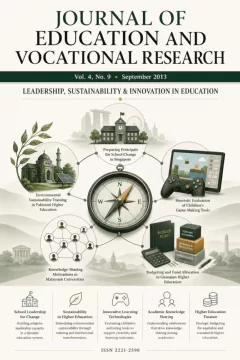 Vol. 4 No. 9 (2013)
Leadership, Sustainability & Innovation in Education
View issue contents
Published
Submissions
Have research to publish? Journal of Education and Vocational Research welcomes submissions.
Make a Submission