Articles

  • Article 1 in this issue

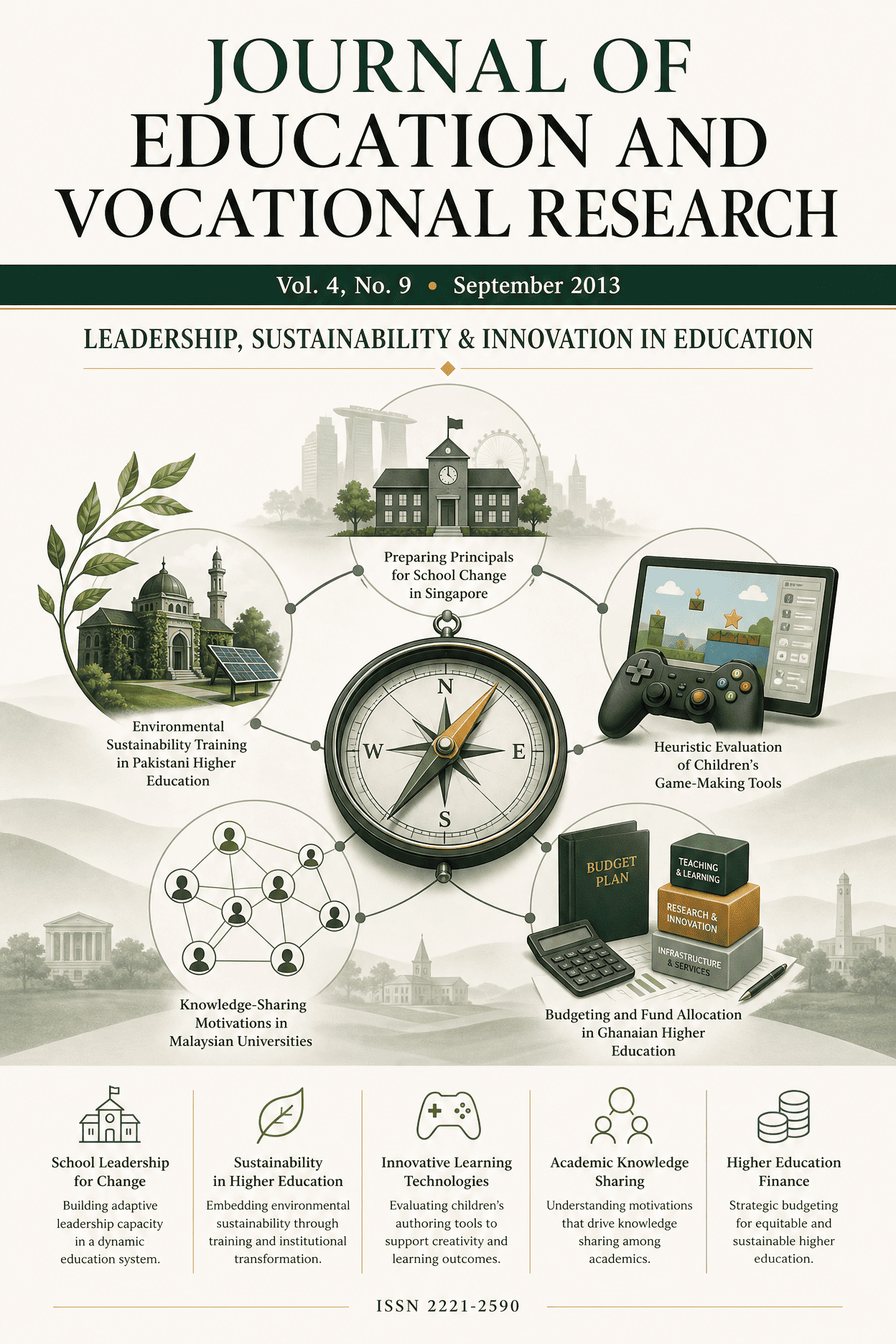
    Preparation of Principal for School Change: A Singapore Perspective

    • Author: Babin Pokharel

    This paper examines the understanding of the educational leadership process and the exploration of systematic preparation of private school principal in order to cope with future school change. Leading through change in education is a must in 21st century. Various contexts determine the change in leadership process. In schools, principal needs to be prepared in order cope with contextual changes. Changes in school can be seen various contexts such as cultural, technological, policy level, outbound competitions so on and so forth. School principal are the most important catalyst in the construction of new and innovative leadership practices that enhance the change process. Specifically, it presents the findings from the case of four private schools principal in Singapore through their storytelling. This paper includes an overview of the study and a discussion of growing themes related to the leadership process of the principals and their preparation strategy for a school change. The results from this study indicate how school principal prepare themselves for future and school change taking the entire internal and external environment into consideration.

    Pages 246-253

    PDF - Preparation of Principal for School Change: A Singapore Perspective (opens in a new tab)
  • Article 2 in this issue

    Lack of Environmental Sustainability in Youth Training at Higher Education

    • Author: Syed Kaleem Ullah Shah Bukhari, Hamdan Said

    This paper aims to explore the need of the Pakistan public university students to be educated and trained to comprehend the significance of environmental safety. Higher education has the responsibility of nation lead, especially, in training the youth to combat with emerging challenges and issues. However, the solution for these challenges –-health diseases, environmental hazards, lack of equal opportunities and others—depend on the safety of environment because of its inevitable connection with everything that exists in this world. Various efforts to preserve the environment are being taken into consideration from every corner of the higher education institutes in the developed and the developing countries alike. The initiatives in Pakistan higher education context seem less with respect to the subsequent adverse affects of the destruction of environment on the growing population of the country. This study employed open-ended one-on-one interview from five higher education academic administrators (N=5) of Pakistan public universities. Thematic analysis produced two themes: a). importance of youth training for environmental sustainability and, b) destruction of ozone layer with six categories. The findings showed the need to revise the curriculum and educate the youth. It was also found that there is a need of combined concerted efforts from all concerned agencies, and ministries to ensure the safety of environment.

    Pages 254-258

    PDF - Lack of Environmental Sustainability in Youth Training at Higher Education (opens in a new tab)
  • Article 3 in this issue

    Heuristic Evaluation of Children’s Authoring Tool for Game Making

    • Author: Laili Farhana Md Ibharim, Maizatul Hayati Mohamad Yatim

    The main purpose of the study is to evaluate the heuristic inspection of children’s authoring tools to develop games. The researcher has selected 15 authoring tools for making games specifically for educational purposes. Nine students from Diploma of Game Design and Development course and four lecturers from the computing department involved in this evaluation. A set of usability heuristic checklist used as a guideline for the students and lecturers to observe and test the authoring tools selected. The study found that, there are just a few authoring tools that fulfil most of the heuristic requirement and suitable to apply to children. In this evaluation, only six out of fifteen authoring tools have passed above than five elements in the heuristic inspection checklist. The researcher identified that to develop a usable authoring tool developer has to emphasis children acceptance and interaction of the authoring tool. Furthermore, the authoring tool can be a tool to enhance their mental development especially in creativity and skill.

    Pages 259-264

    PDF - Heuristic Evaluation of Children’s Authoring Tool for Game Making (opens in a new tab)
  • Article 4 in this issue

    A Case Study of Academics’ Knowledge Sharing Motivations at Malaysian Public Academic Institutions

    • Author: Alsaleh Saad, Haryani Haron

    This qualitative case study aims to explore and describe the academicians’ knowledge sharing motivations in a Malaysian public university. A single case study was conducted with the aim to gather deeper insights on the knowledge sharing motivation. Data were collected through semi-structured interviews. A total of 15 renowned academicians were interviewed. Content analysis method was used to extract the knowledge sharing motivations from the qualitative data. The research results reveal seven important factors which motivate academicians to share their knowledge. These motivations are build reputation, acknowledgement (includes gain rewards, get a promotion, and recognition), to be knowledgeable, reciprocity, vision and mission, mentoring, personal beliefs (includes culture, sense of responsibility, and religion). The research comprehensive analysis and results would expand an area of knowledge sharing motivations among academicians in universities which may still theoretically and empirically not adequately explored and described.

    Pages 265-274

    PDF - A Case Study of Academics’ Knowledge Sharing Motivations at Malaysian Public Academic Institutions (opens in a new tab)
  • Article 5 in this issue

    Budgeting and Fund Allocation in Higher Education in Ghana

    • Author: Emmanuel Newman

    The National Council for Tertiary Education (NCTE) the coordinating body for tertiary education in Ghana) and the Ministry of Education established norms in the early 1990s to assist higher education institutions in planning and ensuring efficiency of their operations and foster performance monitoring and evaluation. The norms also serve as standardised input factors for budgeting and allocation of public funds for higher education. During the past years, budgetary allocation to higher education institutions for recurrent expenditure has fallen short of the norm-based costs. Indeed, the difference between the normbased costs of university education and resources made available to the institutions by the Government were 28.9% in 2005/06 and 23.4% in 2009/10. The consequence of the inability of the state to provide funds to meet the norm-based costs of higher education is the breakdown of norm-based budgeting which was instituted in the early 1990s and a reversion to incremental and ad-hoc budgeting without due regard to the volume of activities performed by the institutions. This development has had grave consequences for equity and efficiency in fund management in higher education. This work assesses the factors behind the discontinuance of the norm-based budgeting approach and the use of the incremental budgeting approaches in higher education in Ghana.

    Pages 275-286

    PDF - Budgeting and Fund Allocation in Higher Education in Ghana (opens in a new tab)