Abstract
The main purpose of the study is to evaluate the heuristic inspection of children’s authoring tools to develop games. The researcher has selected 15 authoring tools for making games specifically for educational purposes. Nine students from Diploma of Game Design and Development course and four lecturers from the computing department involved in this evaluation. A set of usability heuristic checklist used as a guideline for the students and lecturers to observe and test the authoring tools selected. The study found that, there are just a few authoring tools that fulfil most of the heuristic requirement and suitable to apply to children. In this evaluation, only six out of fifteen authoring tools have passed above than five elements in the heuristic inspection checklist. The researcher identified that to develop a usable authoring tool developer has to emphasis children acceptance and interaction of the authoring tool. Furthermore, the authoring tool can be a tool to enhance their mental development especially in creativity and skill.
Keywords
References
- Baytak, A., Land, S. M. & Smith, B. K. (2011). Children as Educational Computer Game Designers: An Exploratory Study. TOJET , 10(4).
- Chiasson, S. & Gutwin, C. (2005). Design principles for children’s technology. Technical report HCI-TR-0502, Computer Science Department, University of Saskatchewan, Canada.
- Connolly, T., Stansfield, M. & Boyle, L. (2009). Games-based learning advancements for multi-sensory human computer interfaces: Techniques and effective practices. Information Science Reference.
- Dix, A. (2004). Human computer interaction. Pearson Education.
- Druin, A. (2002). The role of children in the design of new technology. Behaviour and information technology , 21(1), 1-25.
- Gilutz, S. & Nielsen, J. (2002). Usability of websites for children: 70 design guidelines. http://www.nngroup.com/reports/kids/
- Hall, B. (2001). New Technology Definitions. www.brandonhall. com/ public/glossary/index.htm.
- Kamisah, O. & Nurul-Aini, B. (2013). Teachers and Students as Game Designers: Designing Games for Classroom Integration. In S. de Freitas, M. Ott, M. Popescu, & I. Stanescu ( Eds .), New Pedagogical Approaches in Game Enhanced Learning: Curriculum Integration (pp. 102-113). Hershey, PA: Information Science Reference. doi: 10.4018/978-1-4666-3950-8.ch006.
- Laili Farhana, M. I. (2011). An Alternative Method for Collecting and Gathering Data Using Smartboard Application In The Field of Interaction Design and Children (IDC). Master Dissertation, Universiti Pendidikan Sultan Idris, Malaysia.
- Lim, C. P. (2008). Spirit of the game: Empowering students as designers in schools. British Journal of Educational Technology , 39(6), 996-1003.
- Maizatul Hayati, M. Y. (2009). Children, Computer and Creativity: Usability Guidelines for Designing A Game Authoring Tool for Children. PhD Dissertation, Otto-Von-Guericke University of Magdeburg, Germany.
- Mehm, F., Konert, J., Göbel, S. & Steinmetz, R. (2012). An authoring tool for adaptive digital educational games. In 21st Century Learning for 21st Century Skills (pp. 236-249). Springer Berlin Heidelberg.
- Nielsen, J. & Molich, R. (1990). Heuristic evaluation of user interfaces. In Proceeding of the SIGCHI conference on Human factors in computing systems (pp.249-256). ACM.
- Nielsen, J. (2013). Nielsen Norman Group: Evidence-Based User Experience Research, Training, and Consulting. http://www.nngroup.com.
- Prensky, M. (2008). Students as designers and creators of educational computer games: Who else? British Journal of Educational Technology , 39 (6), 1004-1019.
- Shneiderman, B. &Plaisant, C. (1997 ). Designing the user interface: Strategies for effective HumanComputer Interaction. Boston,USA: Addison-Wesley.
- Vaughan, T. (2001). Multimedia: Making It Work (Fifth Edition). Osborne/ McGrawHill.
- Yatim, M. H. & Masuch, M. (2007). Educating Children through Game Making Activity. http://www. learnit. org.gu.se/digitalAssets/862/862887_yatim_masuch. Pdf, 2007. Figure 1. Scratch Figure 3. Stencylworks Figure 5. Gamestar Mechanic Figure 2. Atmosphir Figure 4. Game Salad Figure 6. Gamefroot
Downloads
No downloads have been recorded for this article yet. Figures appear here once readers begin downloading the full text.
How to Cite
Share this article
License
Copyright (c) 2013 Laili Farhana Md Ibharim, Maizatul Hayati Mohamad Yatim (Author)

This work is licensed under a Creative Commons Attribution 4.0 International License.
Author (s) should affirm that the material has not been published previously. It has not been submitted and it is not under consideration by any other journal. At the same time author (s) need to execute a publication permission agreement to assume the responsibility of the submitted content and any omissions and errors therein. After submission of revised paper in the light of suggestions of the reviewers, the editorial team edits and formats manuscripts to bring uniformity and standardization in published material.
This work will be licensed under Creative Commons Attribution 4.0 International (CC BY 4.0) and under condition of the license, users are free to read, copy, remix, transform, redistribute, download, print, search or link to the full texts of articles and even build upon their work as long as they credit the author for the original work. Moreover, as per journal policy author (s) hold and retain copyrights without any restrictions.
Keywords
Section
Published in
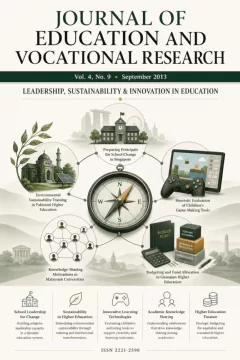 Vol. 4 No. 9 (2013)
Leadership, Sustainability & Innovation in Education
View issue contents
Published
Submissions
Have research to publish? Journal of Education and Vocational Research welcomes submissions.
Make a Submission