-
Article 1 in this issue -
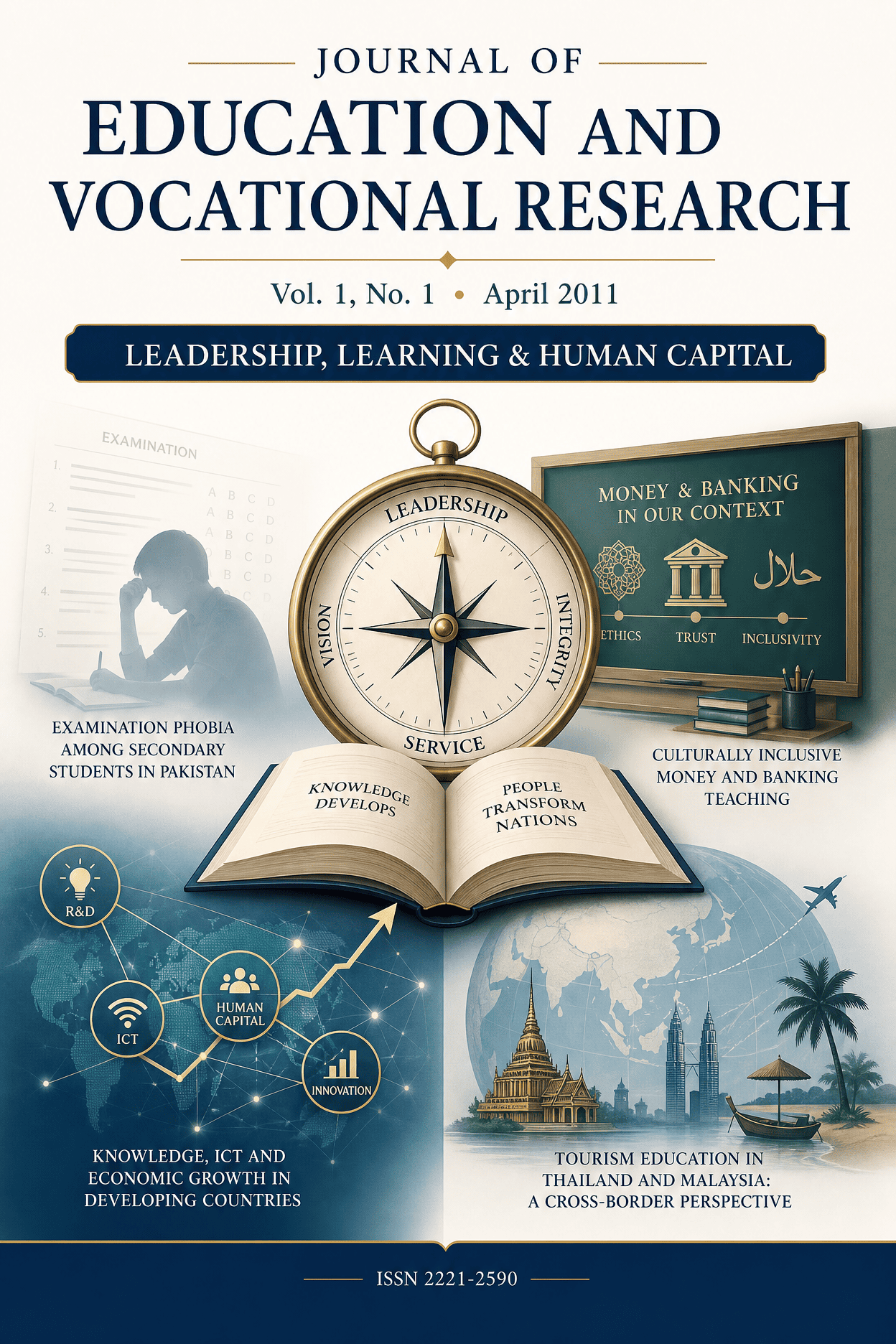
Article 2 in this issue A Survey of Examination Phobia amongst Students at Secondary School Level
- Author: Muhammad Javed, Imran Khan
This paper focuses on exam phobia among students. Exam phobia is an irrational fear that leads to avoidance of the feared situation or object which in turn increases the severity of the phobia. The students having an excessive and unreasonable fear due to exam or the presence or anticipation of a horrible situation causes an anxiety. The sufferer realizes that the fear is irrational; and the avoidance or distress due to the stimuli causes impairment in functioning. Eleven (11) Districts (counties) of the province of the Punjab, Pakistan were taken through convenient sampling. Two public Secondary schools (one male and one female) were selected from each District from urban area randomly. Seventy students (35 students from Boys Secondary school and 35 from Girls Secondary school) of grade 9 from each District were selected randomly. The total sampling was 11×70=770 students. A questionnaire was developed to collect the data. Data was analyzed by using SPSS version 16.0. The intensity of exam phobia was found. A comparison was also made on gender bases by using t-test. The results showed that the students suffer from exam phobia to some extent. Furthermore the results revealed that the level of exam phobia in male and female students was same. Recommendations have been given on the basis of findings.
Read more about A Survey of Examination Phobia amongst Students at Secondary School Level -
Article 3 in this issue Teaching by infusing Topics: Money and Banking
- Author: Amaresh Das
Students’ cultural identities shape their learning styles and preferred modes of expression. Rarely do economic courses paint an inclusive and exciting picture of what students would like to learn and how would they go about learning it. This thinking led the author to infuse race with Money and Banking in his class taught at Xavier University of LA in the spring of 2005. This class had two sections both of which I alone taught. The effectiveness of this teaching technique involving this infusion is tested by a direct comparison between student’s ratings in the class where the infusion was used and those in the class where it was not. The findings of project suggest that the student satisfaction as measured by the over-all learning experience is significantly greater with the infusion than without.
Read more about Teaching by infusing Topics: Money and Banking -
Article 4 in this issue Knowledge and Economic Growth: Evidence from Some Developing Countries
- Author: Alireza Poorfaraj, Ahmad Jafari Samimi, Hadi Keshavarz
The purpose of this paper is to estimate the impact of Knowledge Index consist of R&D, human resources and diffusion of ICT on economic growth in developing countries. To do so we have used a sample of 16 developing countries for which the necessary data were available for the period 2000- 2008. In this paper knowledge economy index (R&D, human resources and diffusion of ICT), Investment (Gross fixed capital formation), general government consumption and labor force considered as explanatory variables and GDP as a dependent variable. Our findings based on panel data econometrics method indicate that the impact of knowledge index on economic growth in the countries under consideration is positive and significance. Therefore, the expansion of knowledge in these countries is suggested.
Read more about Knowledge and Economic Growth: Evidence from Some Developing Countries -
Article 5 in this issue Tourism Education at the Tertiary Level and Competitive Advantage: A Comparison between Thailand and Malaysia
- Author: Thavorn Thitthongkam, John Walsh
Language plays an imperative role in business as a means and a source of power. It is particularly important in the tourism industry when international customers may be unable to communicate directly with service providers in the receiving country, and this has a direct effect on the level of satisfaction that they enjoy during their experience. To address this issue, countries attempt to various degrees to manage their labour markets so as to produce a number of graduates from secondary and tertiary level educational institutions commensurate with the demand from the sector. However, this is quite a young industry at the global level, and it is not clear to what extent the number and quality of such graduates with international language ability will be required. This paper studies the comparative extent of such education at the tertiary level of individuals in both Thailand and Malaysia. It aims to compare the number and variety of people being trained in the tourism and hospitality industry and the extent to which languages are being taught. Results show that there is something of a disconnection between the languages provided and the languages that tourists desire in terms of their mother tongue. Those tourists who can speak English or Chinese may receive service support in those languages, while those who cannot may be disappointed.
Read more about Tourism Education at the Tertiary Level and Competitive Advantage: A Comparison between Thailand and Malaysia
JEVR - Issue
Vol. 1 No. 1 (2011)
Leadership, Learning & Human Capital
This issue explores leadership, learning, and knowledge-driven development. Contributions address the leadership challenge in education, a survey of examination phobia among secondary school students in Pakistan, culturally infused teaching of Money and Banking, the impact of the knowledge economy index on growth in developing countries, and a comparative study of tertiary tourism education in Thailand and Malaysia.