Wired for Thought: How the Brain is Shaping the Future of the Internet
- Author: Jeffrey M. Stibel, Shiva Kumar Srinivasan
Workforce, Wages & Digital Society
This issue examines human capital, labour markets, and digital transformation. Papers analyse the role of the workforce in Iran's economic development, how the brain is shaping the future of the internet, the effect of minimum wage on youth employment in Iranian manufacturing industries, job satisfaction in the Bhakra Beas Management Board, and the impact of Sri Lanka's ICT policy on socioeconomic development.
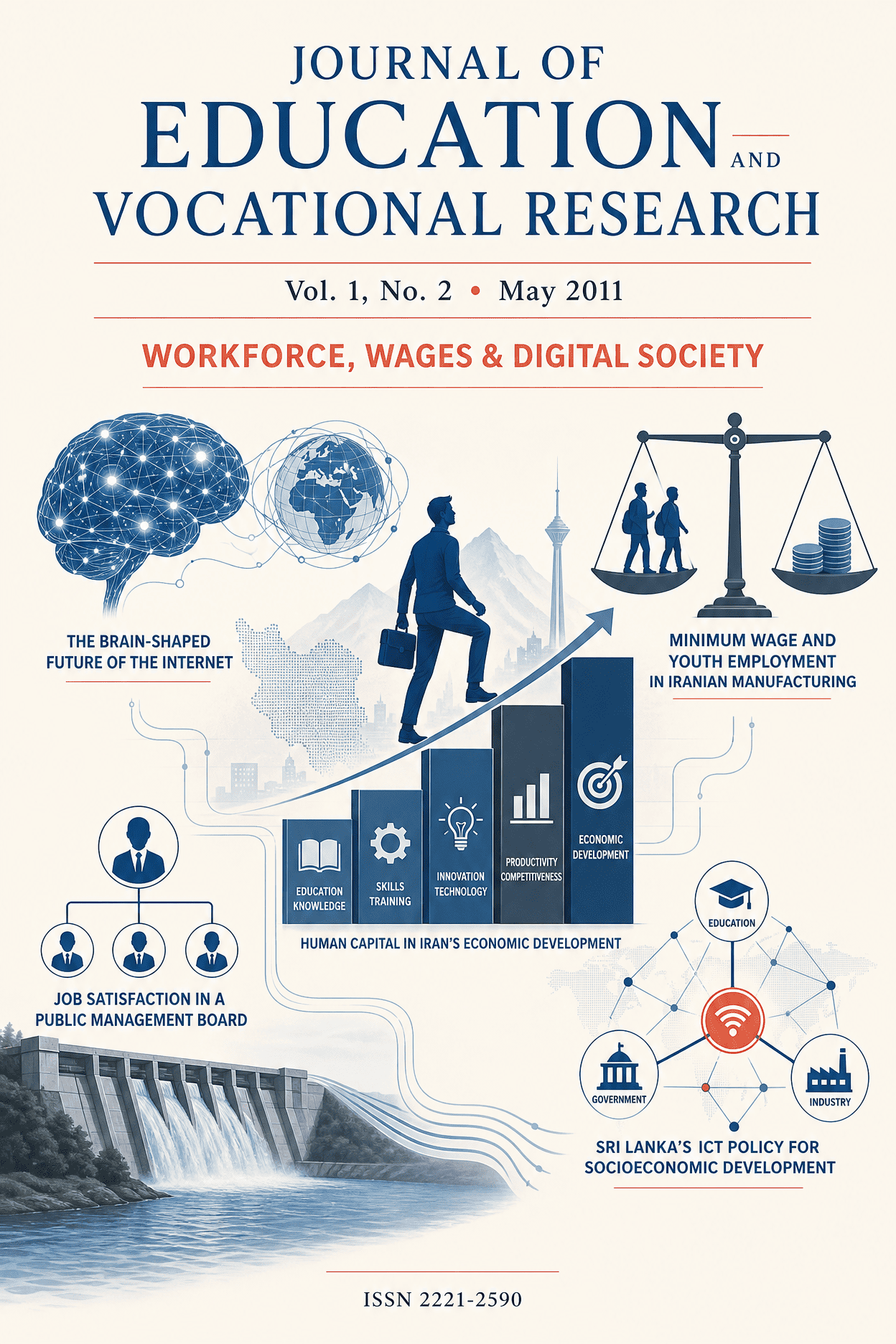
The purpose of this paper is to examine the effect of minimum wage on the youth employment using panel technique in Iran’s manufacturing industries at the 4-digit aggregation level of ISIC classification, during 2001-2006. There is the controversy surrounding minimum wage because the effects of the introduction and increase of minimum wage may differ greatly depending on the labor market structure. In order to capture the effects which various un-observed labor supply and demand factors may have on the youth employment, The Kaitz Index (as the ratio of the minimum wage to the average wage) has been used in our analysis. The obtained results provide the small but positive effect of minimum wage on youth employment.
Read more about Minimum Wage and Youth Employment The Case Study of Iran's Manufacturing IndustriesThe present study deals with the empirical results regarding the study of job satisfaction in Bhakra Beas Management Board. The study is attempted to assess the job satisfaction and their means difference among various satisfaction levels. The satisfied and dissatisfied groups to job satisfaction mean difference is also attempted. The disruptive research method is found suitable for this purpose. Primary data has been assembled by employing questionnaire. A sample of 360 respondents was selected from all unit of organization. The content, construct and item to total correlation validity were established. Reliability of the instrument was justified through the calculation of cronbach’s (α) alpha coefficient. The test-retest measure of reliability coefficient for job satisfaction scale was found acceptable. The finding appears to be reasonably valid in view of the deplorable socio- economic conditions of the employees and their factors influencing job satisfaction .
Read more about An Investigative Study of Job Satisfaction in Bhakra Beas Management BoardThe ICT policy of Sri Lanka has been largely contributed by both local and international institutions with the holistic purpose of enhancing quality of mass and providing sustainable outset for a knowledge society. The methodology followed by the author was secondary data review and the review report discusses the origin of ICT policy and how it integrates with broad set of stakeholders especially with education, government, industry and masses of Sri Lanka. This article provides a review of how successfully Sri Lanka initiates working programmes by the support of institutions accompanied with new policy frameworks. The key insight of this review article educates the importance of strategic implementation of ICT to strengthening country development plans operating as a value adding hub to industries and communities. The contribution of ICT as an enabler to succeed different sectors has been discussed under different segments. Finally, it concludes the way and progress what ICT should have in future to broadening opportunities for third world countries.
Read more about Information Communication Technology (ICT) Policy of Sri Lanka and its Impacts to Socioeconomic Development: A Review of Sri Lankan ExperienceTo reach higher economic growth, investment in human capital is also needed besides material investments. The purpose of this study is to determine the relationship between human capital and economic growth in Iran. The theoretical framework was designed based on this assumption that the total human capital employed in the economy is divided into two sections: Human capital with higher education and lack higher education. The data were collected from 1991 to 2006 and were analyzed using Ordinary Least Squares (OLS) model. The result of the analyses showed that there was significant relationship between human capital and economic growth. Together the independent variables explained 94% of the variance in the dependent variables. The remaining 16% was due to unidentified variables. In relation to that, we can conclude that explanatory power is high for the equation. It showed that one percent change in human capital rate lead to 58% in economic growth. Therefore human capital is regarded as an important factor in Iran's economic growth.
Read more about Workforce as an Important Factor in Iran’s Economic Development