Review of Harvard Business Review: McKinsey Award Winners
- Author: Shiva Kumar Srinivasan
Entrepreneurship, Resources & Quality
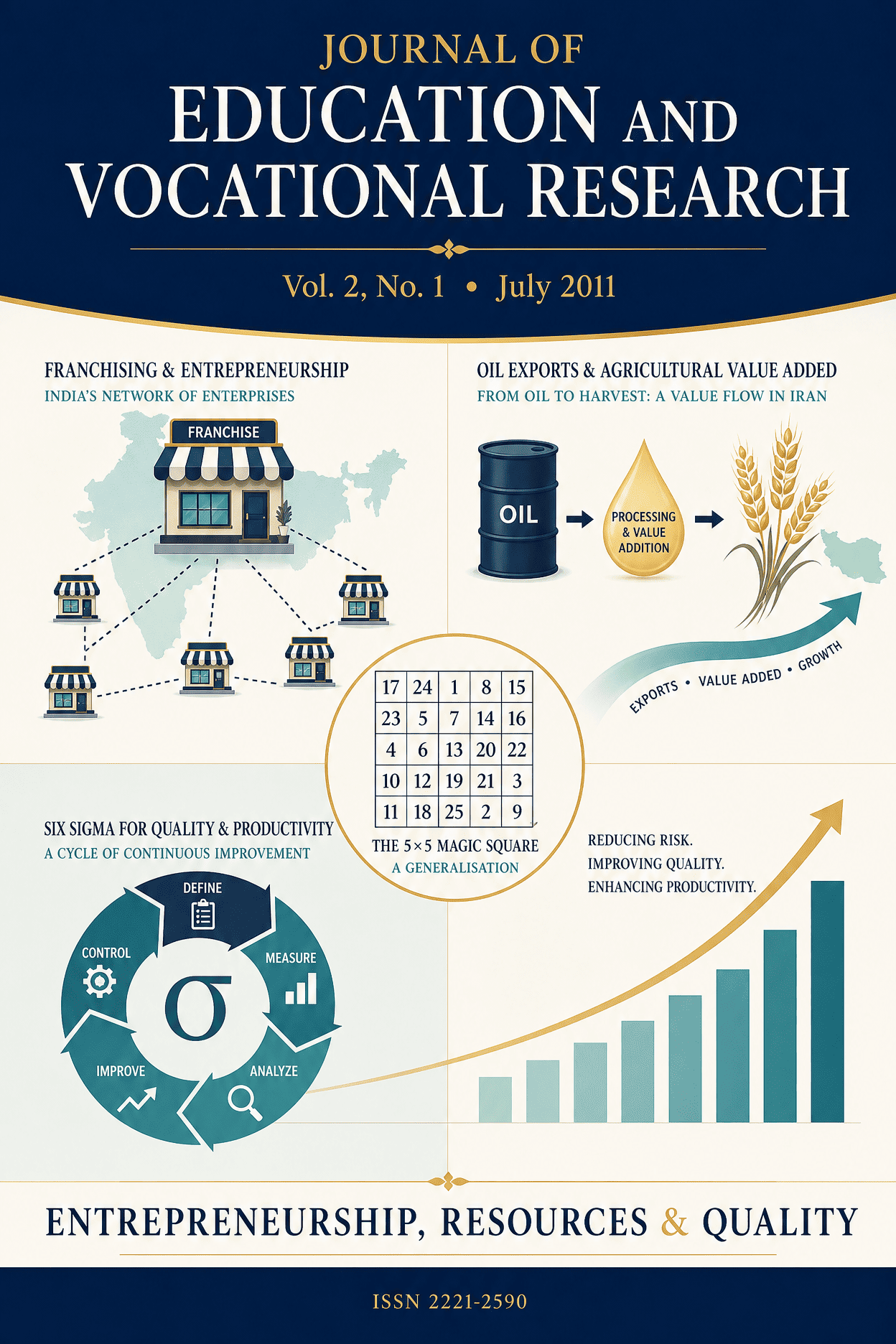
This issue spans entrepreneurship, resource economics, and process quality. Contributions include a review of Harvard Business Review's McKinsey Award winners, franchising as a source of Indian entrepreneurial development, the effect of oil exports on agricultural value added in Iran, a geometrical generalisation of the 5×5 magic square, and a critical analysis of Six Sigma for risk identification, quality, and productivity enhancement.
Most of us encounter dozens of franchised businesses each day, ranging from familiar fast-food restaurants to franchised educational systems such as Learn Right. Franchise means the special right given by the producer of a product (brand) to another firm to sell his product in a particular area. Franchising operation is a contractual relationship between a franchisor (the company offering the franchise) and the franchisee (the company undertaking to promote the sale of franchisor’s products). Individual franchises are a tightly knit group of enterprises whose systematic operations are planned, directed and controlled by the operation’s innovator, called the ‘franchisor’. Franchising continues to be a highly regulated industry that endeavors to promote the healthy growth of the economy. As an entrepreneur is a catalyst in the process of economic development, there is a need to develop the concept of entrepreneurship. Franchise Mart is a source to develop the Indian entrepreneurs. The present paper aims to discuss the concept of franchising, reasons for franchising and different opportunities provided by franchising for development of Indian entrepreneurs. The top established and emerging franchises both national and international are also discussed in our present paper. Finally, some suggestions are given for success in franchising.
Read more about Franchise Mart-The Source of Indian EntrepreneurThe slower economic growth in some countries with high natural resources shows an unsolved dilemma in economics when we compare the economic growth of such countries with some other countries that are poor in natural resources but surprisingly have a higher economic growth. The purpose of this study is to determine the relationship between oil exports and agricultural value added in Iran. The theoretical framework was designed based on this assumption that the total production in the economy is divided into two sections: production for inside and production for exports. The data were collected from 1961 to 2006 and were analyzed using Auto Regressive Distributed Lag (ARDL) model. The result of the analyses showed that there was significant relationship between oil export and agricultural value added. Error correction coefficient is negative and small and is equal to – 0.31 and it shows that if there is any shock or imbalance in total production, the system will be back to stability after a 3-year period. Together the independent variables explained 83% of the variance in the dependent variables. The remaining 17% was due to unidentified variables. In relation to that, we can conclude that explanatory power is high for the equation. It showed that one percent change in oil export rate lead to decrease 13% in agricultural value added. Therefore oil exports have negative effects on agricultural value added and is regarded as an important factor in Iran's agricultural value added.
Read more about A Study Examining the Effect of Oil Exports on Agricultural Value added in IranA magic square of order n is n×n matrix containing integers in such a way that each row and column add up to the same value. We generalize this notion to that of a 5×5 matrix with the help of a special geometrical figure without having much knowledge of algebra and another branch of mathematics. As we know, from very beginning common man always attracts with square magic properties and always tries through various ways to achieve it quickly. Here, we are giving effortless way to achieve it.
Read more about Generalization of 5×5 Magic SquareSix Sigma, with a myriad of its applications in numerous organizational and business processes, offers a project management methodology that supports achieving a goal of near perfection in process performance. Six Sigma is based on the impetus of Plan-Do-Check-Act can help industries, businesses and organizations to achieve significant performance improvement as most of the Fortune 500 companies have adopted Six Sigma (DeFeo & William, 2004). Six Sigma initiatives primarily entail DMAIC and DMADV methods for attaining a high standard of quality. In this paper we provide a critical analysis of the various Six Sigma applications, techniques and tools that can be used for improving quality and productivity of the organizations. The study also provides an insight into the methods used for risk identification in Six Sigma. The proposed techniques are evaluated and analyzed viz-a-viz DMAIC and DMADV approaches. The objective of this research is to summarize the existing level of research in the field of Six Sigma and highlighting the need for intensive academic research in this area. The study comparatively analyzes Six Sigma with Lean, QFD, PSP/TSP, FMEA, TPRM, AHP/ISS and PMBOK requirements. The study also highlights the prospective areas of future/further research in this discipline. The critical analysis of various techniques studied as part of this research reveals that Six Sigma is primarily beneficial for process improvement, risk identification and management etc. The critical analysis of this study is reported herein.
Read more about An Insight into Risk Identification, Quality and Productivity Enhancement using Six Sigma