Understanding Michael Porter: The Essential Guide to Competition and Strategy
- Author: Joan Magretta, Shiva Kumar Srinivasan
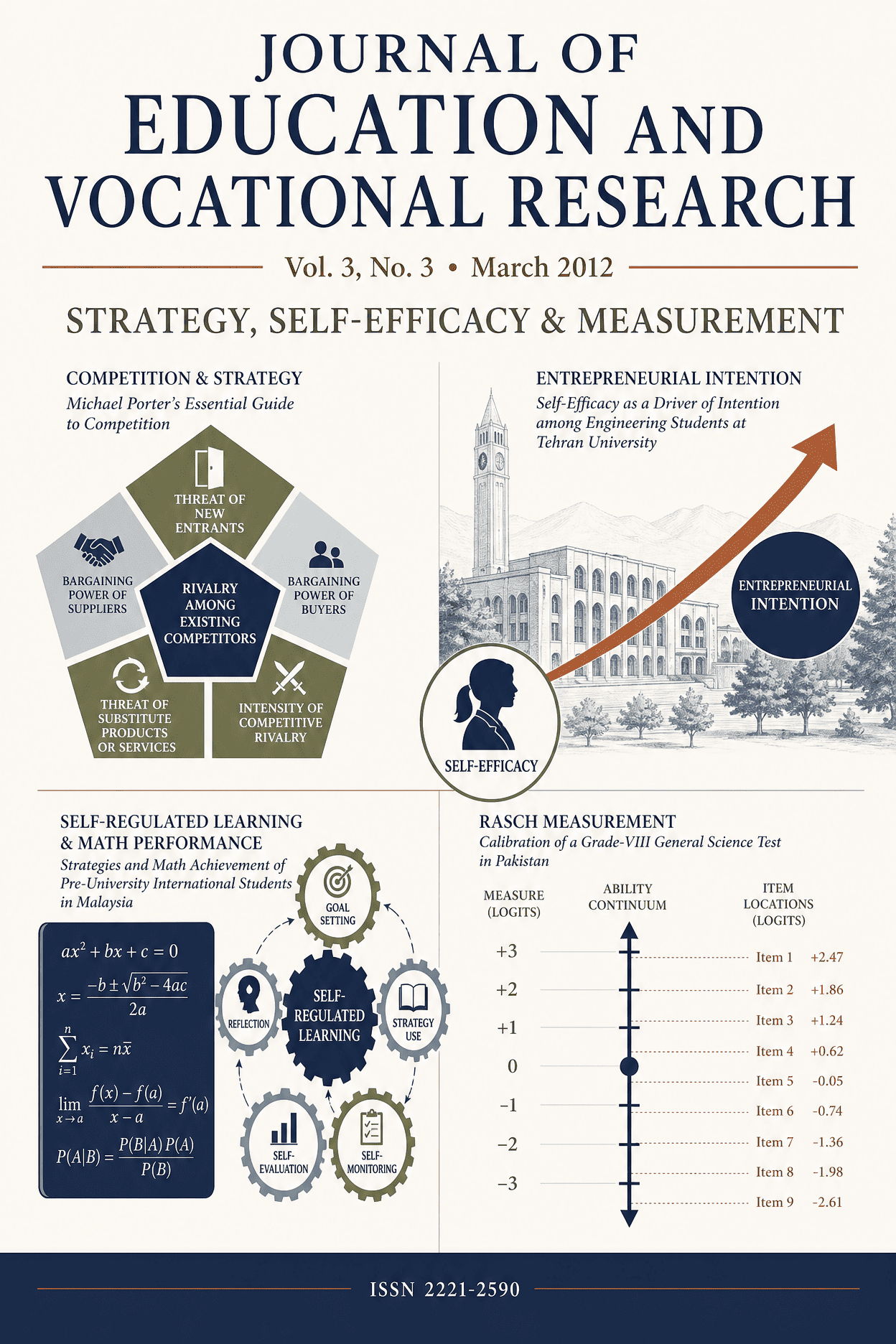
Strategy, Self-Efficacy & Measurement
This issue links strategic thinking, entrepreneurial mindset, and rigorous educational measurement. Contributions include a review essay on Michael Porter's essential guide to competition and strategy, an assessment of entrepreneurial self-efficacy and intention among engineering students at Tehran University, an analysis of self-regulated learning strategies and math performance of pre-university international students in Malaysia, and a Rasch calibration of a Grade-VIII General Science achievement test in Pakistan.
Entrepreneurship is the engine of economics of human society. In most countries, entrepreneurship, and especially start up of new businesses is most essential matter. Intention to run business is the base of entrepreneurial action. People, who have entrepreneurial intention, expect to start businesses in the future. In this study, we evaluated the impact of entrepreneurial self-efficacy on entrepreneurial intention. Women entrepreneurship is very important economic matter. Today, many of developed and developing countries, focus on the importance of women entrepreneurship and the enterprises founded by them (GEM, 2010). In this study, we implemented two modified questionnaire: first; Shapero's entrepreneurial intention questionnaire (Shapero, 1982) and Entrepreneurial self-efficacy questionnaire (DeNoble, et al., 1999). In order to analyze gathered data, we used SPSS11 Software, regression and Coefficient. Result shows that entrepreneurial self-efficacy has positive effect on entrepreneurial intention.
Read more about Evaluating the Role of Entrepreneurial Self-Efficacy on Entrepreneurial Intention of Tehran University (Case Study of Engineering Campus)The study examined any differences in self-regulated learning (SRL) strategies between two groups of international students in the Monash University Foundation Year (MUFY) program in Malaysia, in which one group of 58 international students in their first semester, and another group of 18 international students in their second and third semesters. It followed by examining the effect of the use of SRL strategies on math performance for both groups. The Learning and Study Strategies Inventory (LASSI) was used to measure the use of SRL strategies among international students, and the final score of the most manageable mathematical subject was used to measure their math performance. The result indicated that first-semester international students used as many SRL strategies as second- and thirdsemester international students, and no significant difference in math performance between the groups was found. The result also revealed that attitude towards academic tasks; motivation level and test taking strategies were positively associated with math performance of first-semester international students, while anxiety towards tests, attitude towards academic tasks and test taking strategies were positively associated with second- and third-semester international students’ math performance. Moreover, math performance of first-semester international students was significantly predicted by attitude towards academic tasks and test taking strategies, but second- and third-semester international students’ math performance was not significantly predicted by any SRL strategies.
Read more about Self-Regulated Learning Strategies and Their Effects on Math Performance of Pre-University International Students in MalaysiaThe present study aimed at calibration of General Science achievement test for grade (VIII) through Rasch Model. For this purpose a General Science achievement test comprising 45 items was constructed from the text book of General Science for class VIII. Finally the test was administered to 300 students (M/F) in different high schools for boys and girls in Multan District. The answer sheets were scored and results were tabulated. Eleven (11) items were rejected on the basis of F, D and . Fifteen (15) items were to be improved on the basis of F, D and . Remaining all items were good items. Rasch Model indicates that overall test is good to measure the achievement of the students class (VIII) in the subject of General Science. On the basis of findings, major conclusions were drawn: One item was rejected on the basis of facility index (F). Twelve (12) items need improvement on the basis of facility index (F). Thirty two (32) items were very good items on the basis of facility index (F). Seven items were rejected on the basis of discrimination index (D). One item needed improvement on the basis of discrimination index (D). Thirty seven (37) items were good items on the basis of discrimination index (D). Three items were rejected on the basis of phi-co-efficient ( ). Two items needed improvement on the basis of phi-co-efficient ( ). Forty items were good on the basis of phi-coefficient ( ). Test has high positive test reliability value.22 distracters were to be rejected as attempted by less than 5%.The distracters D(27), B(28), A(31), D(37), B(41), A(43) and B(10) were distracters attracted by high achievers more than low achievers, so they were rejected.
Read more about Rasch Calibration of General Science Test at Grade-VIII in Pakistan