Articles

  • Article 1 in this issue

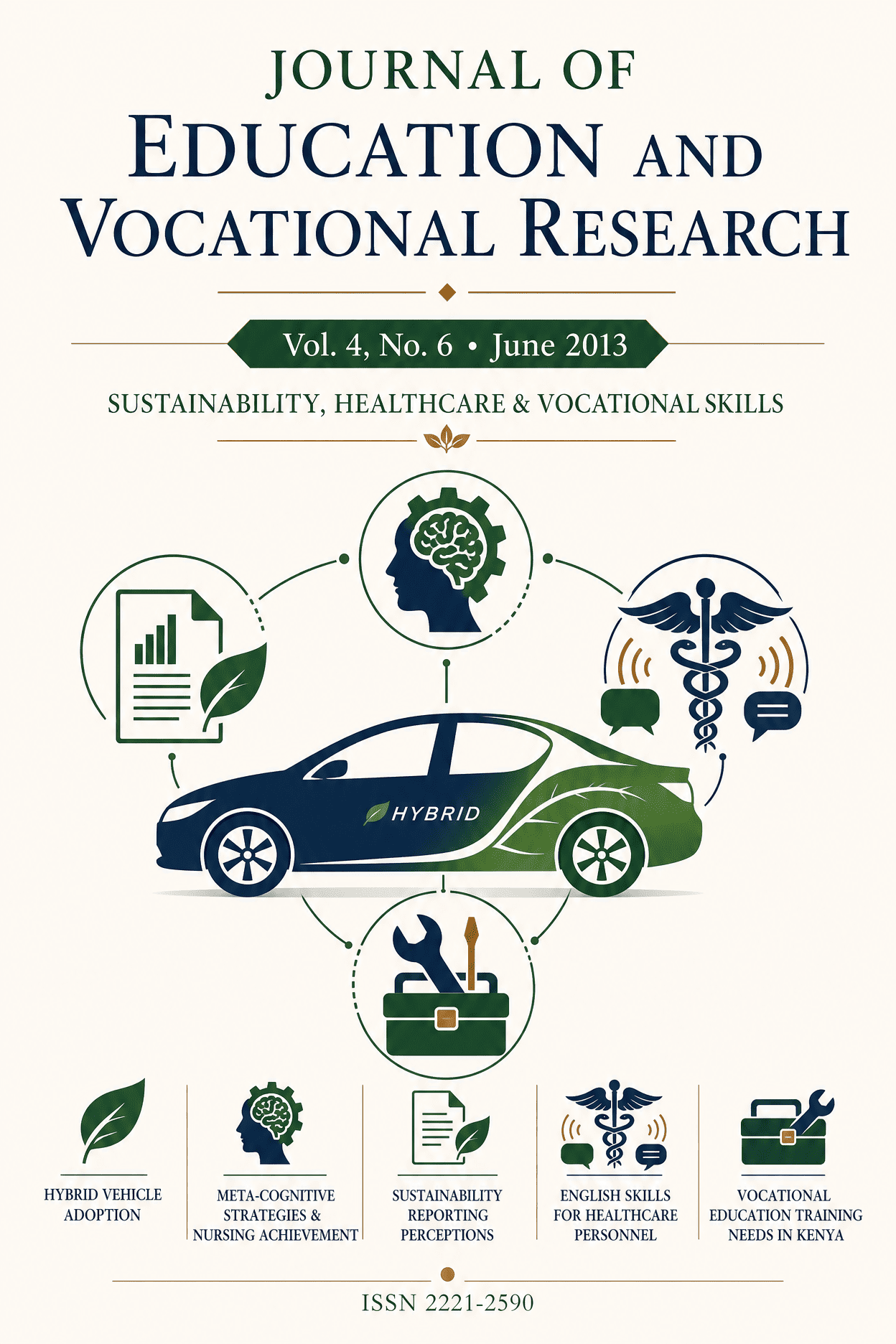
    Hybrid Vehicle Adoption – A Conceptual Study

    • Author: Wong Lai Soon, Wong Tai Seng, Wong Kee Luen, Jenny Marisa Lim Dao Siang

    Market share of hybrid vehicle is still low as compared to non-hybrid vehicle. From business point of view, slow growth in hybrid vehicle sales may causes losses on hybrid automobile manufacturers and they may end up withdraw from the market. In order to increase the sales of hybrid vehicle, a solution must be generated. To find a good solution, automobile producers must understand the market condition as well as the reasons/factors that influenced adoption of hybrid vehicle. This research aims to contribute to the understanding on the consumer behavior that causes the adoption of hybrid vehicle and hope to contribute to the reduction in global warming as well as theoretical development.

    Pages 165-168

    PDF - Hybrid Vehicle Adoption – A Conceptual Study (opens in a new tab)
  • Article 2 in this issue

    Meta-Cognitive Strategies and Nursing Students’ Achievement

    • Author: Salari M., Rohaniahmad tarmizi, Ramlah Hamzah, Zarida Hambali

    In the information era in which there is an increasing and rapid information change, education system needs to enable students to solve the problems of real world with their acquired skills. Metacognition is essential for successful learning and students can learn and use it to improve their performance. This paper was an attempt to investigate the reliability of meta-cognitive awareness inventory that is generated by Schraw and Dennison (1994) and its correlation with nursing students’ achievement in Iran. The design adopted for this study was a descriptive correlation design. To this end, 40 female university students majoring in nursing were selected as the sample. Pediatric nursing performance was measured using a test which included higher and lower order questions. The results indicated that (a) the questionnaire has acceptable internal consistency, with a Cronbach alpha coefficient of .74, (b) there was a strong, positive correlation between the two variables, r = .729, n = 40, p<0.01, with high levels of meta-cognitive awareness associated with higher levels of performance in course of pediatric nursing. In conclusion, meta-cognitive strategies may have impact on nursing performance among university students.

    Pages 169-173

    PDF - Meta-Cognitive Strategies and Nursing Students’ Achievement (opens in a new tab)
  • Article 3 in this issue

    Perception of Preparers and Users on Sustainability Reporting in Singapore

    • Author: Hwang Soo Chiat, Khoo Teng Aun, Wong Dan Chi

    The trend of sustainability reports has increased inexorably as the clamor by various stakeholders including NGOs have been growing louder and louder. In Singapore only a small percentage of listed companies are voluntary providing sustainability reporting but this number is set to increase in line with the world trend. This study attempts to address the perceptions of the importance and usefulness of sustainability reporting, the reporting framework and the training needs of both users and preparers to provide such reports. The results from a survey suggest that the respondents (both undergraduates and managers) perceive sustainability reporting positively and there is a need to provide training especially in the area of integrating financial reporting with sustainability reporting.

    Pages 174-183

    PDF - Perception of Preparers and Users on Sustainability Reporting in Singapore (opens in a new tab)
  • Article 4 in this issue

    A Study of Required English Skills for Healthcare Personnel in Bangkok-Based International Hospitals

    • Author: Inthira Pandey, Kantatip Sinhaneti

    The effective use of English skills is required for the Thai healthcare personnel. This study therefore aims to explore: 1) the use of the four English language skills by Thai healthcare personnel, 2) the minimum framework of effective interaction involvement for their situational contexts, and 3) the problems encountered when they communicate with foreign patients. This study revealed the following findings. Firstly, English speaking and listening skills were the two most important skills especially needed for healthcare personnel in their workplace. Secondly, grammatical errors and varieties of accents and pronunciation were seen as major communication problems. Lastly, the culture, social etiquettes, and values between healthcare personnel and foreign patients are required to build an internationally accepted reputation and meet patients’ social, cultural, and linguistic needs. This study indicates that intensive practice of the language skills is needed for healthcare personnel in preparing Thailand for the medical hub, AEC and the global market.

    Pages 184-192

    PDF - A Study of Required English Skills for Healthcare Personnel in Bangkok-Based International Hospitals (opens in a new tab)
  • Article 5 in this issue

    Where to Vocational Education in Kenya? Is Analysing Training and Development Needs the Answer to the Challenges in this Sector?
    • Author: Susan W. Ngure

    This paper examines training and development (T&D) systems in the technical, vocational education and training (TVET) in Kenya. It is in response to the Kenya Vision 2030 document that identifies TVET as the anchor of its economic pillar through science, technology and innovation to boost Kenya’s industrialisation status. The document notes that skills training faces challenges such as mismatch of skills between the training institutions and the industry, and disparities in accessibility at all levels. This paper seeks to explore whether the accurate assessment of training needs is the answer to the challenges faced by the training program. Data for this study were collected from scrutinising previous research papers and government documents, interviews with four senior education officers drawn from the education ministries and the Kenya Institute of Curriculum Development (KICD), six trainers from technical training institutes and two from a youth polytechnic. Observations were made in the TVET institutions participating in this study. Data were analysed using content analysis and presented by means of description. Findings identified the following challenges: a rigid and unresponsive curriculum, inadequate methods of training and development needs assessment (T&DNA), lack of stakeholder involvement in curriculum design, inadequate numbers of specialised staff at the KICD, poor training methods, obsolete tools and insufficient equipment, political interference and multiple providers. The author concludes that the introduction of a comprehensive T&DNA is indeed a prerequisite for a relevant and adaptive T&D program; however, additional factors such as the right equipment, qualified trainers, a conducive economic, social and political environment, and sound program coordination are also essential to its success. The paper is divided into seven sections: introduction, background to the research, problem statement, methodology, findings, discussion and research conclusions.

    Pages 193-204

    PDF - Where to Vocational Education in Kenya? Is Analysing Training and Development Needs the Answer to the Challenges in this Sector? (opens in a new tab)