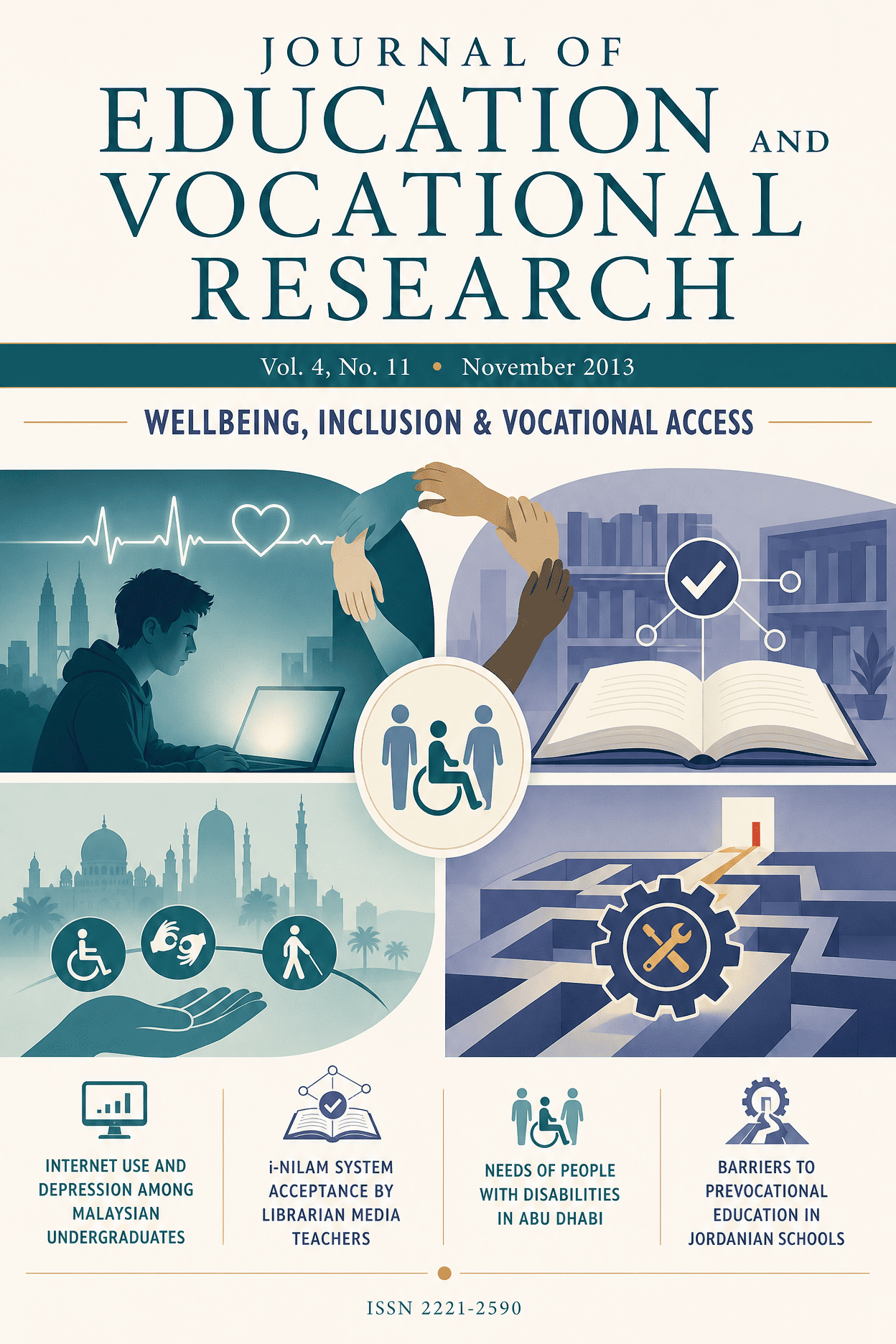
Articles

  • Article 1 in this issue

    Depression and Internet use in a Sample of Malaysian Undergraduate Students

    • Author: Lu Xi, Yeo Kee Jiar

    This study used a set of questionnaire to investigate the Internet use and depression level in a sample of Malaysian undergraduate students, which identified 12 cases as pathological Internet use (PIU) in a total sample of 90 students using Beard and Wolf’s (2001) criterion. Students with PIU spent significantly longer time on Internet and experienced extremely higher level of depression (M=42.83, SD=11.86) than their non-PIU counterparts (M=26.26, SD=14.79), which is in the severe level. The gender difference on depression was also detected in this study but not for time spent online. Lastly, this study found that students with PIU would like to spent more time on SNS, browsing with no specific purpose, and online media viewing, while students with increasing level of depression would accelerate the time spent online, especially on SNS, browsing with no specific purpose, and instant messaging. The same Internet application (SNS and browsing with no specific purpose) chose by students with PIU and high level of depression implied that there may be close association on developing depression and PIU related to usage of SNS and browsing with no specific purpose.

    Pages 317-325

    PDF - Depression and Internet use in a Sample of Malaysian Undergraduate Students (opens in a new tab)
  • Article 2 in this issue

    The Acceptance of the i-NILAM System by Librarian Media Teacher

    • Author: Nor Azah Mansor, Nor Hasbiah Ubaidullah, Ramlah Mailok

    The i-NILAM system is a system that records activity of Nadi Ilmu Amalan Membaca (NILAM) in school. In order to predict user acceptance in technology, the researchers have decided to assess the current system based on theory acceptance model. The Technology Acceptance Model has been adopted as the theoretical framework to determine whether it could help to explain actual individual behavior using the technology. A questionnaire survey has been used and it involves 120 librarian media teachers from schools in Batang Padang district. More importantly, this system will contribute to the efficiency of the management of NILAM Programme. This paper also discusses the theory acceptance model which is a specific model based to explain and expect consumer acceptance towards technology. The results of structural equation modeling using AMOS 18 supported the adequacy of research model.

    Pages 326-330

    PDF - The Acceptance of the i-NILAM System by Librarian Media Teacher (opens in a new tab)
  • Article 3 in this issue

    Assessing the Needs of People with Disabilities in the Emirate of Abu Dhabi, UAE

    • Author: Eman Gaad

    While there are many opportunities for people with disabilities (PWD) in Abu Dhabi (AD), UAE, there hardly been a study of what is required to get such people to meet their full potentials. This study commenced December 2012 and lasted for 4 months. The needs assessment based study tried to answer questions like what is needed to achieve the enhancement of the quality of life of PWD in AD region during and after school/centre times. It also looked at what type of needs (financial, assistive, emotional, and other) those people might have, and what are the needs of the parents of PWD that support the development of their children to reach their full potentials. Adding to that what could be recommended to bridge the gap in such needs. The purpose was mainly to develop a good understanding of the landscape. Benchmarking was undertaken from all private centers and scanning the needs of all parents of PWD in government centers across AD as well. It is hoped that researching the findings would help to develop the services on offer for PWD in the Emirate of AD. In order to achieve the aims of this study, 8 centres were selected out of the total of 17 which is the number of private centres in AD. The selection was based on size, location and type of disability as a purposeful sample to insure fair representation of the centres. The researcher conducted 8 filed visits of centers in Abu Dhabi and Al Ain to assess their current services, operating model etc. Individual briefs were prepared for every center with comparisons across specific factors. Scanning all the needs of all the parents of people with disability in the government centres across Abu Dhabi was looked at differently. To insure validity of the data and because the Emirati people with disability clustered mainly in government centres, all nine government centres under Zayed Higher Organization for Humanitarian Care were visited and sample interviews (qualitative and quantitative) from all centres were undertaken. Selected participants were used to interview and investigate up close (purposeful sampling). Findings showed that there is a desperate need for support after school hours despite the care offered during school hours for those who are in school age. Parents need support on several levels especially with how to spend quality time with their children with disabilities.

    Pages 331-338

    PDF - Assessing the Needs of People with Disabilities in the Emirate of Abu Dhabi, UAE (opens in a new tab)
  • Article 4 in this issue

    Barriers to Effective Prevocational education implementation in Jordanian Schools as Perceived by Teachers

    • Author: Tariq Yousef Jawarneh

    The main goal of this qualitative study was to explore perceptions and opinions of a group of in-service Prevocational Education (PVE) teachers to derive barriers to effective PVE implementation at the middle basic stage in Jordanian schools. The population and sample (n=35 of the study consisted of all teachers responsible for the delivery of PVE at the middle basic stage of the "North Mazar" educational directorate in the northern region in Jordan. The population and sample of the study were conveniently selected. The instrument used in this study was an interview schedule and technique used in analyzing data obtained from open-ended face-to-face interviews was that suggested by Merriam (2009) regarding qualitative data. Frequencies, percentages in addition to examples of sample quotes representing teachers' responses were provided. The results revealed that PVE lack attractiveness for pupils, parents, teachers, and principals and consequently they hold negative attitudes towards this practical provision. The results revealed four categories of barriers: (1), Barriers pertaining to perceptions and attitudes (2) barriers pertaining to economic factors, (3) barriers pertaining to administrative factors, (4) Barriers pertaining to human factors. Discussions of such barriers were provided, and concluding reflections and recommendations were presented.

    Pages 339-353

    PDF - Barriers to Effective Prevocational education implementation in Jordanian Schools as Perceived by Teachers (opens in a new tab)