Articles

  • Article 1 in this issue

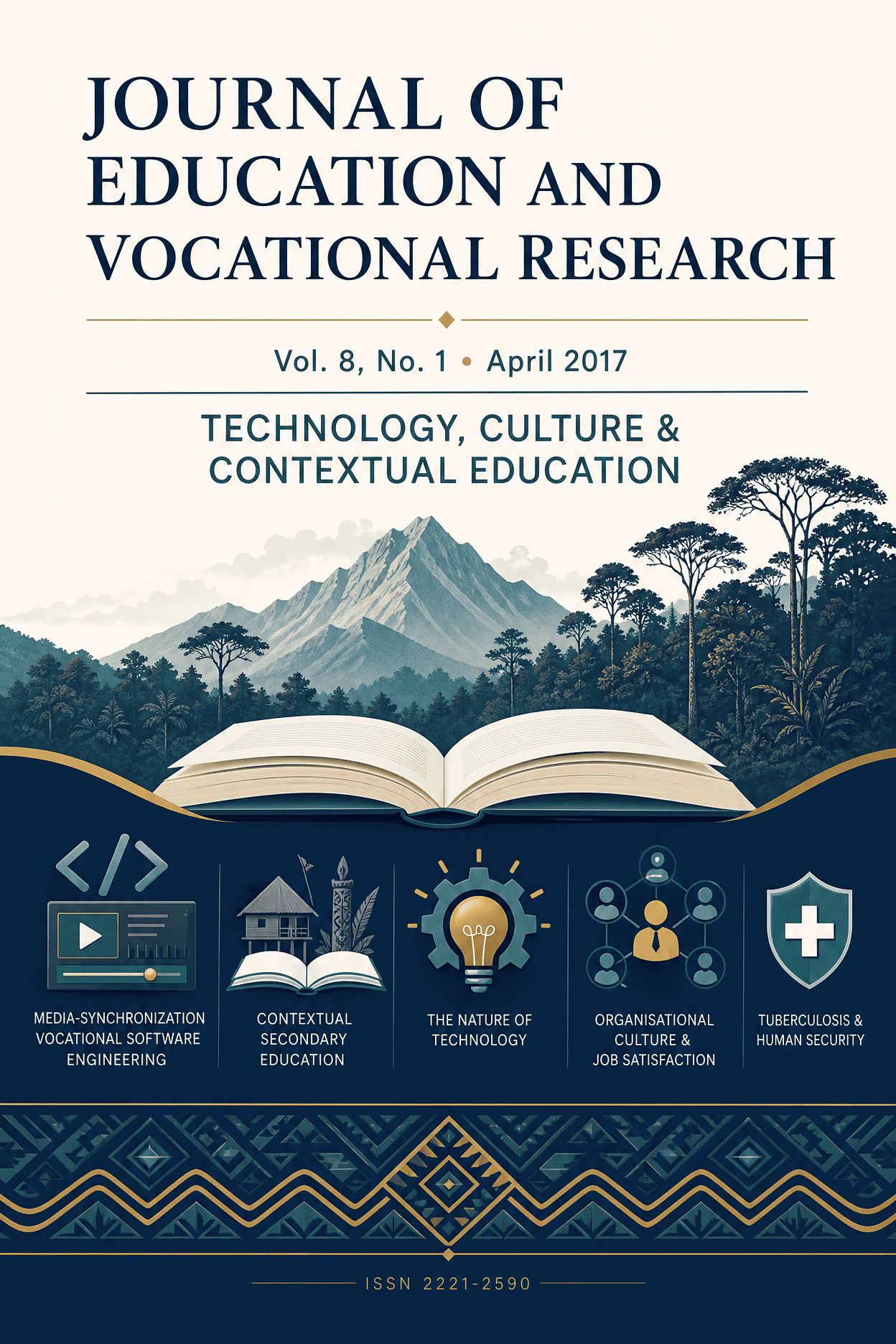
    Effect of Media Synchronization Module on Learning Achievement of the Software Engineering Students of Vocational High School

    • Author: Muhammad Chusni Agus, Amat Mukhadis, Eddy Sutadji

    This research aims at examining the effect of media synchronization module, mechanical aptitude, and prior knowledge on learning achievement of eleven grade students of the Software Engineering (RekayasaPerangkatLunak/RPL) Programin Vocational High School 5 at Malang, East Java, Indonesia. This quasi-experimental research used factorial design of 2x2x2 pattern and applied the non-equivalent control group design . It involved 74 students who were divided into two groups; 37 students were in the experimental group and 37 students were in the control group. Tests were used to investigate the students’ mechanical aptitude, prior knowledge and learning achievement. Data were analyzed by using three-way ANOVA. The results of the research showed that: 1) There was a significant difference in the learning achievement of the group taught by using media synchronization module and those who were taught by using the conventional method; 2) there was no significant difference in the learning achievement in the C++ Programming between students who had high and low mechanical aptitude; 3) there was a significant difference in the learning achievement in C++ Programming between students who had high and low prior knowledge; and 4) there was no significant interaction among media synchronization module, mechanical aptitude, and prior knowledge on the learning achievement with C++ Programming.

    Pages 6-11

    PDF - Effect of Media Synchronization Module on Learning Achievement of the Software Engineering Students of Vocational High School (opens in a new tab)
  • Article 2 in this issue

    Study on the Development of Education: Contextual Secondary Education in Papua

    • Author: Hans Hamadi

    Utilizing knowledge of education to manage technology as modern human lifestyles and meet the demands of work and life is the subject of this study. While those living in the suburbs to meet the demands of education, utilizing information technology as a way of life will come to their rescue. They also still use the natural wealth of forests, mountains and oceans as a source of learning and life. In remote areas, technology and the demands of rapid change, are sluggish and does not make the technology as a necessity of life. They depend on nature to meet their educational knowledge as well as the necessities of life. How technology can be implemented and enjoyed on this earth without distinguishing its diversity. They utilize contextual nature as education and then institutionalized it in teaching. Every human being has the same rights and if in fact there is a gap it means that there is injustice. So there are things that need to be repaired. The knowledge and skills of human resources in the context of this study are defined as an entity of teachers. Human and organizational resources, which indeed underlies the base of organizational performance. There is a substantive difference between knowledge and skill. The concept of knowledge is more oriented to intelligence, intellect, and extensive mastery of knowledge and the narrowness of insight that one. This is a qualitative descriptive study based on the paradigm of post positivism. Qualitative research is still using the theories and concepts that are not tested as in positivism paradigm. The results of the study of literature are (1) The need for establishing educational institutions in each region are categorized as remote and isolated areas. (2) Closer direct services to remote and isolated areas then form the institution can be either natural school. (3) Adequate education that is modified and performed should remain principled and lead to economic value, efficiently utilize the environment without leaving the quality of education. Efforts to render these services is in line with Government Regulation No. 19 Year 2005 on National Education Standards, at the school level, which can be used as a referral to the rule above are: (1) education as a process of acculturation and empowerment. (2) Education in order to increase the nation's competitiveness. (3) Education for development. (4) Education for affirmative action / serving disadvantaged communities. (5) The commitment to the policy of providing certain types of education.

    Pages 12-16

    PDF - Study on the Development of Education: Contextual Secondary Education in Papua (opens in a new tab)
  • Article 3 in this issue

    Turkish Adaptation of Nature of Technology Scale

    • Author: Huseyin ATES, Serbay DURMAZ

    Technology has always existed not for recently. For ages, its effect has occurred on society, economy and politics and evolution of technology is closely related to human development. Accordingly, human needs and desires are satisfied with technological knowledge and problem solving which is seemed as innovative change (International Technology Education Association [ITEA], 2005). However, nature and scope of technology which is a very important place in our lives is not fully understood (Aydın & Karacam, 2015; Bybee, 2010; DiGironimo, 2011; ITEA, 2006). Researches about nature of technology showed that technology in people's minds remains just as electric products, such as phones or computers (DeVries, 2003; Lewis, 1999; Volk & Dugger, 2005). Technology should be considered as a whole not one thing that separates the parts (Williams, 2000; Yıldız & Baltacı, 2016). Understanding nature of technology is possible with only education completely. Since there are limited studies about nature of technology in science education (e.g., Liou, 2015) and is no required number of scales especially in Turkish language, this study is needed. For all of these needs to be resolved, the purpose of this study is to adapt ‘Nature of Technology Scale’ into Turkish. The sample consisted of 255 pre-service science teachers who enrolled in the faculty of education of a university in Turkey. In the study, as an instrument, ‘The Student Concepts of the Nature of Technology Questionnaire’ developed by Liou (2015) was used. The data in this study were collected in the 2015-2016 spring semester. Data were analyzed with Structural Equation Modeling (SEM) method. According to findings, our data results showed that this study is suitable for Turkish adaptation of scale (CMın/Df, 1.52, GFI, .94, NFI, .92, RMSEA, .04, CFI, .95). Turkish form of the scale has 29 items that fall under 6 factors.

    Pages 17-22

    PDF - Turkish Adaptation of Nature of Technology Scale (opens in a new tab)
  • Article 4 in this issue

    Influence of Cultural Organization and Leadership on the Performance of Employees Mediated Job Satisfaction on District Health Department Mimika Papua

    • Author: Adolf Halley, B Kambuaya, J Ronsumbre, Ferdinand Risamasu

    Cultural organizations have become the talk very interesting and very important in today's era. Not just in depth but in order to make changes continuously, making the competitive advantage and the ability to survive in an era of constantly changing. If an organization is not treated culture then the organization can certainly run into problems which ultimately affect the sustainability of the organization. Organizational culture becomes a key element of the changes that will be a huge impact for the working system of the organization. The purpose of this study is; (1) To examine and analyze organization with cultural influence, directly or indirectly through job satisfaction on the performance of employees at the Department of Health Government of Mimika District of Papua Province (2) To examine and analyze the effect leadership directly or indirectly through job satisfaction on the performance of employees at the Department of Health Government of Mimika District of Papua Province. (3) To examine and analyze the effect job satisfaction on the performance of employees at the Department of Health Government of Mimika District of Papua Province. Unit sample in this study were clerks in Mimika District Health Office. Respondents amounted to 259 employees, were taken using the convenient sampling method. Data were analyzed using Structural Equation Modeling (SEM) with the help of the program Analysis of Moment Structure (AMOS). The results showed that. The results showed that organizational culture and positive significant influence on employee performance both directly and indirectly through job satisfaction. It shows that when organizations are paying attention and make improvements to the organization's culture will directly be able to increase job satisfaction and indirectly affect employee performance. Leadership and positive significant effect on employee performance, both directly and indirectly through job satisfaction. It shows that the improvement of leadership in the organization will directly improve the performance of employees or indirectly through job satisfaction. Job satisfaction had positive significant influence on employee performance. This means that increasing employee satisfaction will be able to improve employee performance.

    Pages 23-30

    PDF - Influence of Cultural Organization and Leadership on the Performance of Employees Mediated Job Satisfaction on District Health Department Mimika Papua (opens in a new tab)
  • Article 5 in this issue

    Tuberculosis in Jayapura: Human Security Threat in International Relations Perspective

    • Author: Melyana R Pugu, Mariana E Buiney

    The concept of human security defines the purpose of human to be free from poverty, free from terror and free from disease. This paper aims to provide an overview of the infectious disease, tuberculosis (TB), as one of the threats to human security in the city of Jayapura. The method used to assess this study is qualitative research method that describes and illustrates findings in the form of data and figures about the disease both by elaborating primary data collection through interviews with staffs and patients in government-funded health care as well as through secondary data libraries, books, journals and the Internet. The results from this study depict that from 2013 to 2015 the number of tuberculosis patients who reported themselves and get treatment and medication in Jayapura city through public health centres had both increased and decreased significantly. This is due to several reasons i.e. the presence of doctors in the health centres that handled the cases, the rise of patients’ awareness on the treatments, the availability of drugs for TB patients in clinics and assistance facilitating by USAID in Papua under the auspice of WHO. In the perspective of international relations, the increasing spread of tuberculosis in Jayapura has become the serious threat to human security and this requires crucial intervention of multi-stakeholders including local government through its health department covering the issue of the availability of accessible health centres, doctors and drugs for tuberculosis treatment. This also includes the promotion and raising awareness for local community relating to TB testing and maintaining one’s healthy environment.

    Pages 31-36

    PDF - Tuberculosis in Jayapura: Human Security Threat in International Relations Perspective (opens in a new tab)
  • Article 6 in this issue

    Hidden Structure in the Study of Papuanistiecs and Melanesianology

    • Author: Don Augusthinus Lamaech Flassy

    Development until the late 1980s and early 1990s on embodied the initiative of a typical science as the study of Papua titled Papuanistiecs as a course of study at the Department of Southeast Asia and Oceania, Faculty of Arts, University of Leiden-The Netherlands, while Melanesianology lead anthropology has been developed since 1896 when Boas carry out research works in the region of South Pacific and the Southwest Pacific. When Papuanistiecs sounds as a specific branch of the broader Melanesianology include anthropology, the course is not closed for any other specific subject areas, especially on the natural environment as physical nature (tangible) as well as the philosophy as the inner nature (intangible). A concept of intangible or philosophy of Papua-Melanesian on Socio-Cultural structure is what being proposed in this writing work as a "hidden-structure” or ‘covered structures'. The term or this formula was by the author uses to accommodate referrals various scholars who call the social structure of Papua-Melanesian as "loosely structure" or a missing structure and also as "confusing diversity" or as confuse or chaos diverse. That, "hidden structure" is said to be so because it is hidden to those outside the system which understanding as ethics while looking for people in the system who view of understanding the relationship of emics accused loose or off and confuse or confusing is very well lightly acknowledge. Melanesianology and Papuanistiecs very well coordinated by the Sydney University and the Australian National University in Canberra by enabling the University of Papua New Guinea/UPNG in Port Moresby PNG and the University of the South Pacific/USP, in Suva-Fiji. In addition to its general purpose by making Papuanistiecs and Melanesianology as a discipline of area regional study, the special purpose of the author also is about to raise these matters in connection with the State University of Cenderawasih who have declared itself as Anthropological Study Base, then the function of Papuanistiec and Melanesianology may be of the major studies take precedence in all disciplines.

    Pages 37-48

    PDF - Hidden Structure in the Study of Papuanistiecs and Melanesianology (opens in a new tab)