Abstract
The present study compares the risk and return of the Nifty Shariah index and Nifty index at days, months and quarters wise during the period 2nd January 2007 to 31st December 2010. The raw returns of the both indices are calculated as today price minus yesterday price divided by yesterday price. The t- test has been used to test the mean returns difference between both indices. The average Monday return of the Nifty Shariah index is compared with average return of the Nifty index by using two sample t-test. Like that, the average returns of the remaining of the days of Nifty Shariah index are compared with average returns of remaining days of the Nifty Index. The study finds that there is no difference between average day -wise returns of the Nifty Shariah index and average day return of the Nifty Index during the study period. The study also compares the average January return of the Nifty Shariah index with average January return of the Nifty index, average February return of the Nifty Shariah index with average return of the Nifty index and so on. Finally, the average return of the first, second, third and fourth quarter of Nifty Shariah with average return of the respective first, second, third and fourth quarter of Nifty index are compared. The study finds that there is a significant difference between average return of the Nifty Shariah and Nifty indices in the month of July and September. It is derived from the study that the Muslim Investors are evincing more interest to sell the shares in the market from July to September. The reason being, expenses inconnection with Ramalan Festival during that period. Therefore, the study confirms that Ramalan effect have been prevailing in the Indian Stock Market. Thus, this study reveals that the seasonal variation exits very much in Shariah Index.
Keywords
- Nifty Shariah Search this journal for Nifty Shariah (opens in a new tab)
- Islamic Index Search this journal for Islamic Index (opens in a new tab)
- Ramalan Effect Search this journal for Ramalan Effect (opens in a new tab)
- Seasonal Effects Search this journal for Seasonal Effects (opens in a new tab)
- Day of the Week Effect Search this journal for Day of the Week Effect (opens in a new tab)
References
- Ahmad, Z. and Ibrahim, H. (2002). A Study of Performance of the KLSE Syariah Index, Malaysian Management Journal, 6 (1&2): 25-34.
- Albaity, M. and Ahmad, R. (2008). Performance of Syariah and Composite Indices: Evidence from Bursa Malaysia. Asian Academy of Management Journal of Accounting and Finance. 4(1): 23-43.
- Beik, S. I. and Wardhana, W. (2009). The Relationship between Jakarta Islamic Index and Other Selected Markets: Evidence from Impulse Response Function. Persatuan Pelajar Indonesia International Islamic University Malaysia. ppi-iium.org/.../The%20Relationship%20between%20JII%20&%20US.pdf.
- Bhattacharya, K., Sarkar, N. and Mukhopadhyay, D. (2003). Stability of the day of the week effect in return and in volatility at the Indian capital market: a GARCH approach with proper mean specification, Applied Financial Economics. 13: 553- 563.
- Bandhani, K. N. (2004). Anomaly or Rationality: Explaining the Day-Of-The-Week Effect on S&P CNX Nifty Index-Returns during Different Settlement Regimes. Kumaun University Working paper, 2007.
- Chaudhury, S. K. (1991). Seasonality in share returns: preliminary evidence on day of the week effect. Chartered Accountant (India). 40: 107-9.
- Choudhury, T. (2000). Day of the week effect in emerging Asian stock markets- Evidence from GARCH model, Applied Financial Economics. 20: 235-42
- Goswami, R. and Anshuman, R. (2000). Day of the week effect on Bombay Stock Exchange. ICFAI Journal of Applied Finance. 6: 31-46.
- Hakim, S. & Rashidian, M. (2004). How costly is investor’s compliance to Sharia? Paper presented at the 11th Economic Research Forum Annual Conference in Sharjah, U.A.E. on December 14-16
- Hakim. S. & Rashidian, M. (2002). Risk and Return of the Islamic Stock Market, Paper presented at the presentation to Economic Research Forum Annual Meetings, Sharjah, UAE.
- Hussein, A. K. (2004). Ethical Investment: Empirical Evidence From FTSE Islamic Index. Islamic Economic Studies, 12(1): 21-40.
- Hussein, A. K. (2005). Islamic Investment: Evidence From Dow Jones and FTSE Indices, Working paper, Islamic Business Research Centre, Norway.
- Mohd Dali, N. R. S. B., Mudasir, H. H. and Hamid, S. A. (2008). Performance of Shariah compliance companies in the plantation industry. International Journal of Islamic and Middle Eastern Finance and Management. 1(2):166–178.
- Poshakwale, S. (1996). Evidence on weak form of efficiency and day of the week effect in the Indian stock market. Finance India. 10: 605-16.
- Rahman, F. A. and Wajdi, F. M. (2006). Dividend Signaling Hypothesis and Agency Cost: An Investigation on Shariah and Non Shariah Compliant Firms in Kuala Lumpur. Shariah Index Empirika, 19(1):1-9.
- Sadeghi, M. (2008). Financial Performance of Shariah-Compliant Investment: Evidence from Malaysian Stock Market. International Research Journal of Finance and Economics, 20: 15-26.
- Seng, K., Gianluigi. G. and Jason, L. (2009). Performance of Shariah-Compliant Indices in London and NY Stock Markets and their potential for diversification. International Journal of Monetary Economics and Finance, 2(3/4): 398–408.
- Yusof, M. R. and Abd. Majid, S. M. (2007). Stock Market Volatility Transmission in Malaysia: Islamic Versus Conventional Stock Market J. KAU: Islamic Econ. 20(2): 17-35.
Downloads
No downloads have been recorded for this article yet. Figures appear here once readers begin downloading the full text.
How to Cite
Share this article
License
Copyright (c) 2011 M. Dharani, P. Natarajan (Author)

This work is licensed under a Creative Commons Attribution 4.0 International License.
Author (s) should affirm that the material has not been published previously. It has not been submitted and it is not under consideration by any other journal. At the same time author (s) need to execute a publication permission agreement to assume the responsibility of the submitted content and any omissions and errors therein. After submission of revised paper in the light of suggestions of the reviewers, the editorial team edits and formats manuscripts to bring uniformity and standardization in published material.
This work will be licensed under Creative Commons Attribution 4.0 International (CC BY 4.0) and under condition of the license, users are free to read, copy, remix, transform, redistribute, download, print, search or link to the full texts of articles and even build upon their work as long as they credit the author for the original work. Moreover, as per journal policy author (s) hold and retain copyrights without any restrictions.
Keywords
- Nifty Shariah Search this journal for Nifty Shariah (opens in a new tab)
- Islamic Index Search this journal for Islamic Index (opens in a new tab)
- Ramalan Effect Search this journal for Ramalan Effect (opens in a new tab)
- Seasonal Effects Search this journal for Seasonal Effects (opens in a new tab)
- Day of the Week Effect Search this journal for Day of the Week Effect (opens in a new tab)
Section
Published in
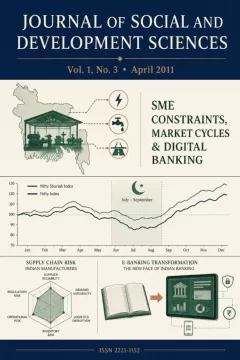 Vol. 1 No. 3 (2011)
SME Constraints, Market Cycles & Digital Banking
View issue contents
Published
Submissions
Have research to publish? Journal of Social and Development Sciences welcomes submissions.
Make a Submission