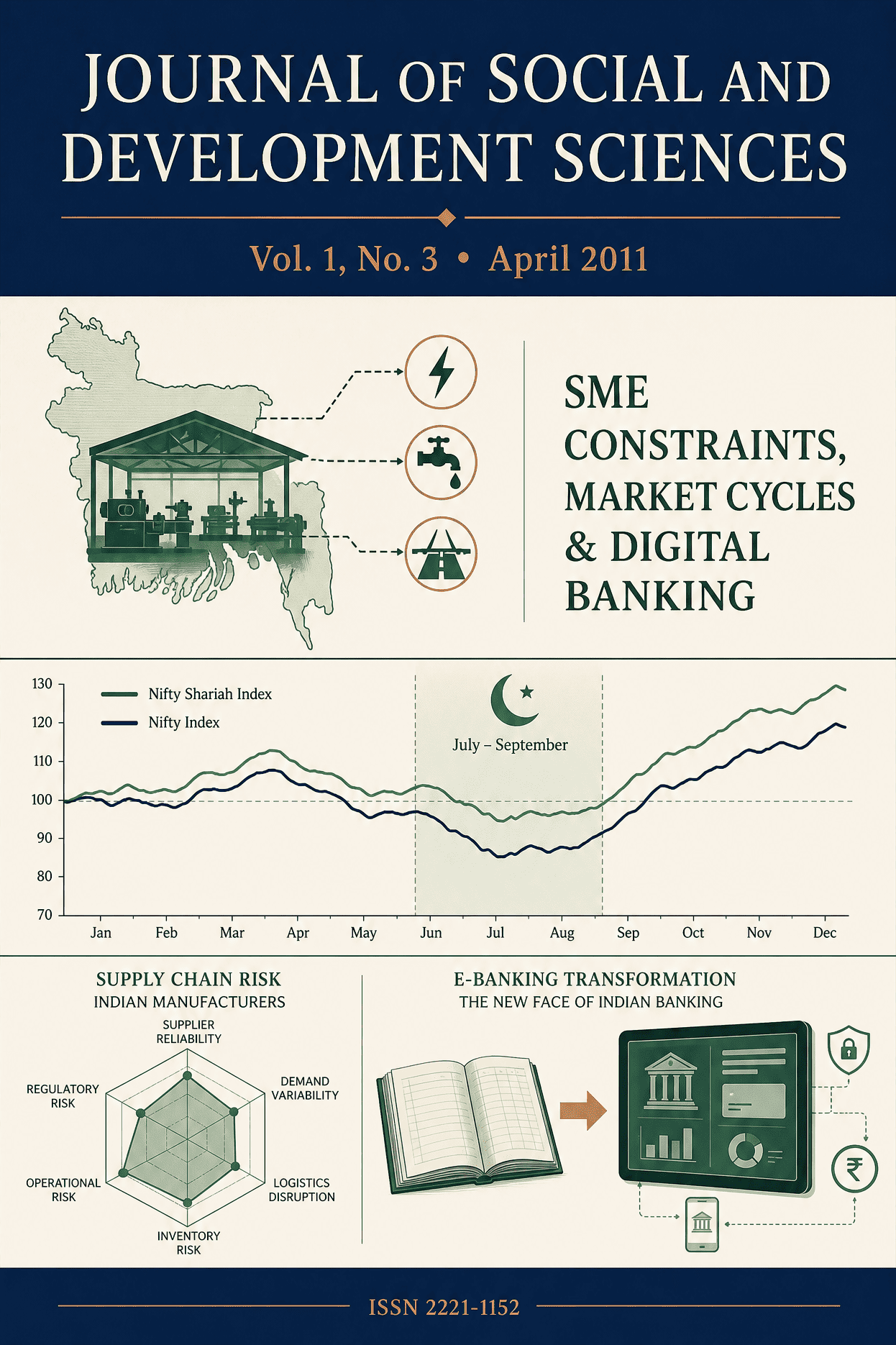
Articles

  • Article 1 in this issue

    Constraints of Manufacture based Small and Medium Enterprise (SME) Development in Bangladesh

    • Author: Feroz Ahmed, Md. Mizanur Rahman, Monimul Haque

    Small and medium enterprises (henceforth, SMEs) play a key role in economic growth and industrial development of a country. They make vital contributions in improving economic and social sectors of a country through stimulating large scale employment, investment, development of indigenous skill and technology, promotion of entrepreneurship and innovativeness, enhancing exports, and also building an industrial base at different scales. SMEs worldwide have been benefited from the combined interactions of forces of product mix, location factors, and market advantages. However, evidences also suggest that there are cases of SME failures. Growth of SMEs is constrained by many factors. Many SMEs occasionally go on growing into large firms. This paper looks for identifying such constraints of manufacture based SME Development in Bangladesh. From the study, it has been identified that, lack of utility facilities, for example, electricity, gas and water, frequent changes of the prices of raw materials as well as shortage of raw materials, political unrest, high interest rate on borrowings, high transportation cost, lack of financing for ongoing concern, and inadequate infrastructure are the major constraints of manufacture based SMEs Development in Bangladesh. The researchers assume that few initiatives like developing necessary infrastructure, ensuring utility services, reducing bank rate and ensuring consistent supply of raw materials can change the total scenario and thus can help the manufacturing sector which in turn will result the industrial development of the country and thus will be able to contribute to the economic development.

    Pages 91-100

    PDF - Constraints of Manufacture based Small and Medium Enterprise (SME) Development in Bangladesh (opens in a new tab)
  • Article 2 in this issue

    Seasonal Anomalies between S&P CNX Nifty Shariah Index and S&P CNX Nifty Index in India

    • Author: M. Dharani, P. Natarajan

    The present study compares the risk and return of the Nifty Shariah index and Nifty index at days, months and quarters wise during the period 2nd January 2007 to 31st December 2010. The raw returns of the both indices are calculated as today price minus yesterday price divided by yesterday price. The t- test has been used to test the mean returns difference between both indices. The average Monday return of the Nifty Shariah index is compared with average return of the Nifty index by using two sample t-test. Like that, the average returns of the remaining of the days of Nifty Shariah index are compared with average returns of remaining days of the Nifty Index. The study finds that there is no difference between average day -wise returns of the Nifty Shariah index and average day return of the Nifty Index during the study period. The study also compares the average January return of the Nifty Shariah index with average January return of the Nifty index, average February return of the Nifty Shariah index with average return of the Nifty index and so on. Finally, the average return of the first, second, third and fourth quarter of Nifty Shariah with average return of the respective first, second, third and fourth quarter of Nifty index are compared. The study finds that there is a significant difference between average return of the Nifty Shariah and Nifty indices in the month of July and September. It is derived from the study that the Muslim Investors are evincing more interest to sell the shares in the market from July to September. The reason being, expenses inconnection with Ramalan Festival during that period. Therefore, the study confirms that Ramalan effect have been prevailing in the Indian Stock Market. Thus, this study reveals that the seasonal variation exits very much in Shariah Index.

    Pages 101-108

    PDF - Seasonal Anomalies between S&P CNX Nifty Shariah Index and S&P CNX Nifty Index in India (opens in a new tab)
  • Article 3 in this issue

    Analyzing the Risk Factors of Supply Chain Management in Indian Manufacturing Organizations

    • Author: Rana Basu, Mousumi Modak, Pranab K Dan

    Today organizations of any magnitude have heavily integrated supply chain. The supply chain management consists of all parties involved, directly or indirectly in fulfilling customer request. There is an immense growth which has expanded from the traditional point of view as not only of physical distribution of materials but also to services. Implementing supply chain risk management has been troubleshooting in many organizations. In practice assessing risk management in supply chain is rather underdeveloped and often dealt with informal and reactive manner. As risk management issues today is subjected to substantial research and the organizations are trying to mitigate the risk issues so as to maintain the smooth operation of supply chain. The purpose of this paper is to identify and prioritize the risk factors in context to supply chain management of Indian manufacturing organizations. The research presented here is specifically targeted to Indian manufacturing organizations which are managing the supply chain operations. This paper deals with the risk issues and thus empirically assesses which risk factors are most influencing one in supply chain operations which must be given careful attention.

    Pages 109-114

    PDF - Analyzing the Risk Factors of Supply Chain Management in Indian Manufacturing Organizations (opens in a new tab)
  • Article 4 in this issue

    E-Age Technology–New Face of Indian Banking Industry: Emerging Challenges and New Potentials

    • Author: R. K. Uppal

    The present paper analyzes the performance of major banks in terms of productivity and profitability in the pre and post e-banking period. Under the regime of banking sector reforms, IT Act of 1999 gave new dimensions to the Indian banking sector. IT has created transformation in banking structure, business process, work culture and human resource development. It has affected the productivity, profitability and efficiency of the banks to a large extent. The paper concludes that performance of all the banks under study is much better in post-e-banking period and further foreign banks are at the top position, whereas the performance of the public sector banks is comparatively very poor. The paper suggests some measures to tackle the challenges faced by the banks particularly public sector banks. At the end, paper suggests how public sector banks can convert the emerging challenges into opportunities.

    Pages 115-129

    PDF - E-Age Technology–New Face of Indian Banking Industry: Emerging Challenges and New Potentials (opens in a new tab)