Abstract
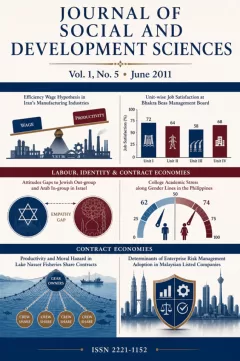
The purpose of this paper is to test the efficiency wage hypothesis for Iran's manufacturing industries at the 4-digit aggregation level of ISIC classification, during 2001-2006. According to the efficiency wage hypothesis, it is logical for some firms to pay wages that are above the market wage. In some cases the mere fact that workers are paid more can make them more productive. In other words, efficiency wages would increase productivity and there is positive relationship between wages and productivity . In this paper, panel data technique has employed to examine the mentioned hypothesis. However, the obtained results contradict the efficiency wage hypothesis for Iran's manufacturing industries. In other words, according to this result, higher wages lead to less efficient performance by the workers of Iran's manufacturing industries.
Keywords
- Efficiency Wage Hypothesis Search this journal for Efficiency Wage Hypothesis (opens in a new tab)
- Productivity Search this journal for Productivity (opens in a new tab)
- Iran's Manufacturing Industries Search this journal for Iran's Manufacturing Industries (opens in a new tab)
- Panel Data Search this journal for Panel Data (opens in a new tab)
References
- Abbas, S. K., & Zaman, A. (2005). Efficiency Wage Hypothesis: The Case of Pakistan. The Pakistan Development Review , 44(4), 1051–1066.
- Akerlof, G. A. (1982). Labour Contracts as Partial Gift Exchange. Quarterly Journal of Economics , 97(4), 543–63.
- Akerlof, G. A. (1984). Gift Exchange and Efficiency-Wage Theory: Four Views. American Economic Review , 74, 79–83.
- Akerlof, G. A. (1979). The Case against Conservative Macroeconomics. An Inaugural Lecture. Economica , 46: 219 -237.
- Akerlof, G. A. (2002). Behavioural Macroeconomics and Macroeconomic Behaviour. American Economic Review , 92, 411-433.
- Akerlof, G. A. and Yellen, J. L. (1986). Introduction in Efficiency Wage Models of the Labor Market. Cambridge University Press, Cambridge.
- Akerlof, G. A. & Yellen, J. L. (1990). The Fair Wage–Effort Hypothesis and Unemployment. Quarterly Journal of Economics , 105 (2), 255-283.
- Baltagi, H. B. (2008), Econometric Analysis of panel Data . Johnwiley and Sons, Forth Edition.
- Bardhan, P. (1993). Economics of Development and the Development of Economics. Journal of Economic Perspectives , 7(2), 129-142.
- Blinder, A. S. (1988). The Challenge of High Unemployment. American Economic Review , 78, 1–15. Centre of Statistic of Iran, Statistics Yearbook, Various Year, Iran, Tehran.
- Gordon, R. J. (1990). What Is New-Keynesian Economics? Journal of Economic Literature , 28(3), 11151171.
- Greene, W. (2008). Econometric Analysis, Prentice-hall, Sixth Edition.
- Gujarati, D. N. (2004). Basic Econometrics, Forth Edition, McGraw-hill.
- Haley, J. (1990). Theoretical Foundations of Sticky Wages. Journal of Economic Surveys , 4, 115–155.
- Hsiao, C. (2005). Analysis of panel Data, Cambridge University Press, Second Edition.
- Huang, T. L., Hallam, A., Orzem, P. F. & Paterno, E. M. (1998). Empirical tests of efficiency wage models, Economica , 65, 125-143.
- Katz, L. F. (1986). Efficiency Wage Theories: A Partial Evaluation. NBER Macroeconomics Annual , (1), 235290.
- Katz, L. F. (1988). Some Recent Developments in Labour Economics and Their Implications for Macroeconomics. Journal of Money, Credit, and Banking , 20(3), 507-522.
- Katz, L. F. & Krueger, A. B. (1999). The High-Pressure Labour Market. Brookings Papers on Economic Activity , 30(1), 1-88.
- Leibenstein, H. (1957). The Theory of Underdevelopment in Densely Populated Backward Area, In H. Leibenstein (ed.), Economic Backwardness and Economic Growth. New York: Wiley.
- Leibenstein, H. (1979). A Branch of Economics Is Missing: Micro–Micro Theory. Journal of Economic Literature , 17, 477.
- Leonard, J. S. (1987). Carrots and Sticks: Pay, Supervision, and Turnover. Journal of Labor Economics , 5, 137-152.
- Levine, D. (1992). Can Wage Increases Pay for Themselves? Tests with a Production Function, Economic Journal, 102, 1102-1115.
- Lundborg, P. (2005). Individual Wage Setting, Efficiency Wage and Productivity in Sweeden, FIEF Working Paper, 205.
- Maloney, W., & Ribeiro, E. P. (1999). Efficiency Wage and Union Effects in Labor Demand and Wage Structure in Mexico: An Application of Quantile Analysis, Mexico University.
- Marshall, A. (1920), Principles of Economics, London: Macmillan.
- Millea, M. (1998). A Direct Test of Efficiency Wage Theory: Evidence from U.S. and other OECD Countries, UMI Company, No. 9829528.
- Phelps, E. S. (1968). Money Wage Dynamics and Labour Market Equilibrium. Journal of Political Economy , 76 (4): 678-711.
- Phelps, E. S. (1970). Microeconomic Foundations of Employment and Inflation Theory, New York: W.W. Norton.
- Raff, D., & Summers, L. (1987). Did Henry Ford pay efficiency wages? Journal of Labor Economics , 5(4), 257-586.
- Romaguera, P. (1991). Wage Differentials and Efficiency Wage Models: Evidence from the Chilean Economy. Kellog Institute Discussion Working Paper No. 153.
- Salop, S.C. (1979). A Model of the Natural Rate of Unemployment. American Economic Review , 69, 117-25.
- Saygili, Ş. (1998). Is the Efficiency Wage Hypothesis Valid for Developing Countries? Evidence from the Turkish Cement Industry, Studies in Economics, University of Kent at Canterbury, Kent. Discussion Paper, No. 9810.
- Shapiro, C. & Stiglitz, J. (1984). Equilibrium Unemployment as a Worker Discipline Device, American Economic Review , 74, 433–44.
- Solow, R. M. (1979). Another Possible Source of Wage Stickiness. Journal of Macroeconomics , 1, 79–82.
- Solow, R. M. (1980). On Theories of Unemployment. American Economic Review , 70, 1–11.
- Solow, R. M. (1990). The Labor Market as a Social Institution. Basil Blackwell, Cambridge, Massachusetts.
- Spence, M. (1974). Market Signalling, Cambridge, MA: Harvard University Press.
- Stiglitz, J. E. (2002). Information and Change in the Paradigm in Economics. American Economic Review , 92(3), 460-501.
- Strauss, J. (1986). Does Better Nutrition Raise Farm Productivity? Journal of Political Economy , 94, 297320
- Thurow, L. C. (1983). Dangerous Currents: The State of Economics, New York: Random House.
- Wadhwani, S. B. & Wall, M. (1991). A Direct Test of the Efficiency Wage Model using UK Micro-Data, Oxford Economic Papers , 43, 529-548.
- Weiss, A. (1980). Job Queues and Layoffs in Labour Markets with Flexible Wages. Journal of Political Economy, 88, 526–38.
- Weiss, A. (1991). Efficiency Wages: Models of Unemployment, Layoffs and Wage Dispersion, Oxford: Clarendon Press.
- Yellen, J. L. (1984). Efficiency Wage Models of Unemployment. American Economic Review, 74(2), 200205.
Downloads
No downloads have been recorded for this article yet. Figures appear here once readers begin downloading the full text.
How to Cite
Share this article
License
Copyright (c) 2011 Ahmad Jafari Samimi, Saman Ghaderi (Author)

This work is licensed under a Creative Commons Attribution 4.0 International License.
Author (s) should affirm that the material has not been published previously. It has not been submitted and it is not under consideration by any other journal. At the same time author (s) need to execute a publication permission agreement to assume the responsibility of the submitted content and any omissions and errors therein. After submission of revised paper in the light of suggestions of the reviewers, the editorial team edits and formats manuscripts to bring uniformity and standardization in published material.
This work will be licensed under Creative Commons Attribution 4.0 International (CC BY 4.0) and under condition of the license, users are free to read, copy, remix, transform, redistribute, download, print, search or link to the full texts of articles and even build upon their work as long as they credit the author for the original work. Moreover, as per journal policy author (s) hold and retain copyrights without any restrictions.
Keywords
- Efficiency Wage Hypothesis Search this journal for Efficiency Wage Hypothesis (opens in a new tab)
- Productivity Search this journal for Productivity (opens in a new tab)
- Iran's Manufacturing Industries Search this journal for Iran's Manufacturing Industries (opens in a new tab)
- Panel Data Search this journal for Panel Data (opens in a new tab)
Section
Published
Submissions
Have research to publish? Journal of Social and Development Sciences welcomes submissions.
Make a Submission