Articles

  • Article 1 in this issue

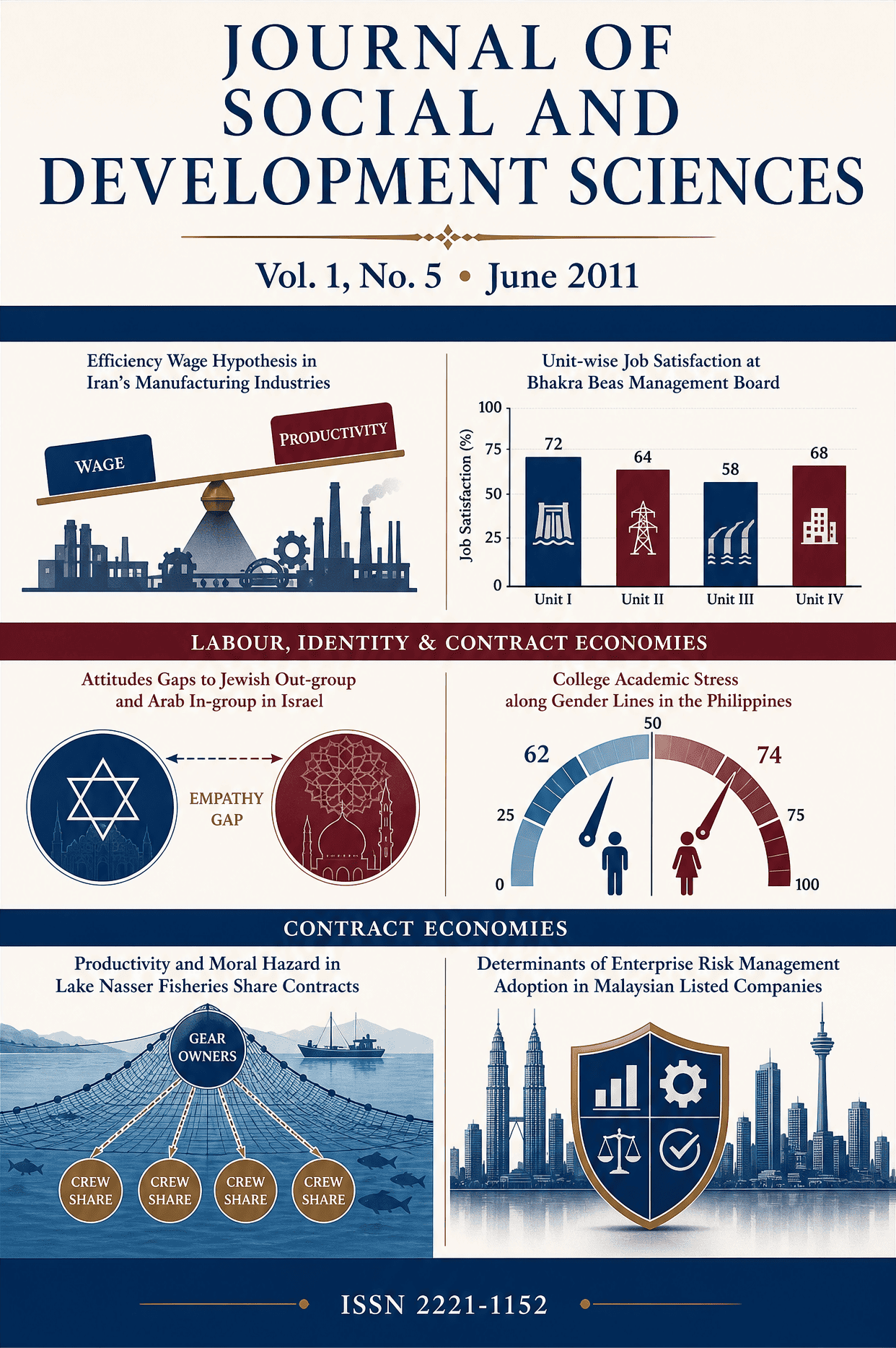
    Efficiency Wage Hypothesis: The Case Study of Iran's Manufacturing Industries

    • Author: Ahmad Jafari Samimi, Saman Ghaderi

    The purpose of this paper is to test the efficiency wage hypothesis for Iran's manufacturing industries at the 4-digit aggregation level of ISIC classification, during 2001-2006. According to the efficiency wage hypothesis, it is logical for some firms to pay wages that are above the market wage. In some cases the mere fact that workers are paid more can make them more productive. In other words, efficiency wages would increase productivity and there is positive relationship between wages and productivity . In this paper, panel data technique has employed to examine the mentioned hypothesis. However, the obtained results contradict the efficiency wage hypothesis for Iran's manufacturing industries. In other words, according to this result, higher wages lead to less efficient performance by the workers of Iran's manufacturing industries.

    Pages 157-164

    PDF - Efficiency Wage Hypothesis: The Case Study of Iran's Manufacturing Industries (opens in a new tab)
  • Article 2 in this issue

    Unit-Wise Comparative Survey of Job Satisfaction and Related Factors

    • Author: Suresh Kumar

    This paper is an attempt to compare and contrast unit-wise job satisfaction levels and the commitment to stay at job was also determined .A sample of 360 employees drawn from the four different units located in Himachal and Punjab states. The Bhakra-Beas Management Board was undertaken as universe for the present study .The study was conducted during 2008 to 2010.The study found that the employees of different units does have significant difference on job satisfaction according to their units location and the work environment prevailing in the organization .The study further found that a few respondents responded to leave the organization in normal conditions. The fact confirms that the more satisfied employees will definitely supports the fact that they will stay until they retire from this job. The study recommends that a highly satisfied employee do have the opinion of above average performance or outstanding performance at job. Finally, the units found a significant place in the determination of attitude towards overall and dimension specific job satisfaction.

    Pages 165-172

    PDF - Unit-Wise Comparative Survey of Job Satisfaction and Related Factors (opens in a new tab)
  • Article 3 in this issue

    Attitudes Gaps to Jewish Out-Group and Arab In-Group as an Expression of the Self-Identity of the Arab Minority in Israel

    • Author: Hujierat Mussa

    The objective of this study is to examine the practice of members of an in-group giving preference to the in-group rather than the out-group in any society, thereby providing its members with status, prestige and a positive social identity. This study examines the gap in the emotional attitude of the in-group and the out-group. The out-group in this study is the Jewish majority and the in-group is the Arab minority in Israel. This gap has been researched in large part, in research in laboratory conditions. Research has been done less on actual groups. The purpose of this study is to examine the degree of emotional identification of the Arab minority with the suffering and sorrow related to an unfortunate tragic event that occurs to another member of their group and to one that occurs to a member of the Jewish out-group. It is also to find how the attitude gaps relate to the traditionalism level of the in-group and to the region where the subjects live. To begin, a questionnaire was composed that included details about events that provoke feelings of grief and sadness. Subjects were asked in the pilot study to respond emotionally to these events. The hypothesis was that the Arab minority would identify emotionally with their group and less with the Jewish out-group and that a gap would be found that is related to the residential region and society's level of traditionalism. The findings show a bias of emotional attitude to the Arab side. The gaps that were discovered in the attitude to both groups were related to the society's level of traditionalism and partially to the residential region.

    Pages 173-182

    PDF - Attitudes Gaps to Jewish Out-Group and Arab In-Group as an Expression of the Self-Identity of the Arab Minority in Israel (opens in a new tab)
  • Article 4 in this issue

    Productivity, Capital Mobilization and Moral Hazard in Fisheries Share Contracts: Lake Nasser, Egypt

    • Author: Cambria Finegold, Christophe Béné, Mohamed Shehata, Olfat Anwar Habib

    As part of an international research project on reservoir fisheries productivity in developing countries, this paper examines contractual relations in the Lake Nasser fishery, seeking to understand why so many seemingly redundant contract types coexist and what effect they have on productivity. Based on the results of a socio-economic survey conducted in the fishery and drawing on the literature on agricultural sharecropping and share remuneration systems in fisheries, the paper analyses the roles of the different contracts observed in the Lake Nasser fishery. In particular, it discusses the incentives, limitations, and opportunities that these contracts offer to the different groups of actors (gear owners, license owners, crew members), and shows how these arrangements influence and shape the fishing strategies, capital mobilisation, and ultimately labour productivity of those different groups. While the debate on share contracts generally seeks to assess their efficiency relative to other types of contracts, this paper argues that the relevant question is not how efficient the contracts are, but what functions are served by the various co-existing contracts, and why different actors may choose each type. While the standard explanations of risk management and the impossibility of close supervision seem to provide some insight into this, it is also clear that the actors in the fishery use these contracts to mobilise capital and combine productive resources with other actors. This interlinking is a key function of the contracts, and the diversity of resource endowments and needs of the different actors helps explain the diversity of contract types.

    Pages 183-193

    PDF - Productivity, Capital Mobilization and Moral Hazard in Fisheries Share Contracts: Lake Nasser, Egypt (opens in a new tab)
  • Article 5 in this issue

    College Academic Stress: Differences along Gender Lines

    • Author: Glenn M. Calaguas

    This study examined the perception of academic stress among college students in a state college in the Philippines highlighting gender differences. In order to achieve the purpose of the study, an indigenous survey instrument was developed. A total of 1,210 college students chosen through systematic random sampling responded to the survey instrument. To determine gender differences among the respondents, independent samples t-test was used via SPSS version 15.0. Statistical analyses showed that male and female respondents differed significantly in their perceptions of subject, teacher, schedule, classroom, and expectation-related stressors but did not significantly differ in their perceptions of enrolment and admission, classmate, and financial- related stressors. Generally, no significant difference was found between male and female respondents in their perception of academic stressors, however using the mean scores as basis, female respondents scored higher compared to male respondents.

    Pages 194-201

    PDF - College Academic Stress: Differences along Gender Lines (opens in a new tab)
  • Article 6 in this issue

    The Determinants of Enterprise Risk Management (ERM) Practices in Malaysian Public Listed Companies

    • Author: Ahmad Rizal Razali, Ahmad Shukri Yazid, Izah Mohd Tahir

    The objective of this study is to examine the determinants of Enterprise Risk Management (ERM) adoption in Malaysian Public Listed Companies (PLCs). The study focuses on ten industries from five hundred and seventy four Public Listed Companies in Malaysia for the period 2007. These ten industries include industrial products, trading/services, consumer products, properties, constructions, plantations, infrastructure projects, technology, hotels and mining. Logit regression approach will be employed, and a dummy variable equals one if companies adopt ERM and zero otherwise, is used as the dependent variable. Seven independent variables used are Size, Leverage, Profitability, International Diversification, Ownership, Chief Risk Officer and Turnover. The main results of this research is that companies with high turnover, hiring Chief Risk Officer and companies that are not diversified internationally are more likely to adopt ERM. Interestingly, Size, Leverage, Profitability, and Ownership are not significant determinants of ERM practices.

    Pages 202-207

    PDF - The Determinants of Enterprise Risk Management (ERM) Practices in Malaysian Public Listed Companies (opens in a new tab)