Abstract
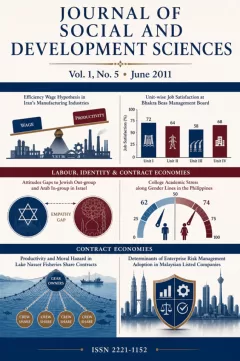
The objective of this study is to examine the practice of members of an in-group giving preference to the in-group rather than the out-group in any society, thereby providing its members with status, prestige and a positive social identity. This study examines the gap in the emotional attitude of the in-group and the out-group. The out-group in this study is the Jewish majority and the in-group is the Arab minority in Israel. This gap has been researched in large part, in research in laboratory conditions. Research has been done less on actual groups. The purpose of this study is to examine the degree of emotional identification of the Arab minority with the suffering and sorrow related to an unfortunate tragic event that occurs to another member of their group and to one that occurs to a member of the Jewish out-group. It is also to find how the attitude gaps relate to the traditionalism level of the in-group and to the region where the subjects live. To begin, a questionnaire was composed that included details about events that provoke feelings of grief and sadness. Subjects were asked in the pilot study to respond emotionally to these events. The hypothesis was that the Arab minority would identify emotionally with their group and less with the Jewish out-group and that a gap would be found that is related to the residential region and society's level of traditionalism. The findings show a bias of emotional attitude to the Arab side. The gaps that were discovered in the attitude to both groups were related to the society's level of traditionalism and partially to the residential region.
Keywords
- Emotional Attitude Search this journal for Emotional Attitude (opens in a new tab)
- Arab Minority Search this journal for Arab Minority (opens in a new tab)
- Jewish Majority Search this journal for Jewish Majority (opens in a new tab)
- Identity Search this journal for Identity (opens in a new tab)
- Social Identity Search this journal for Social Identity (opens in a new tab)
- In-group Search this journal for In-group (opens in a new tab)
- Out-group Search this journal for Out-group (opens in a new tab)
References
- Abrams, D. & Hogg, M. (1999). Social identity and social cognition . Oxford: Blackwell.
- Abrams, D. & Hogg, M. (2001). Collective identity: Group membership and self-conception. In M. Hogg & R. Tindale (Eds.), Blackwell handbook of social psychology: Group processes (pp. 425-460). Oxford: Blackwell.
- Brewer, M. & Norman, M. (1996). Intergroup Relations . Buckingham: Open University Press.
- Brewer, M. & Roccas, S. (2002). Social Identity Complexity. Personality and Social Psychology Review. 6, 88-106.
- Baron, R. & Byrne, D. (2003). Social Psychology . Boston: Allyn and Bacon.
- Babad, E., Birnbaum, M. & Benne K. (1983). The Social Self: Group influence on Personal Identity . London: Sage Publications, Beverly Hill.
- Deschamps, J. (1982). Social identity and relations of power between groups. In H. Tajfil, Social Identity and Intergroup relations (85-97). Cambridge: Cambridge University Press.
- Ellemers, N., Spears, R., & Doosje, B. (2002). Self and social identity. Annual Review of Psychology , 53, 161186.
- Erikson, E. (1968). Identity, youth and crisis . New York: Norton & Company.
- Gaertner, S. & Dovidio, J. (2000). Reducing intergroup bias: The common in-group identity model . Philadelphia: Psychology Press.
- Gonnet, R. (2000). Relationships between Groups. Social Psychology. 8, 137-213.
- Hogg, M. & Abrams, D. (1998). Social Identifications: A social psychology of intergroup relations and group processes. London: Routledge.
- Hogg, M. & Terry, D. (2000). Social identity and self-categorization processes in organizational contexts. Academy of Management Review , 25, 121-140.
- Hogg, M. & Vaughan, G. (2002). Social Psychology . London: Prentice Hall.
- Hogg, M. (2003). Social identity. In M. Leary & J. Tangney (Eds.), Handbook of self and identity (462-480). New York: Guilford.
- Hogg, M. (2006). Social identity theory. In P. J. Burke (Ed.), Contemporary social psychological theories (111-136). Palo Alto: Stanford University Press.
- Hornsey, M. & Jetten, J. (2004). The individual within the group: Balancing the need to belong with the need to be different. Personality and Social Psychology Review , 8, 248-264.
- Hujierat, M. (2008). Collective Identity of the Arab Minority in Israel: Complex Identify and Self-Esteem . Kfar Qara: Alhuda Press.
- Israel Annual Statistics, Israel Central Bureau of Statistics, 2009.
- Mruk, C. (2006). Self-Esteem research, theory, and practice: Toward a positive psychology of self-esteem . New York: Springer.
- Nick, H. & Steve, R. (1996). The Construction of Social Categories and Processes of Social Change: Arguing about National Identities, In G. Breakwell, Changing European Identities (pp. 69-95). Oxford: Butterworth-Heinemann.
- Postmes, T. & Jetten, J. (2006). Individuality and the group: Advances in social identity . London: Sage Publications Inc.
- Penner, L., Dovidio, J., Piliavin, J., & Schroeder, D. (2005). Prosocial behavior: Multilevel perspectives. Annual Review of Psychology , 56, 365-392.
- Robinson, P. (ed.). (1996). Social Groups and Identities: developing the legacy of Henri Tajfel . Oxford: Butterworth Heinemann.
- Smith, E. & Mackie, M. (1995). Social Psychology . New York: Worth Publishers.
- Spears, R. (2001). The interaction between the individual and the collective self: Self-categorization in context. In C. Sedikides & M. Brewer (Eds). Individual self, relational self, and collective self: Partners, opponents or strangers? (pp. 171-198). Philadelphia: The Psychology Press.
- Schubert, T. & Otten, S. (2002). Overlap of self, in-group and out-group: Pictorial measurement of self categorization. Self and Identity , 4, 353-376.
- Tropp, L. & Wright, S. (2004). In-group Identification as the Inclusion of In-group in the Self. Personality and social Psychology Bulletin . 27, 585-600.
- Tamir, Y. & Nadler, A. (2007). The role of personality in social identity: Effects of field-dependence and context on reaction to threat to group distinctiveness. Journal of Personality , 75(5), 927-954.
- Tajfil, H. & Turner, J. (1979). An Integrative Theory of intergroup conflict. In G. Austin, & S. Worchel. The social psychology of intergroup relations (pp. 305-315). Monterey, CA: Books/Cole.
- Tajfil, H. (1981). Human groups and social categories: Studies in social psychology . Cambridge: Cambridge University Press.
- Tajfil, H. (1982). Social Identity and Intergroup Relations . Cambridge: Cambridge University Press.
- Tajfel, H. & Turner, J. (2004). The social identity theory of intergroup behavior. In J. Sidanius & J. Jost (Eds.), Political psychology: Key readings (276-293). New York: Psychology Press.
- Turner, J. (1982). Towards a cognitive redefinition of social group, In H. Tajfil, Social Identity and Intergroup Relations (15-41). Cambridge: Cambridge University Press.
- Tuner, J., Hogg, M., Oakes, J., Reicher, D. & Wetherell, S. (1987). Rediscovering the Social Group: A SelfCategorization theory . Oxford: Blackwell.
- Tyler, T. & Blader, S. (2001). Identity and prosocial behavior in groups. Group processes and intergroup relations . 4, 207-226.
- Xenia, C. (1996). How Group Membership is formed: Self Categorization or Group Beliefs? The Construction of a European Identity in France and Greece. In G. Breakwell. Changing European Identities (297-315). London: Methuen.
Downloads
No downloads have been recorded for this article yet. Figures appear here once readers begin downloading the full text.
How to Cite
Share this article
License
Copyright (c) 2011 Hujierat Mussa (Author)

This work is licensed under a Creative Commons Attribution 4.0 International License.
Author (s) should affirm that the material has not been published previously. It has not been submitted and it is not under consideration by any other journal. At the same time author (s) need to execute a publication permission agreement to assume the responsibility of the submitted content and any omissions and errors therein. After submission of revised paper in the light of suggestions of the reviewers, the editorial team edits and formats manuscripts to bring uniformity and standardization in published material.
This work will be licensed under Creative Commons Attribution 4.0 International (CC BY 4.0) and under condition of the license, users are free to read, copy, remix, transform, redistribute, download, print, search or link to the full texts of articles and even build upon their work as long as they credit the author for the original work. Moreover, as per journal policy author (s) hold and retain copyrights without any restrictions.
Keywords
- Emotional Attitude Search this journal for Emotional Attitude (opens in a new tab)
- Arab Minority Search this journal for Arab Minority (opens in a new tab)
- Jewish Majority Search this journal for Jewish Majority (opens in a new tab)
- Identity Search this journal for Identity (opens in a new tab)
- Social Identity Search this journal for Social Identity (opens in a new tab)
- In-group Search this journal for In-group (opens in a new tab)
- Out-group Search this journal for Out-group (opens in a new tab)
Section
Published
Submissions
Have research to publish? Journal of Social and Development Sciences welcomes submissions.
Make a Submission