Abstract
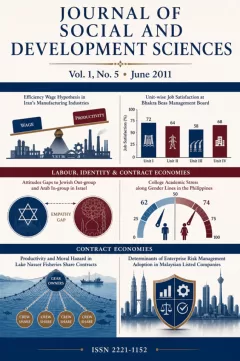
The objective of this study is to examine the determinants of Enterprise Risk Management (ERM) adoption in Malaysian Public Listed Companies (PLCs). The study focuses on ten industries from five hundred and seventy four Public Listed Companies in Malaysia for the period 2007. These ten industries include industrial products, trading/services, consumer products, properties, constructions, plantations, infrastructure projects, technology, hotels and mining. Logit regression approach will be employed, and a dummy variable equals one if companies adopt ERM and zero otherwise, is used as the dependent variable. Seven independent variables used are Size, Leverage, Profitability, International Diversification, Ownership, Chief Risk Officer and Turnover. The main results of this research is that companies with high turnover, hiring Chief Risk Officer and companies that are not diversified internationally are more likely to adopt ERM. Interestingly, Size, Leverage, Profitability, and Ownership are not significant determinants of ERM practices.
Keywords
- Enterprise Risk Management Search this journal for Enterprise Risk Management (opens in a new tab)
- Public Listed Companies Search this journal for Public Listed Companies (opens in a new tab)
- Logit Regression Search this journal for Logit Regression (opens in a new tab)
- Malaysia Search this journal for Malaysia (opens in a new tab)
References
- Beasley, M. S., Clune, R., & Hermanson, D. R. (2005). Enterprise Risk Management : An Empirical Analysis of Factors Associated with the Extent of Implementation. Journal of Accounting & Public Policy , 24(6), 521-531.
- Cassidy, D. (2005). Enterprise Risk Management (ERM): A New Reality for Businesses. Employee Benefit Plan Review , 59(11), 29-31.
- Committee of Sponsoring Organizations (COSO) (2004). Enterprise Risk Management-Intergrated Framework. COSO, New York.
- D'Arcy, S. P. (2001). Enterprise Risk Management. Journal of Risk Management of Korea , 12 (1), 207-228.
- Desender, K. A. (2007). The Influence of Board Composition on Enterprise Risk Management Implementation. Available at: http://papers.ssrn.com
- Hoyt, R. E., & Liebenberg, A. P. (2006). The Value of Enterprise Risk Management: Evidence from the U.S. Insurance Industry. Available at: http://www.aria.org/meetings/2006papers/Hoyt_Liebenberg_ERM_070606.pdf
- Hoyt, R. E., & Liebenberg, A. P. (2008). The Value of Enterprise Risk Management: Evidence from the U.S. Insurance Industry. Available at: http://www.risknet.de
- Hussin, R. M., Yazid, A. S. & Razali, R. A. (2008). A Cross Sectional Study on Foreign Exchange Risk Management by Malaysian Manufacturers. Interntional Business Management, 2(2), 28-32.
- Kleffner, A. E., Lee, R. B., & McGannon, B. (2003). The Effect of Corporate Governance on the Use of Enterprise Risk Management : Evidence From Canada. Risk Management and Insurance Review , 6 (1), 53-73.
- KPMG. (2006). Enterprise Risk Management in the United States : A 2006 Report Card. Available at: http://www.sdabocconi.it/files/kpmg_en_version_339QIKWY11U2ZKUEHUY51224057629.pdf
- Lam, J. C. (2000). Enterprise-Wide Risk Management and the role of the Chief Risk Officer. Available at: http://www.erisk.com/learning/research/011_lamriskoff.pdf
- Lee, C. R. (2000). Chief Risk Officer Stepping Up. Risk Management , 47 (9), 22-27.
- Liebenberg, A. P., & Hoyt, R. E. (2003). The Determinants of Enterprise Risk Management : Evidence From the Appointment of Chief Risk Officers. Risk Management and Insurance Review , 6 (1), 37-52.
- Manab, N. A., Hussin, M. R., & Kassim, I. (2007). Empirical Study on Theory and Practice of Enterprise-Wide Risk Management (EWRM) on Internal Auditing and Risk Managment Functions of Public Listed Companies in Malaysia . Available at: http/.rmi.nccu.edu.tw/apria/docs/Concurrent%20IV/Session%201/14707EWRM_APRIA_2007_ New.doc
- Pagach, D., & Warr, R. (2007). An Empirical Investigation of the Chraracteristics of Firms Adopting Enterprise Risk Management . Available at: http://papers.ssrn.com
- Protiviti Inc. (2006). Guide to Enterprise Risk Management: Frequently Asked Questions. Available at: http://www.knowledgeleader.com/KnowledgeLeader/Content.nsf/dce93ca8c1f384d68625714 20036f06c/87e5c452010aadc9882571c00081a23c/$FILE/ERM%20FAQ%20Guide.pdf
- Yazid, A. S. (2001). Perceptions and Practices of Financial Risk Management in Malaysia. Unpublished Ph.D Tesis, Glasgow Caledonian University.
- Yusuwan, N. M. Adnan, H., Omar, A. F. & Jusoff, K. (2008). Clients’ Perspectives of Risk Management Practice in Malaysian Construction Industry. Journal of Politics and Law . 1(3), 121-131.
Downloads
No downloads have been recorded for this article yet. Figures appear here once readers begin downloading the full text.
How to Cite
Share this article
License
Copyright (c) 2011 Ahmad Rizal Razali, Ahmad Shukri Yazid, Izah Mohd Tahir (Author)

This work is licensed under a Creative Commons Attribution 4.0 International License.
Author (s) should affirm that the material has not been published previously. It has not been submitted and it is not under consideration by any other journal. At the same time author (s) need to execute a publication permission agreement to assume the responsibility of the submitted content and any omissions and errors therein. After submission of revised paper in the light of suggestions of the reviewers, the editorial team edits and formats manuscripts to bring uniformity and standardization in published material.
This work will be licensed under Creative Commons Attribution 4.0 International (CC BY 4.0) and under condition of the license, users are free to read, copy, remix, transform, redistribute, download, print, search or link to the full texts of articles and even build upon their work as long as they credit the author for the original work. Moreover, as per journal policy author (s) hold and retain copyrights without any restrictions.
Keywords
- Enterprise Risk Management Search this journal for Enterprise Risk Management (opens in a new tab)
- Public Listed Companies Search this journal for Public Listed Companies (opens in a new tab)
- Logit Regression Search this journal for Logit Regression (opens in a new tab)
- Malaysia Search this journal for Malaysia (opens in a new tab)
Section
Published
Submissions
Have research to publish? Journal of Social and Development Sciences welcomes submissions.
Make a Submission