Abstract
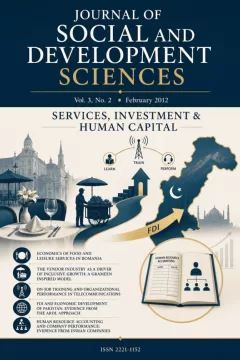
The foreign direct investment has made its position better as a bundle of benefits during the last three decades at the global level. The ultimate result of its benefits for the recipient countries is often sought in term of economic development. Such results do not appear in the same fashion in all recipient economies and so provide the space to investigate this nexus at country level. This study is an endeavor to examine empirically the impact of FDI on economic development of Pakistan. For this purpose, the time series data covering the period (1971-2009) were used. For data analysis, the bound testing approach to co integration within the framework of the Autoregressive Distributed Lag (ARDL) was utilized. The findings of the study supported the hypothesis of positive impact of FDI on economic development of Pakistan. The results also endorsed the views that the FDI is more effective than that of domestic investment.
Keywords
References
- Ahmad, M. H., Alam, S. & Butt, M. S. (2004). Foreign Direct Investment and Domestic Output in Pakistan. Nineteen Annual General Meeting, PIDE, Quaid-e-Azam University Islamabad, Pakistan.
- Alfaro, L., Chanda, A., Ozcan, S. K. & Sayek, S. (2006). How Does Foreign Direct Investment Promote Economic Growth? Exploring the Effect of Financial Markets on Linkages. Cambridge, MA, NBER Working Paper No W12522.
- Atique, Z., Ahmad, M. H. & Azhar, U. (2004). The Impact of FDI on Economic Growth Under Foreign Trade Regime: A Case Study of Pakistan. Pakistan Development Review , 43(4), 707-718.
- Baharumshah, A. Z. & Thanoon, M. A. M. (2006). Foreign capital flows and economic growth in East Asian countries. China Economic Review, 17 , 70-83.
- Balasubramanyam, V. N., Salisu, M. & Sapsford, D. (1999). Foreign Direct Investment as an Engine of Growth. The Journal of International Trade and Economic Development, 8(1), 27-40.
- Cypher, J. M. & Dietz, J. L. (2004). The Process of Economic Development (2nd ed.). London and New York: Routledge.
- Domar, E. D. (1946). Capital Expansion, Rate of Growth, and Employment. Econometrica, 14, 137-147.
- Duasa, J. (2007). Determinants of Malaysian Trade Balance: An ARDL Bound Testing Approach. Journal of Economic Cooperation , 28(3), 21-40.
- Dutta, M. (2005). China’s Industrial Revolution: Challenges for a Macroeconomic Agenda. Journal of Asian Economics, 15, 1169-1202.
- Government of Pakistan. (1996). Pakistan Economic Survey 1995-96. Economic Adviser’s Wing, Finance Division, Government of Pakistan, Islamabad.
- Government of Pakistan. (2006). Pakistan Economic Survey 2005-06. Economic Adviser’s Wing, Finance Division, Government of Pakistan, Islamabad.
- Griffin, K. B. (1970). Foreign Capital, Domestic Savings and Development. Oxford Bulletin of Economics and Statistics, 32, 99-112.
- Grossman, G. M. & Helpman, E. (1991). Innovation and Growth in the Global Economy. Cambridge MA: The MIT Press.
- Haddad, M. & Harrison, A. (1993). Are There Positive Spillovers From Direct Foreign Investment? Evidence From Panel Data for Morocco. Journal of Development Economics, 42, 51-74.
- Harrod, R. F. (1939). An Essay in Dynamic Theory. The Economic Journal , 49, 14-33.
- Iqbal, Z. & Zahid, G. M. (1998). Macroeconomic Determinants of Economic Growth in Pakistan, The Pakistan Development Review , 37(1), 125-148.
- Khan, A. H. & Kim Y. H. (1999). Foreign Direct Investment in Pakistan: Policy Issues and Operational Implications. EDRC Report Series No. 66.
- Khan, M. A. (2007). Foreing Direct Investment and Economic Growth: The Role of Domestic Financial Sector. Pakistan Institute of Development Economics (PIDE) Working Paper 18.
- Kojima, K. (1978). Direct Foreign Investment: A Japanese Model of Multinational Business Operations. London: Croom Helm.
- Lall, S. (1980). Vertical Inter-firm Linkages in LDCs: An Empirical Study. Oxford Bulletin of Economic and Statistic, 42(3), 203-226.
- Lekhi, R. K. (2008). The Economics of Development and Planning. New Delhi, India, Kalyani Publishers.
- Lensink, R. & Morrissey, O. (2006). Foreign Direct Investment: Flows, Volatility, and the Impact on Growth. Review of International Economics , 14(3), 478-493.
- Lucas, R. E. J. (1988). On the Mechanics of Economic Development. Journal of Monetary Economics , 22(1), 3- 42.
- Makki, S. S. & Sumwaru, A. (2004). Impact of Foreign Direct Investment and Trade on Economic Growth: Evidence From Developing Countries. American Journal of Agriculture Economics , 86(3), 795-801.
- Markusen, J. & Venables, A. (1999). Foreign Direct Investment as a Catalyst for Industrial Development. European Economic Review , 43(2), 335-56.
- Narayan, P. K. (2004). Reformulating Critical Values for the Bounds F-statistics Approach to Cointegration: An Application to the Tourism Demand Model for Fiji. Discussion Papers, Department of Economics, Monash University, Australia.
- Pesaran, M. H. & Shin, Y. (1999). Autoregressive Distributed Lag Modeling Approach to Cointegration Analysis, Chapter 11, in: Storm, S., (ed.), Econometrics and Economic Theory in the 20th Centrury: The Ragnar Frisch Centennial Symposium (Cambridge: Cambridge University Press)
- Pesaran, M. H., Shin, Y. & Smith, R. J. (2001). Bound Testing Approaches to the Analysis of the Long run Relationships. Journal of Applied Economic, 16, 289-326.
- Rebelo, S. (1991). Long-run Policy Analysis and Long-run Growth. Journal of Political Economy, 96 , 500-521.
- Reisen, H. & Soto, M. (2001). Which Types of Capital Inflows Foster Developing-Countries Growth? International Finance, 4(1), 1-14.
- Romer, P. (1990). Endogenous Technological Change. Journal of Political Economy, 98(5), S71-102.
- Ruffin, R. J. (1993). The Role of Foreign Investment in the Economic Growth of the Asian and Pacific Region. Asian Development Review, 11(1), 1-24.
- Sahoo, P. (2006). Foreign Direct Investment in South Asia: Policy, Trends, Impact and Determinants. ADB Institute Discussion Paper No. 56.
- Sahoo, D. & Mathiyazhagan, M. K. (2003). Economic Growth in India: Does Foreign Direct Investment Matter? The Singapore Economic Review, 48(2), 51-171.
- Seid, S. H. (2002). Global Regulations of Foreign Direct Investment. 131 Main Street Burington, VT 054015600 USA, Ashgate Publishing Company
- Shabbir, T. & Mahmood, A. (1992). The Effects of Foreign Private Investment on Economic Growth of Pakistan. The Pakistan Development Review, 31(4), 831-841.
- Sharma, B. & Gani, A. (2004). The Effects of Foreign Direct Investment on Human Development. Global Economy Journal , 4(2). http://www.aiecon.org/advanced/suggestedreadings/PDF/sug189.pdf
- Sharma, S. & Sharma, R. (2003). Globalization, Foreign Direct Investment, and Development. http://www.bimtech.ac.in/5_2.html.
- SHRDC. (2007). Foreign Direct Investment and Human Resource Development: A Case Study of South Asia. SAARC Human Resource Development Centre Islamabad, Pakistan.
- State Bank of Pakistan. (2005). Handbook of Statistics on Pakistan Economy 2005. http://www.sbp.gov.pk
- State Bank of Pakistan. (2010). Handbook of Statistics on Pakistan Economy 2010. http://www.sbp.gov.pk UNCTAD. (2006). World Investment Report 2006: FDI From Developing and Transition Economies. New York and Geneva: United Nations.
- Walz, U. (1997). Innovation, Foreign Direct Investment and Growth. Economica , 64, 63-79.
- Wang, J. Y. (1990). Growth, Technology Transfer, and Long-Run Theory of International Capital Movements. Journal of International Economics , 29(3-4), 255-271.
- Weisskof, T. E. (1972). The Impact of Foreign Capital Inflow on Domestic Savings in Underdeveloped Countries. Journal of International Economics , 2, 25-38.
- World Bank. (2007). World Development Indicators 2007. CD-ROM, Washington, D.C. World Bank.
- Yudaeva, K., Kozlov, K., Melentieva, N. & Ponomareva, N. (2003). Does Foreign Ownership Matter? The Russian Experience. Economics of Transition, 11(3), 383-409.
- Zhang, K. H. (2001). How Does Foreign Direct Investment Affect Economic Growth in China? Economics of Transition, 9(3), 679-693.
Downloads
No downloads have been recorded for this article yet. Figures appear here once readers begin downloading the full text.
How to Cite
Share this article
License
Copyright (c) 2012 Muhammad Tahir Mahmood, Kashif-ur-Rehman (Author)

This work is licensed under a Creative Commons Attribution 4.0 International License.
Author (s) should affirm that the material has not been published previously. It has not been submitted and it is not under consideration by any other journal. At the same time author (s) need to execute a publication permission agreement to assume the responsibility of the submitted content and any omissions and errors therein. After submission of revised paper in the light of suggestions of the reviewers, the editorial team edits and formats manuscripts to bring uniformity and standardization in published material.
This work will be licensed under Creative Commons Attribution 4.0 International (CC BY 4.0) and under condition of the license, users are free to read, copy, remix, transform, redistribute, download, print, search or link to the full texts of articles and even build upon their work as long as they credit the author for the original work. Moreover, as per journal policy author (s) hold and retain copyrights without any restrictions.
Keywords
Section
Published
Submissions
Have research to publish? Journal of Social and Development Sciences welcomes submissions.
Make a Submission